
“We do not have solid and clear evidence to bring accusations against any of the parties. However, as I have already stated, the logic of the situation suggests that the outcome benefits the Russian Federation.”
Rumen Radev, Prime Minister of Bulgaria, October 13
Drones sank a cargo ship 17 nautical miles off Bulgaria’s Black Sea coast overnight into Tuesday, and 11 of its sailors are still missing. Prime Minister Rumen Radev answered by summoning Russia’s ambassador, a week after he said a strike like this one gave Bulgaria no grounds to invoke NATO’s treaty. He was half right about that treaty. The half he got wrong is the one that could have forced a formal alliance consultation seven days and one sinking ago.
Start with the count, because the count is where most of Tuesday’s coverage stops short. The wires are calling this the second deadly sinking off Bulgaria in a week, which is accurate. Widen the frame by one day and one border and it is the third cargo ship sunk off NATO’s Black Sea coast in eight days, out of five hit. Two sailors are confirmed dead, 10 were lost at sea when the search for them ended, and 11 are missing as of Tuesday, which makes 23. Forty-nine others were pulled out alive. Treat Tuesday’s figures as provisional: Radev first reported a single survivor from the sunken ship, Bulgarian officials later said five, and even the vessel’s name is unsettled, with Bulgarian media calling it the Azov Concord and President Iliana Iotova identifying it as the Guinea-Bissau-flagged HS Dignity.
What Five Ships in Eight Days Have in Common
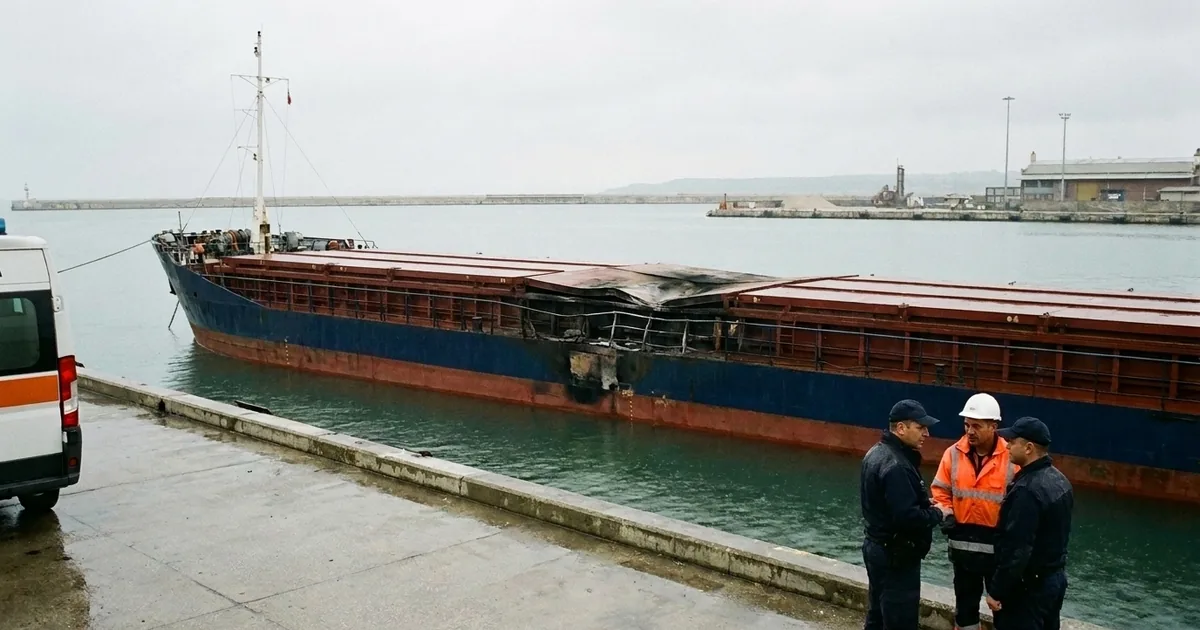
The run began on Monday, October 5, when the Royad Mammadov, a Turkish-owned ship under the flag of Saint Kitts and Nevis, caught fire and sank inside Romania’s exclusive economic zone while carrying corn from the Ukrainian port of Izmail to Ravenna, Italy. Two of its crew died and 11 were rescued. About 3 a.m. the next morning, air and sea drones hit two more Turkish-owned ships roughly 70 nautical miles east of the Bulgarian town of Byala. The Togo-flagged Alfa Watan went down, and Bulgaria called off the search for its 10 crew after finding three life rafts and an overturned lifeboat with nobody in them. The Palau-flagged Able burned, and a Bulgarian ferry that was nearby took off all 18 of its crew.
Then came Tuesday. A distress call arrived at 1:30 a.m. from the Chelsea 3, a Maltese-flagged, Ukrainian-owned ship 18 nautical miles east of Byala, whose crew said three aerial drones had struck its deck and side. A Border Police crew rescued all 15 people aboard, seven Ukrainians and eight Azerbaijanis, and five were treated for minor injuries. The second ship, 17 nautical miles east of the village of Krapets on Bulgaria’s northern coast, sank. Those distances are Radev’s own, given to an emergency meeting of his Security Council.
Line the five up and you get a pattern with honest holes in it. None of the five flew the flag of a NATO member: the registries are Saint Kitts and Nevis, Togo, Palau, Malta and, depending on which identification holds, Guinea-Bissau or Saint Vincent and the Grenadines. All five were hit outside any country’s 12-nautical-mile territorial sea. Three have a documented tie to Ukraine’s export trade: the Royad Mammadov’s corn, the Ukrainian cargo that Bulgarian authorities said was aboard one of the October 6 ships, and the Chelsea 3’s Ukrainian owner. That is three of five, and we are not going to round it up, because nothing public ties the other October 6 ship to Ukraine and almost nothing is known about the ship that sank on Tuesday.
Why were they there at all? Russia has been bombing Ukraine’s Black Sea ports, which pushes Ukrainian exports onto the Danube river ports and into shipping lanes that hug the Romanian and Bulgarian coasts. In July, Russian cruise missiles killed 10 people on a grain ship off Odesa. The route Ukraine fell back on, the one that runs past NATO territory, is now where the ships are going down.
Who is sinking them has not been proven. Searchers recovered no drone debris after the October 6 attack, Ukraine’s foreign minister, Andrii Sybiha, blamed Russia outright, and President Volodymyr Zelensky has said Ukrainian forces were not operating near last week’s strikes. It is also true that Ukraine has been hitting Russian grain ships elsewhere in the Black Sea and the Sea of Azov. Russia’s ambassador, Eleonora Mitrofanova, told Radev she had no information from her Defense Ministry and did not rule out “a provocation by a third party,” an answer that denies nothing.
The Line Radev Drew a Week Ago
After the first Bulgarian sinking, Radev said there were no grounds to invoke Article 4 or Article 5 of the NATO treaty, because the strike happened in waters that are legally neutral even though they lie inside Bulgaria’s economic zone. Here is the distinction he was leaning on. Under the UN Convention on the Law of the Sea, a country’s territorial sea extends up to 12 nautical miles from its coast, and inside it the country is sovereign. The exclusive economic zone runs out as far as 200 nautical miles and gives the coastal state rights over fish, gas and wind, while every other country keeps freedom of navigation there. So when a Togo-flagged ship is hit 70 nautical miles off Byala, the law sees, roughly, an attack on a Togolese vessel at sea, with Bulgaria as the nearest rescuer.
Now look at where the second attack landed. Last week’s ships were about 70 nautical miles out. Tuesday’s were 18 and 17, which puts them five or six nautical miles beyond the territorial line and more than 50 nautical miles closer to shore than the week before. Two data points are not a trend, and ships near the coast may simply be where the traffic is. We cannot source anyone’s intent, and we will not guess at it. What the numbers do show is narrower and still uncomfortable: a head of government named, in public, the line beyond which an attack would not go to NATO, and the next attack fell far closer to that line and still outside it.
Article 4 Has No Map
Read the treaty and you find Radev is right about Article 5. That clause covers an armed attack on a member “in Europe or North America,” and Article 6 spells out what counts: a member’s territory, or its “forces, vessels, or aircraft” when they are in or over that territory, the Mediterranean Sea or the North Atlantic north of the Tropic of Cancer. The Black Sea is not named. A ship registered in Togo or Palau is not, on our reading, a vessel of any NATO member, even with a Turkish owner. Nobody should want Article 5 stretched to cover that, and we do not.
Article 4 is a different instrument, and it is one sentence long: “The Parties will consult together whenever, in the opinion of any of them, the territorial integrity, political independence or security of any of the Parties is threatened.” There is no geography in it. Article 6 opens with the words “For the purpose of Article 5,” and it limits nothing else. The test is a member’s own opinion that its security is threatened, and NATO’s tally, last updated in September 2025, counts nine invocations. One was filed on February 24, 2022, by eight members including Bulgaria and Romania, on the day Russia invaded Ukraine, when no shot had landed on either of them. Poland used it in September 2025 after Russian drones crossed its airspace.
By his own account on Tuesday, Radev has already met that test. He called the attacks “absolutely unacceptable” and told Russia’s ambassador they are a significant escalation of the conflict. His government listed the damage: higher risk for commercial shipping, higher insurance prices, carriers refusing cargo for Bulgarian ports, and oil deliveries to the Burgas refinery made more expensive and put under threat. That is a member state saying its security is threatened, which is the whole of what Article 4 asks. What he requested instead, in calls with NATO Secretary General Mark Rutte and European Commission President Ursula von der Leyen, was help watching the sea and the sky, and what Rutte offered in public was that the alliance would keep adjusting its eastern presence “as needed.”
Here is where we land. Twenty-three sailors dead or missing in eight days is the need, and “as needed” is no answer to it. Bulgaria and Romania should request Article 4 consultations now, together, as they did in 2022. A request commits nobody to fire a shot. It puts every ally in one room with the same evidence and a duty to say what it shows, and NATO’s top commander has already described the next step. U.S. Air Force Gen. Alexus Grynkewich said in Brussels shortly before the sinkings began, “Once we have confidence in the attribution, we do need to make that public.”
We think Radev’s logic is sound, and it weighs more coming from him. He has spent his presidency and now his first term as prime minister resisting criticism of the Kremlin and voicing skepticism about Ukraine, and he played down Russia’s role after the October 6 attack. When that prime minister says the outcome benefits Russia, logic has done about all it can do, and the alliance with the sensors is the one that can supply the rest.
Neither the Reuters nor the AP account of Tuesday’s attack quotes anyone in Washington. The sinking came two days after President Trump declared a Russia-Ukraine energy ceasefire for the second time in 27 days, one Zelensky called “news for me.” The people with the least say in any of this are the crews: nine Syrians and an Egyptian lost with the Alfa Watan, and Indians, Turks, Azerbaijanis and Ukrainians pulled from the other ships. They sail under flags whose governments have no navy in the Black Sea and no seat at NATO. A flag of convenience is cheap for a shipowner, and this month it has meant that when the ship goes down, no state with any power in the region has to answer for it. Watch two things from here: whether the next distress call comes from inside 12 nautical miles, and whether Sofia files the request before it does.