
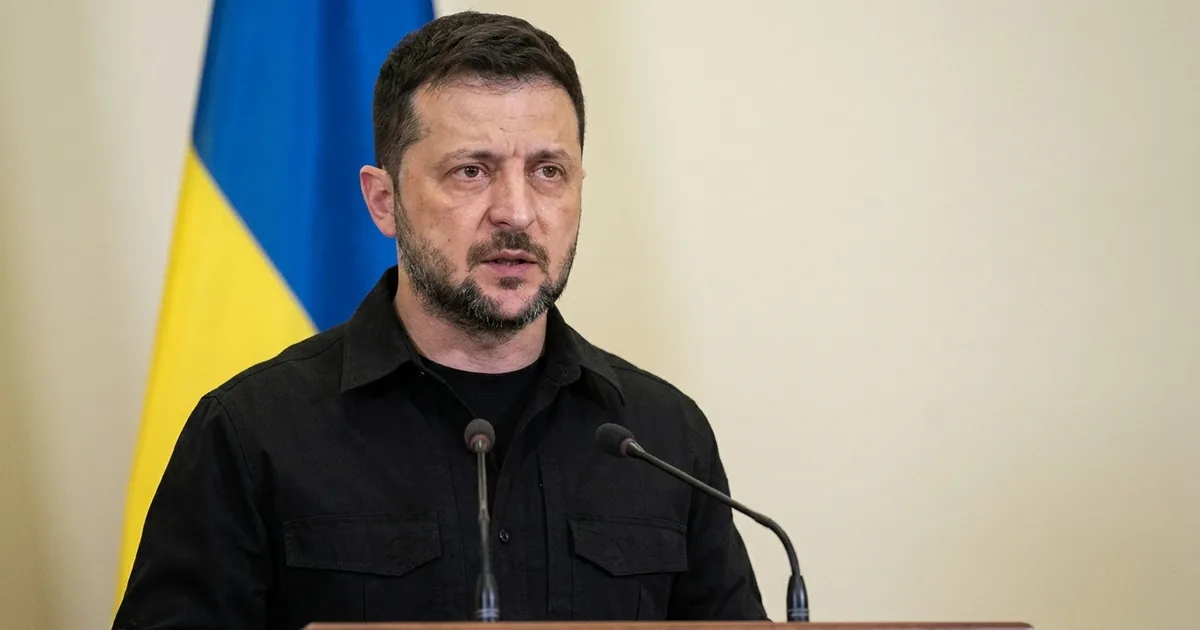
President Donald Trump announced on Truth Social on Sunday morning that Russia and Ukraine had agreed to an immediate “ENERGY CEASEFIRE,” and the president of Ukraine said it was the first he had heard of it.
- The post, in full: “Effective immediately, there is an ENERGY CEASEFIRE in the War between Russia and Ukraine. Both parties have agreed. Do not break it! Thank you for your attention to this matter.”
- Volodymyr Zelensky told Axios the announcement “was news for me,” and that Ukraine will accept a truce if Russia does.
- Moscow has confirmed nothing.
- The same afternoon in Kyiv, a Russian attack on an energy facility cut power to parts of five districts.
- Trump made the same claim on September 14. Russia launched 200 drones that night.
The coverage so far treats this as a dispute over whether a deal exists. The public record of the previous four days settles a more useful question, which is who had agreed to what before the president hit post.
One party has said yes on the record, repeatedly, since September. It is the party that found out from Truth Social.
Who Had Already Said Yes
Zelensky has been offering this exact trade for weeks. “If they don’t want us to attack their diesel and refineries, we are ready, if they will not attack our energy system,” he said in September.
He repeated it earlier on Sunday. “Ukraine will be ready to stop striking Russian oil refineries if Russia stops striking our energy infrastructure,” he wrote on X.
On ABC’s This Week he told Jonathan Karl, “We are ready for energy ceasefire, not to attack energy both sides.”
Then the post went up, and a Ukrainian official summed up Kyiv’s part in the negotiation: “We just read it as you did.”
“It was news for me. But if Russians agree to an energy ceasefire, Ukraine will agree. If President Trump negotiated it with Putin, please tell us when the ceasefire begins.”
That is Zelensky to Axios. Asking for the start time of a ceasefire billed as “effective immediately” is about as pointed as a head of state gets with the country that arms him.
What Moscow Said on Thursday
Three days before Trump announced that both parties had agreed, the Kremlin’s spokesman explained why Russia saw no reason to.
“Kyiv is not currently proposing a long-term settlement, but rather a ceasefire in an area that is its Achilles’ heel, the energy sector,” Dmitry Peskov said on October 8.
Then came the price. Russian envoy Kirill Dmitriev told Trump’s envoys Steve Witkoff and Jared Kushner, in two September meetings, that an energy truce would cost sanctions relief and a linked Black Sea ceasefire, the Kyiv Independent reported on Friday, citing American and Ukrainian officials.
By midday Sunday in Washington no Russian official had confirmed a thing. TASS, the Russian state news agency, ran Trump’s post with nobody from the Kremlin attached to it.
The Friday Afternoon License
That same Friday, at 2:43 p.m. Eastern, Treasury signed General License 135, which eases sanctions on Russian diesel through April 7. We read the license on Saturday. It asks nothing of Russia.
Trump sold it as Vladimir Putin releasing 300,000 tons of diesel immediately, 500,000 more in November and a million after that. American diesel was averaging $6.28 a gallon, and the midterms are 23 days out.
No document shows the license was Moscow’s fee for a truce. We think the order of events makes the case without one: Moscow’s reported price was sanctions relief, Washington eased sanctions on Friday, and the president announced a truce on Sunday.
Zelensky objected to the diesel deal on Saturday. Trump’s answer to reporters: “I suggest they get a new leader who can make a deal because he could have made many deals and for some reason he never does.”
So the American president called for the removal of an allied wartime leader, and one day later announced that leader’s agreement to a deal he had not been shown.
Zelensky’s reply on ABC was that “it’s up to our society, up to our people to choose one or another leader.” He added, “I know that Putin wanted very much to change the president in Ukraine.”
September’s Version Lasted One Night
Sunday’s announcement is the second in 27 days.
On September 13, at his golf course in Doonbeg, Ireland, Trump said Zelensky “has to stop knocking out diesel fuel in Russia.” The next day he announced that both sides had agreed to stop hitting each other’s energy sites.
Russia fired 200 drones overnight at energy and port facilities, killing one person in Kyiv and injuring seven. Ukraine hit the Syzran oil refinery. Peskov called the truce “a very good idea” and committed Russia to nothing.
The Financial Times reported that same day that Moscow had agreed to no deal, and that Putin wanted no energy truce before winter because strikes on the grid in the cold are what might force Kyiv to concede.
Two weeks after that, the Kyiv Independent reported that Trump privately doubted Putin would agree to an energy truce before winter.
The longer ledger reads the same way. The 30-day energy pause Trump and Putin announced in March 2025 came apart within weeks, with Ukraine counting more than 30 Russian strikes on its energy sites by mid-April. A one-week pause Trump requested in January ended with more than 70 missiles and 450 drones during a cold snap, after which Trump said Putin had “kept his word.” The three-day truce Trump announced this May was cracking by its second morning.
That is four earlier pauses announced from Washington that we can document. The strikes outlived every one of them.
One difference matters. In January, when Putin did agree to something, the Kremlin said so within a day. In September it praised the idea and confirmed nothing. On Sunday it has not spoken.
What an Energy Truce Leaves Running
A real energy ceasefire would still not have touched the week’s worst attacks. The 23 people Zelensky says were killed in Zaporizhzhia on Saturday, four of them children, were in apartment blocks. The 33 killed in Kramatorsk days earlier were riding two buses.
Zelensky gave Karl his running count: “They attacked 196 times our energy sector. It’s only electricity, plus 20 times gas and oil. And they killed for now 153 civilians.”
In Kyiv’s parliament, lawmaker Yaroslav Zhelezniak asked for an explanation. His worry is that the phrase means Ukraine stops hitting Russian refineries and tankers in exchange for a Russian promise to spare Ukrainian oil tankers it would struggle to find.
Andrii Kovalenko, who used to run Ukraine’s Center for Countering Disinformation, was shorter. Trump had declared an energy ceasefire once before, Putin “broke it within five minutes,” and perhaps this time the president was “announcing it to himself.”
Euromaidan Press put the gap between Sunday’s strike on Kyiv’s grid and Trump’s post at about seven minutes, a timing we could not match anywhere else. The outage itself is confirmed. Mayor Vitali Klitschko said a damaged high-voltage line also cut water pressure on both banks of the Dnipro.
We think the practical effect is one-sided. “Do not break it!” lands hardest on the capital that depends on American weapons and has been told since September 13 to leave Russian diesel alone.
A Republican Senator Says the Law Is in the Way
Sen. Thom Tillis of North Carolina went on Meet the Press on Sunday and said of the diesel deal, “I do believe there’s a legitimate case for saying the president’s not following the law.”
The Senate voted unanimously in 2022 to ban Russian oil imports, and Congress has not changed that law since.
Asked whether the deal puts American lives at risk, Tillis said, “It absolutely will.” Then: “I’m not the only Republican concerned with this.”
House Majority Whip Tom Emmer, on This Week, called the same deal “another example of our president thinking out of the box.”
The objection runs across the spectrum. The Bulwark, which opposes Trump from the right, titled its segment “Trump’s Putin Deal Is a Disgraceful Act of Betrayal,” and MeidasTouch’s Ben Meiselas, from the left, spent Sunday morning on Trump’s call to remove Zelensky.
What Has to Exist Before This Is a Ceasefire
A ceasefire has terms, a start time, a monitor and two governments willing to say so out loud. This one has a capitalized noun, an exclamation mark and a sign-off thanking readers for their attention.
We think the White House owes the public two things today: the text of what Russia agreed to, and the name of the Russian official who agreed to it. Until it produces both, Kyiv is right to treat the truce as something that has not started.
Congress has a lever, too. Tillis said that if the president wants his support on year-end military funding, he “needs to understand this is a problem.” Republicans who agree with him should tie that vote to the diesel license.
The test is cheap and it arrives fast. September’s version was dead by the next morning, and night falls in Kyiv a few hours after a Sunday-morning post from Washington. Ukraine’s grid operators will know whether anything changed long before the White House says another word.