
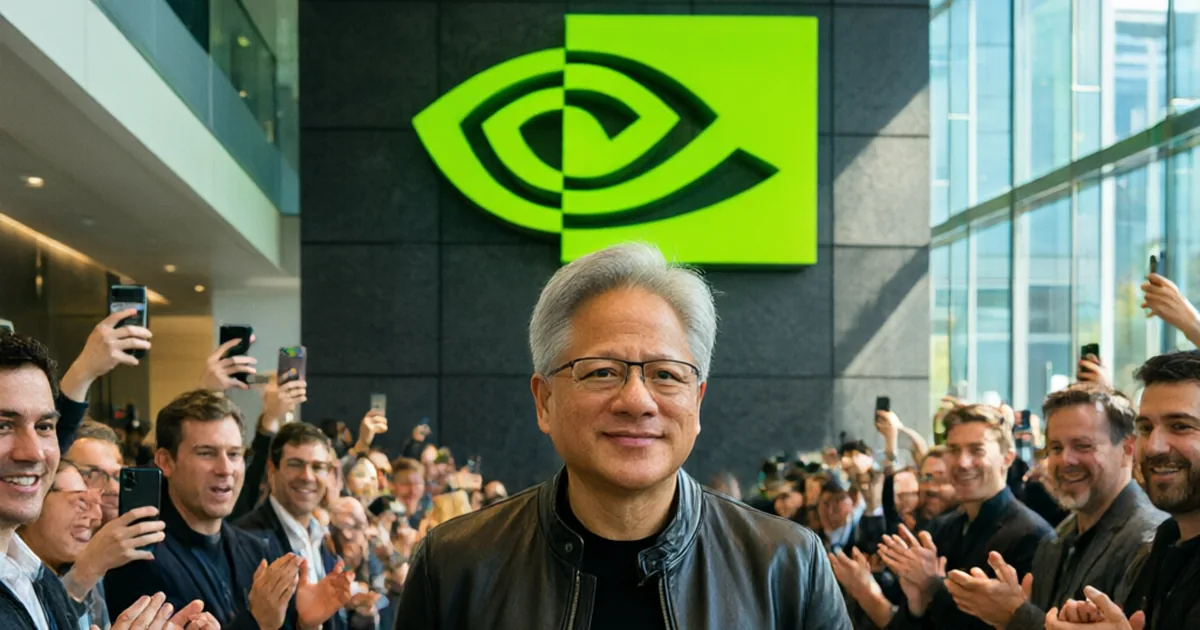
The Board believes Jensen is the right person to lead NVIDIA.
Harvey C. Jones, Nvidia board chair, November 23, six days after telling analysts the board did not intend to reinstate Huang
Nvidia’s board voted unanimously on Monday to bring Jensen Huang back as president, chief executive and director, eleven days after he resigned over an affair with a woman U.S. officials suspect of spying for China, and the stock jumped 31% on the news. Read the two filings that bracket his exit side by side and one thing stands out: the board’s own investigation has not finished, so the only new input it names is the White House, whose president spent the week asking for exactly this outcome.
Harvey Jones is the person to watch here. Nvidia made him its first-ever board chair on November 12, the day the company announced Huang’s resignation in a release that gave no reason for it and promised a search for a permanent successor, internal or external. Five days later, on the third-quarter earnings call, Jones told analysts the board had accepted the resignation and did not intend to reinstate Huang. On Monday he signed the opposite.
So what moved him? Here is the week, assembled from the company’s two releases and the public record.
| Date | What happened |
|---|---|
| Nov 12 | Huang resigns, effective immediately. Colette Kress becomes interim CEO while staying CFO. No reason given. |
| Nov 15 | Treasury Secretary Scott Bessent calls on Fox News for a “dramatic shake-up” of Nvidia’s leadership and an outside CEO. |
| Nov 16 | Trump says he “would not mind” Huang returning, and also backs former Apple chief Tim Cook as a successor. |
| Nov 17 | Huang says he would be “honored” to return. On the earnings call the same day, Jones says the board does not intend to reinstate him. |
| Nov 22 | The New York Times reports that Alice Huang was in contact with an officer of China’s Ministry of State Security during part of the relationship. Hours later Trump posts that he hopes the board rehires Huang. |
| Nov 23 | The board reinstates Huang, citing “input from senior levels of the United States government.” |
Lay it out like that and the problem is plain. Between Jones saying no and Jones saying yes, the facts about the security risk did not improve. They got worse. The Sunday report placed Alice Huang, who worked with the Singapore chip customer Megaspeed, in contact with China’s main intelligence service while she was seeing Nvidia’s founder.
What changed was the politics. Trump told reporters on November 16 that he did not know Alice Huang was a spy, a day after his own Treasury secretary demanded an outside chief executive. By Sunday night the president had settled the argument inside his administration in public: “I hope the Board of Nvidia rehires Jensen Huang. It would be the best thing for the Company, and also, for the U.S.A.” On Monday morning, after the board did, he called it “the correct and proper decision” and Huang “a Great Patriot and National Treasure.”
Now read what the reinstatement filing actually commits to. Monday’s release says the independent committee looking into whether Huang was “the target of a foreign intelligence effort” will “proceed to conclusion.” In other words, it has not concluded. The board says it is satisfied with Huang’s “candor,” and that based on the government’s input it is “confident that Mr. Huang’s reinstatement poses no national security risk.” It does not say who in the government gave that input, in what form, or what it covered.
The filing also creates two things that did not exist before: a National Security and Export Control Committee of independent directors, and a new Chief Compliance Officer reporting to the governance committee. Those are the right structures. They are also an admission that the board is putting oversight in place after the decision it was supposed to inform.
We think the board got the order backwards, and the timing shows why. A company that sells the world’s most export-controlled chips, with a Singapore customer under Justice Department scrutiny for allegedly routing them to China, had an investigation running for a reason. Bringing the chief executive back before it reports, on the strength of an assurance from an administration that publicly lobbied for the result, swaps a finding for a favor. If the committee’s eventual report is clean, the board will have been lucky. If it is not, Jones has already told shareholders and regulators that the White House vouched for him.
The market, for its part, did not hesitate. Huang holds about 811.5 million Nvidia shares, the figure 24/7 Wall St used to put his paper loss during the slide at $92 billion. At Friday’s close of $125.53, every 10% move in the stock is worth roughly $10.2 billion to him (811.5 million times $12.55). A 31% jump puts back more than $30 billion on paper.
That money is the argument investors made for Huang all along, and it is a real one: Nvidia without its founder spent seven straight sessions falling. But the questions that forced him out were never about whether he could run the company. They were about who had access to him. Monday’s filing answers the first question again and leaves the second to a committee that has not finished, and to a president who has already decided.