
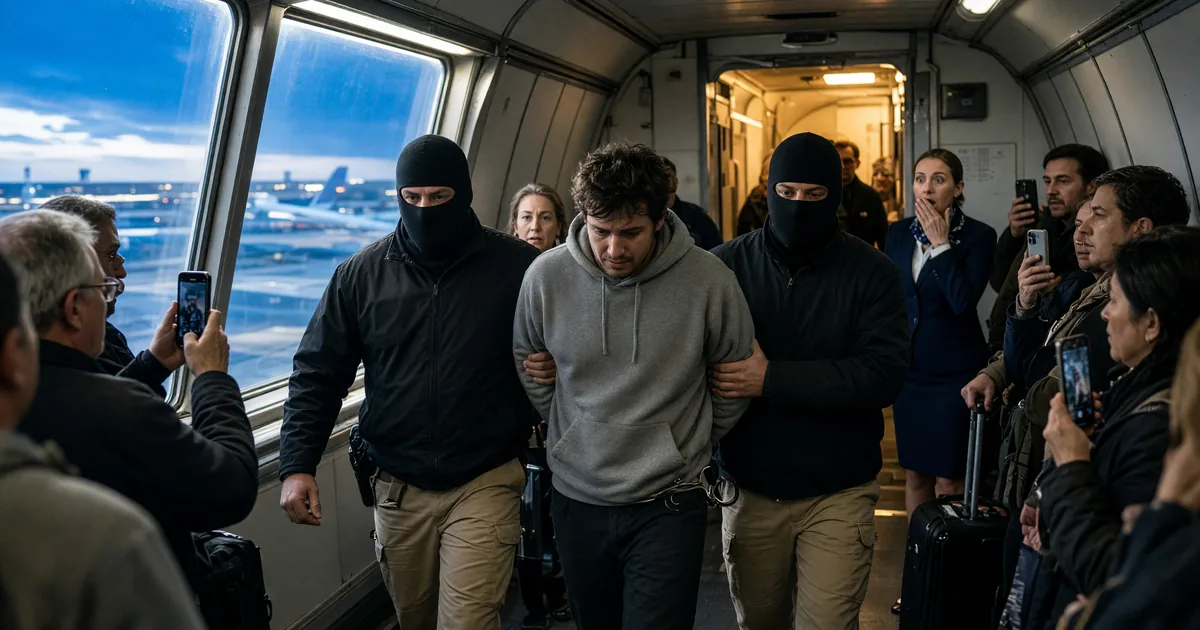
Masked immigration officers pulled two people off a crowded jet bridge at Seattle-Tacoma International Airport on Saturday morning as passengers boarded Alaska Airlines Flight 1306 to Los Angeles, and by afternoon Gov. Bob Ferguson was standing with labor leaders calling the video “horrific” and “chilling.” The outrage is earned, but almost every account of the morning has skipped the question that matters most: how did ICE know which gate, which flight and which minute to be standing at the door of a plane scheduled to leave at 8:10?
The answer is not a mystery, and that is the uncomfortable part. Since early 2025 the Transportation Security Administration has been handing ICE names drawn from Secure Flight, the passenger screening system built in 2007 to check travelers against terrorism watchlists. Reuters reviewed internal ICE data and found that TSA supplied records on more than 31,000 travelers, and that ICE arrested more than 800 people following those tips between the start of Trump’s term and February 2026. Run the arithmetic and it comes to roughly one arrest for every 39 names handed over, a hit rate of about 2.6 percent. Every person who books a domestic ticket is now fed into a deportation search, and 97 of every 100 names flagged led to no arrest at all. That is the machine behind the jet bridge, and ICE has not said whether it drove Saturday’s arrest. Reuters noted the tips were mainly useful for one thing: knowing when a person would be traveling.
What ICE has said is narrow. Officers “conducted a targeted enforcement operation to arrest Ricardo Larrondo Mendoza,” a man from Mexico who the agency said “overstayed his visa in violation of our nation’s laws,” the agency said in a statement. A second passenger, Sofia Hernandez Mejia, also from Mexico, “hurled hot coffee on the officers,” ICE claimed, adding that she too had overstayed a visa and could be charged with assaulting a federal officer. The coffee is ICE’s account and nobody else’s so far. What the video does show is men in unmarked jackets and khakis wrestling someone to the floor between rolling suitcases while a woman screams that her daughter is being taken and that she has a work permit. Alaska Airlines said it was “concerned by this morning’s law enforcement action during the boarding of Alaska Flight 1306” and that ICE gave it no warning. The Port of Seattle said it would ask federal officials what happened, which is a polite way of saying the people who run the airport did not know either.
We pulled the airport cases of the past eight months into one list, because each was covered as a local story and read together they describe a policy, not a string of accidents:
- March 22, San Francisco International. Agents arrested Angelina Lopez-Jimenez and her daughter Wendy in Terminal 3 on a 2019 removal order. Video went viral overnight, and both were deported to Guatemala within days. Federal documents reported afterward traced that arrest to a TSA tip.
- July 13, Harry Reid International, Las Vegas. Agents tackled Phu Nguyen, a 57-year-old Australian who had overstayed a visa, then walked away from the arrest and left him handcuffed in Terminal 3 for police to sort out. ICE picked him up at LAX the next day.
- July 30, the same airport. Clark County admitted in a records response that there are no policies or procedures for working with ICE inside its own terminals.
- September 17, Harry Reid again. Agents arrested Ho Yin Mo, a staffer for a California Assembly member, on a visa overstay dating to 2020.
- November 21, Sea-Tac. Two arrests on a jet bridge, during a pre-Thanksgiving weekend, days after a communications failure grounded flights nationwide.
Laid out that way, the pattern is hard to miss. The targets are overwhelmingly people whose only alleged offense is staying past a visa date, a civil violation, and the setting keeps shrinking toward the narrowest, most public, least escapable place in American life: the corridor between the gate and the aircraft door. An airport is where you cannot leave, cannot argue, and cannot pretend you are somewhere else, because a federal database put you there at a known time. Agents do not need a warrant to read a passenger manifest that TSA already hands them. This is what it looks like when a counterterrorism product gets repurposed for an immigration quota and nobody outside the agency is told the terms.
Ferguson’s response has two parts, and they deserve different grades. The first is political, and it is correct. “We need a system of immigration enforcement and border security that is effective, ethical and humane,” he said at the news conference. “And ICE is not it. It is beyond reform.” He said earlier on X that “ICE is completely and totally out of control,” and Rep. Adam Smith called the arrests “absolutely unacceptable.” April Sims, who leads the Washington State Labor Council and said union members were aboard the flight, put the cost in terms every traveler understands: “Airport workers are already managing extraordinary stress, passengers are already anxious and instead of restoring calm and confidence, federal agents introduced more fear and more chaos.” We agree with all of it, and we think a governor saying plainly that an agency cannot be fixed is more honest than another round of calls for a review.
The second part is legal, and it is where the story will actually be decided. Ferguson said he believes the agents broke Senate Bill 5855, the law he signed on March 19 that bars local, state and federal officers in Washington from wearing identity-concealing masks while dealing with the public. The law’s remedy is a civil suit for damages, so the real test is simple:
- Someone on that jet bridge, or the two people taken off it, has to sue.
- A court has to agree that a state can set conduct rules for federal agents working inside a federally regulated airport.
- The agents have to be identified, which is the exact thing the masks were meant to prevent.
Ferguson himself called a court fight “inevitable” when he signed the bill. Saturday handed him the cleanest possible test case: video, a named flight, a crowded public space and agents whose faces nobody can describe. If Washington does not bring it, the mask law becomes a press release. His other move, telling Alaska Airlines it should ask ICE to leave its airports, sounds stronger than it is. An airline does not control who federal law enforcement sends through a checkpoint, and the Las Vegas records show that airport operators often have no written rules for ICE at all. The leverage Washington actually has sits with the Port of Seattle, which runs Sea-Tac, and with the state’s own courts.
The question no official has answered yet is the one this piece opened with. If Larrondo Mendoza was found through TSA’s passenger data, then the 2.6 percent hit rate is no longer an abstraction: it means every Alaska passenger who checked in for that 8:10 flight had their name run through a deportation search so that officers could be waiting at the right door. Ferguson, Smith and the Port should ask DHS one direct question in writing and publish the answer, whatever it is: did a Secure Flight record put ICE on that jet bridge? Until someone in Washington, D.C. answers it, every boarding pass in the country doubles as a tip sheet, and the next video will come from a different gate.