
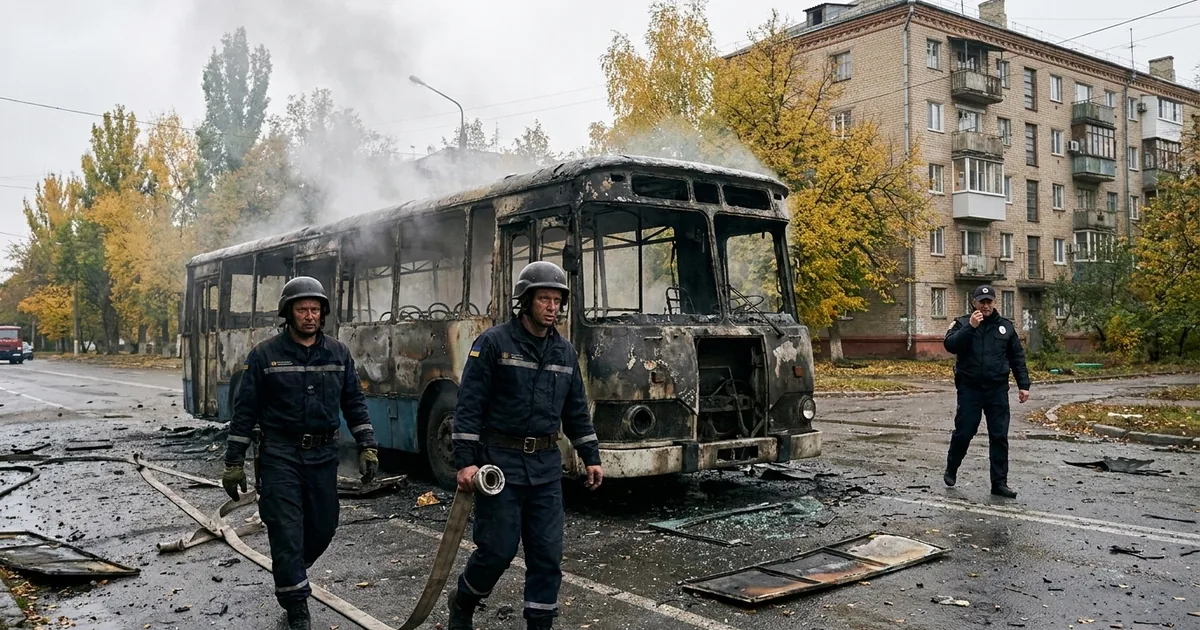
A Russian glide bomb hit two passenger buses on a street in Kramatorsk on Thursday morning, killing at least 33 people and wounding 18, Ukrainian rescue officials said. You will hear a lot about air defense today, and it is the wrong conversation, because the weapon that did this is one no shipment of interceptors was ever going to stop.
The coverage so far stops at the toll and the regional governor’s charge. What it leaves out is the bomb. Glide bombs are the Russian weapon the interceptor debate barely touches, Russia drops them by the thousand every month, and UN monitors counted 62% more civilians killed or injured by them this year than last.
What Moscow says. Russia denies targeting civilians. By Thursday afternoon it had said nothing about Kramatorsk.
What hit the street. A UMPB D-30SN, by preliminary Ukrainian accounts: a bomb steered by satellite navigation, landing on a street where two scheduled buses were running.
How a Bomb Gets to a Bus Stop
Start with the aircraft. A Russian Su-34 never has to enter Ukrainian-held sky to hit Kramatorsk. It climbs over ground Russia already holds, releases a bomb fitted with wings and fins, and the bomb glides the rest of the way.
Glide bombs are typically dropped 20 to 30 kilometers from the front line, and they fly too fast for interceptor drones to catch. Kramatorsk is a front-line city. It sits comfortably inside that envelope.
The model Ukrainian officials named on Thursday is a newer design. Analysts who examined recovered pieces in 2024 found inertial and satellite guidance, an antenna built to resist jamming and a warhead over 100 kilograms, with a range tentatively put at around 90 kilometers. That is two-year-old analysis of an early batch, so hold the range loosely. The guidance finding is the one that matters: this bomb goes where its coordinates send it.
Count the Bombs
Now do the arithmetic the wire copy skips. Russia dropped 8,300 glide bombs in July, a record for the war by the Ukrainian defense ministry’s count. That is roughly 270 a day.
Our report on Wednesday’s Pryluky strike worked from an estimate that the United States builds about 50 Patriot interceptors a month. Russia drops that many glide bombs in under five hours. Even if every interceptor America made went to Ukraine, firing a missile that costs millions at a bomb that costs a fraction of that is a trade no defender can sustain.
The UN has the human cost. Its monitors counted nearly 2,500 civilians killed or injured by guided aerial bombs in the Donetsk, Kharkiv, Sumy and Zaporizhzhia regions in the first eight months of 2026, up 62% on the same stretch of 2025.
The Second Bus This Week
Thursday was not the first attack on a Kramatorsk bus this month. On October 2, a little after 7 a.m., a Russian FPV drone hit a passenger bus on its regular route and wounded two people. The city council said Russian troops had “once again attacked civilian transport.”
The city has been here before. In April 2022 a missile struck Kramatorsk’s railway station while thousands of people waited for evacuation trains, and at least 50 were killed.
| Date | What was hit | Weapon | Toll |
|---|---|---|---|
| April 8, 2022 | Railway station crowded with evacuees | Tochka-U missile | At least 50 killed |
| October 2, 2026 | Passenger bus on its morning route | FPV drone | 2 wounded |
| October 8, 2026 | Two scheduled buses on a city street | Glide bomb (preliminary: UMPB D-30SN) | At least 33 killed, 18 wounded |
| October 8, 2026 | Public transport in Kramatorsk and Sloviansk | Regional suspension order | Buses stop running |
Aimed or Indifferent, It Is a Crime
Vadym Filashkin, who heads the Donetsk regional administration, said a bus with passengers is an attractive target to Russia “precisely because one hit can kill as many people as possible.”
We cannot see into the cockpit, and we will not claim to know what the crew wanted. We do not need to. A satellite-guided bomb was sent to a city street at mid-morning, with scheduled buses on it, in a city whose civilian transport had already been hit once that week. Either someone picked that street knowing the buses were there, or someone picked it without caring what was there. The laws of war prohibit both, deliberate attacks on civilians and indiscriminate ones alike. We think Thursday’s strike belongs in the same war-crimes file as the railway station.
What Actually Stops a Glide Bomb
Range. The way to stop a glide bomb is to reach the jet before it releases, or the airfield before it takes off. Kyiv understands this, which is why its long-range drone campaign this summer went after Russian airfields alongside refineries.
So read again what Donald Trump asked of Ukraine last month. “Mr. Zelensky has to do one thing,” the president told reporters in Ireland on September 13. “He has to stop knocking out diesel fuel in Russia.”
We think he has the pressure on the wrong side. Ukraine’s long reach is its main answer to the aircraft that bomb Donbas, and Washington spent September asking Kyiv to narrow that reach, two months after Russia set a wartime record for glide bombs dropped on Ukrainian towns. If the White House wants fewer bodies on Kramatorsk’s streets, the demand belongs in Moscow and the help belongs with whatever lets Ukraine reach those airfields.
A City Without Buses
By Thursday afternoon, Filashkin had ordered public transport suspended in Kramatorsk and Sloviansk. “We have no right to risk the lives of passengers and drivers,” he said.
It is the right call, and it leaves the people who still live in two front-line cities without the ordinary way of getting to a pharmacy, a job or a train out. Four years ago, Kramatorsk’s civilians died at the station trying to leave. The question now is how the ones who stayed get anywhere at all.