
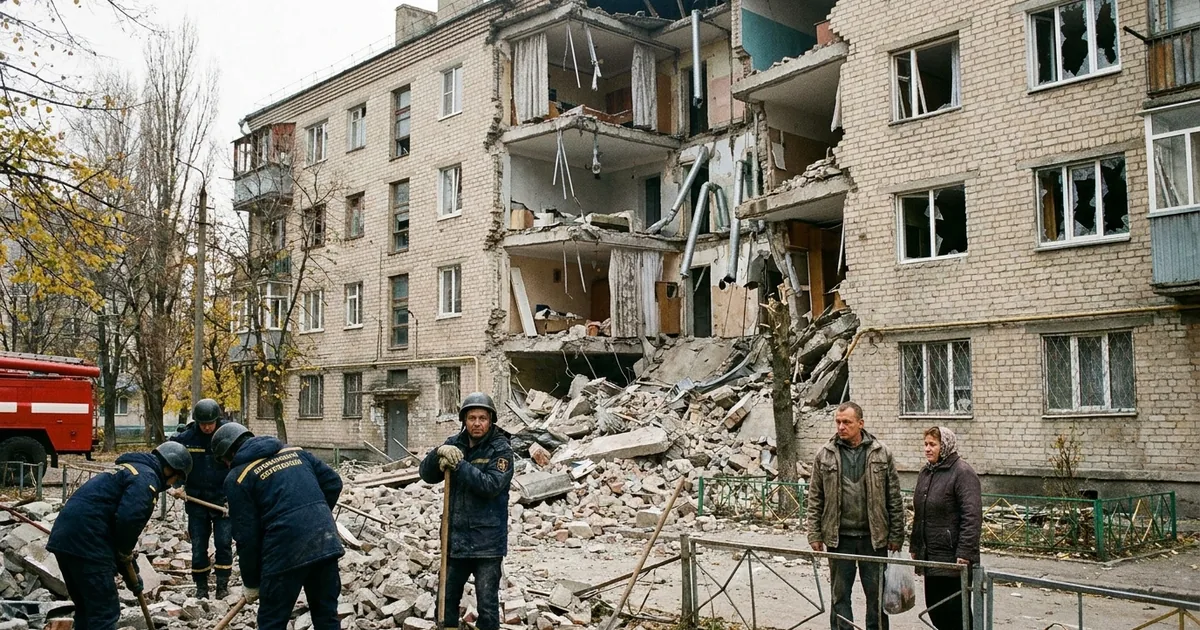
Russia hit Kyiv and a dozen other Ukrainian regions overnight into Wednesday with roughly 70 missiles and about 130 drones, and by Wednesday afternoon at least 21 people were dead, four of them children.
What is established so far:
- Pryluky took the worst of it. A missile tore into a five-story apartment building in the Chernihiv region city, killing at least 15 people and wounding about 50. Local counts kept rising through the afternoon as rescuers worked the rubble.
- Kremenchuk, Kyiv and Oleksandriia each lost two people. Around 60 were wounded nationwide.
- The warning came first. On Tuesday night Volodymyr Zelensky told Ukrainians that intelligence showed Russia building up for a massive strike and pleaded with them to take air-raid alerts seriously.
- Energy was a main target, Zelensky said, alongside apartment blocks in a dozen regions.
- The date was Vladimir Putin’s 74th birthday.
Most of the coverage stops at the toll and the grim irony that Kyiv saw this coming.
The more useful question is why a strike announced a day early still got through. The answer is a number you can check yourself: Ukraine does not have enough interceptors for the missiles Russia builds, and Washington has spent the autumn announcing deals instead of closing that gap.
This is also the third time since August that we have written some version of this story.
Why Knowing It Was Coming Did Not Save Pryluky
A warning buys you minutes. It gets you to a shelter, a basement, a metro platform.
It does not stop the missile.
Drones and cruise missiles can be brought down by a wide mix of older systems, mobile gun teams and electronic jamming. Ballistic missiles are a different problem, because they come in steep and fast.
In Ukraine, the weapon that reliably stops them is the American Patriot, specifically the PAC-3 interceptor. Foreign Policy reported on Monday that a severe PAC-3 shortage has left Ukraine largely defenseless against Russian ballistic missiles such as the Iskander.
Zelensky said many of Wednesday’s 70 missiles were ballistic. He named the problem in two sentences:
“Russian ballistic missiles remain the greatest challenge. And air defense packages for us right now are a vital necessity.”
Russia’s Defense Ministry said it struck facilities that produce and store missiles and drones.
The building in Pryluky was a five-story apartment block.
The Arithmetic Ukraine Cannot Win
Start with production, because that is where this war’s air campaign is decided.
Russia now builds around 100 ballistic missiles a month, up from a handful a month in 2022. The United States builds about half that many Patriot interceptors a month. Those are the Foreign Policy figures.
Now do the math we did. Half of 100 is roughly 50 interceptors a month, and that output has to cover every customer, the US Army’s own stockpile included.
Wednesday’s barrage was 70 missiles in a single night.
The honest caveat: not all 70 were ballistic, and not every missile needs a Patriot to stop it. Cruise missiles can be met with other systems.
The caveat does not rescue the picture. A defender who receives a slice of 50 interceptors a month cannot keep pace with an attacker producing 100 ballistic missiles a month. The gap grows every month it is left alone.
And it was made worse by a choice. Patriot stocks dwindled during the war in the Middle East, Foreign Policy found, leaving Washington reluctant to send more to Kyiv.
Three Nights, at Least 53 Dead
We went back through our own coverage to see whether Wednesday was an outlier.
It was not.
On August 5 we reported that Russia killed 17 people around Kyiv with the one weapon Ukraine can no longer intercept. Fifteen days later, 15 more died in Kyiv because the Patriot interceptors still had not been replaced.
Add Wednesday’s floor of 21 and you get at least 53 people killed in three nights. The same missing interceptor was named in all three.
That is a pattern, and patterns have causes. Our read is that Russia found the hole in Ukraine’s defenses this summer and has been aiming at it since.
The Truce That Was Never There
You may remember that this was supposed to be getting better.
On September 14, Donald Trump announced that Russia and Ukraine had agreed to stop striking each other’s energy infrastructure. Within a day, both governments made clear there was no such agreement, and Russia fired 200 drones at Ukraine that night, hitting energy and port facilities.
The Kremlin called the idea “a good initiative.” Zelensky said he would halt strikes on Russian energy only if Russia did the same, and that he did not trust it to.
On Wednesday, Zelensky said one of the key targets was Ukraine’s energy system. Ukraine, for its part, targeted two oil facilities inside Russia the same night. Neither side is observing a truce, because there is no truce to observe.
Then, at the United Nations late last month, Trump said of Zelensky, “I want him to settle with Putin, and I want Putin to settle with him”, and hoped for a deal “maybe before the heavy winter.”
We think that is spin, and the costly kind. Announcing a ceasefire that neither party signed does not protect a single substation. Telling the country under bombardment to settle, as Russia lines up its winter campaign against that country’s power grid, is pressure aimed at the wrong capital.
What Washington Could Do This Week
The White House already knows what the fix is, because the president said it out loud.
At the NATO summit in Ankara on July 8, Trump said of Ukraine: “We’ll give them the right to make Patriots. We’ll show them how to do it. I think they can produce them pretty quickly.”
Our read: a license to build interceptors is a factory promise, and factories take years. Three months after that pledge, the shortage was the problem Zelensky named on Wednesday.
What would actually change the next night is interceptors in Ukraine, from existing stocks, now. That is a priority call the United States makes every month when it divides those roughly 50 interceptors among its customers.
European Commission President Ursula von der Leyen said Wednesday that “Russia is pursuing a deliberate strategy of terror.” She is right. That strategy works best against a defender whose ammunition is rationed, and the ration is being set in Washington.
Kyiv will issue its next warning. The heating season is weeks away, Russia’s factories are running, and the strikes on the grid have already started.
When that warning comes, the question for you to ask is simple: did anything change in the interceptor count since Pryluky?