
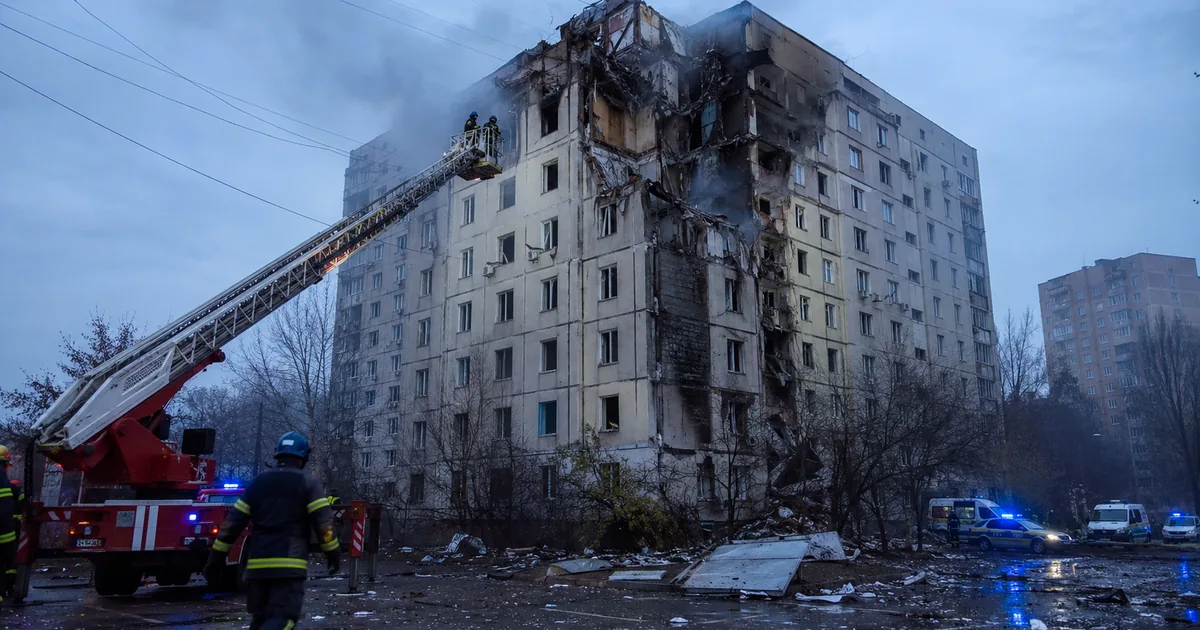
Russian ballistic missiles tore the top two floors off a nine-storey apartment block in Kyiv’s Solomianskyi district overnight, and by late morning Mayor Vitali Klitschko put the city’s death toll at 15, with 39 more injured. Ukraine’s air defence crews had an excellent night against almost everything else Moscow sent, and that is precisely the problem.
The figures from the barrage describe two different wars happening in the same sky. Ukraine knocked down close to 90 percent of the 168 drones Russia launched and intercepted most of the cruise missiles, The Moscow Times reported. Against the ballistic missiles, the ones that arrive in minutes on a steep terminal dive, there was effectively nothing. Those are the weapons that came down in Solomianskyi.
This is not a story about a bad night for Ukrainian air defence. It is a story about a defence that works exactly as well as its supply of a single American-made interceptor allows, and about what happens in the fifteen days when nobody restocks it.
Ninety Percent Is Not the Number That Matters
The interception rate Ukraine posts against drones is genuinely impressive and almost entirely beside the point. Shahed-type drones are slow, loud and cheap, and Ukraine has built a layered answer to them out of mobile gun teams, electronic warfare and interceptor drones of its own. None of that touches a ballistic missile.
Stopping one of those requires a Patriot battery firing a PAC-3 interceptor, and Ukraine’s stock of those interceptors is the binding constraint on whether a Kyiv apartment block stays standing. President Volodymyr Zelensky has been blunt about where that stock sits.
The interceptors for Patriot systems have not yet been replaced, and they are needed every day.
That sentence is the whole story. It is not a request for new systems or a complaint about Western hesitancy in the abstract. It is a status report: the magazines are empty, they were empty before Thursday, and they were empty on Thursday.
The damage pattern follows directly. Emergency crews worked more than a dozen sites across the capital. Windows blew out at a children’s hospital in Solomianskyi and cars burned in the grounds. A school was hit, and rescuers spent the morning pulling people out of two residential buildings and a school shelter. In the Brovary district on the city’s edge, Tymur Tkachenko, head of the Kyiv regional military administration, reported one man killed. Around 90,000 homes lost power, though the utility DTEK said more than half were reconnected within hours, Euronews reported.
What Fifteen Days Bought
On 5 August this site reported that Russia had killed 17 people around Kyiv using the one weapon Ukraine could no longer intercept, after a barrage of 24 ballistic missiles. The claim at the time was that Ukraine’s ballistic interceptors were gone and that Moscow had worked this out.
Fifteen days later the test of that claim has an answer, and the answer is that nothing was resupplied. Zelensky’s phrasing, that the interceptors “have not yet been replaced,” is the confirmation. A shortage that persists for two weeks past a mass-casualty strike is no longer a shortage. It is a condition, and both sides are now planning around it.
Russia is certainly planning around it. The July pattern was heavy mixed barrages designed to saturate everything at once, including the largest ballistic attack on the capital since the war began. Thursday’s attack was more economical. Send drones in volume knowing most will be shot down, because they cost little and they occupy every air defence crew in the region, then send the ballistic missiles that nothing in the sky can stop. Ukraine’s own interception statistics tell Moscow exactly which half of its arsenal is worth spending.
Russia’s Defence Ministry described the strikes as hitting facilities producing drone components, a military depot and a logistics hub. A children’s hospital, a school and the upper floors of a residential tower do not appear in that description.
The Ceiling Is Not in Kyiv
The reason the interceptors have not arrived has very little to do with Ukraine and almost everything to do with arithmetic performed elsewhere. PAC-3 interceptors are built at a fixed and modest annual rate, they were drawn down heavily during this year’s fighting in the Middle East, and the remaining stock sits in national inventories that their owners are unwilling to run down further.
That makes Ukraine’s air defence a rationing problem rather than a policy debate. Somewhere outside Kyiv, a finite number of interceptors gets allocated between deterrence in one theatre and apartment blocks in another, and Thursday shows what the current split produces. Ukraine can be told it has Western support, can have the batteries physically parked on its territory, and can still be unable to defend a residential district, because a Patriot without interceptors is a very expensive radar.
None of the coverage of Thursday’s attack will change that arithmetic, which is the frustrating part. The strike will be described as an escalation. It is closer to a routine exploitation of a gap that has been publicly documented for weeks, by a military that reads the same interception statistics everyone else does.
The School Shelter
The detail worth sitting with is that rescuers had to pull people out of a school shelter. A shelter is where the system tells civilians to go when the sirens start, and the instruction assumes that something overhead is capable of stopping what is incoming. On Thursday, for one category of weapon, nothing was.
Ukraine will publish another interception percentage after the next barrage, and it will probably be high again. The number to watch is not that one. It is whether anyone, in the fifteen days after this attack rather than the last, actually replaces what Zelensky says has not been replaced.