
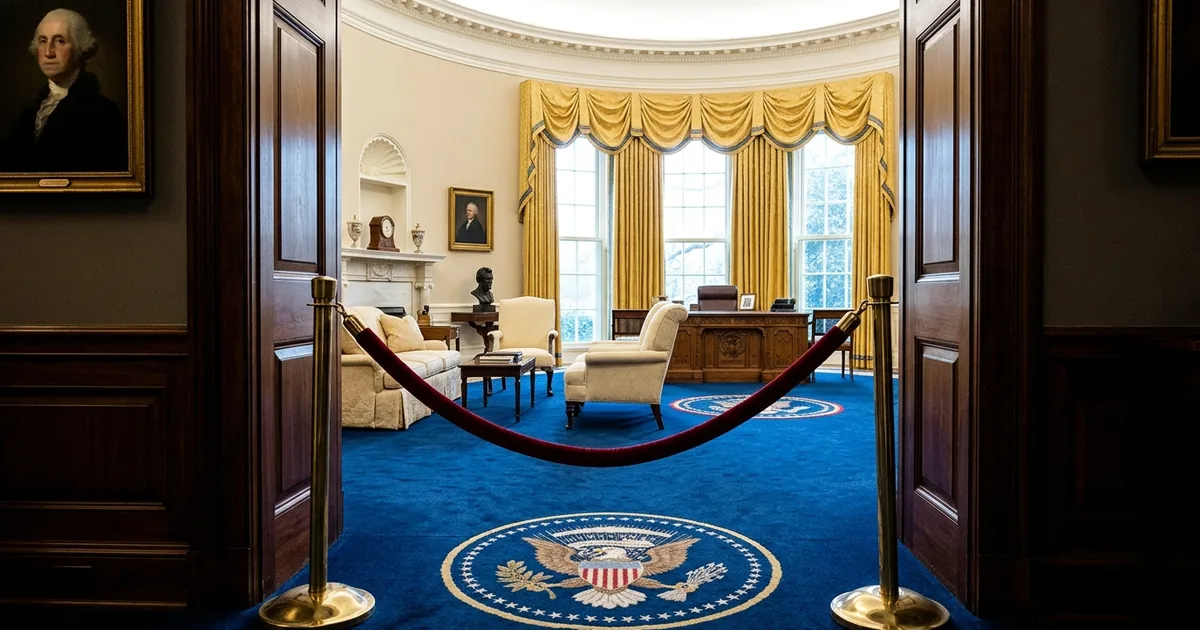
Nothing in this proclamation shall be construed to restrict the President’s authority to redecorate the monument, select furnishings, or make ordinary operational and security modifications that do not substantially impair the monument’s historic structure or architectural character.
That sentence comes from the proclamation Trump signed Thursday, and it is the firmest protection in the document. What it protects is the president’s freedom to redecorate.
Trump told reporters he would send the proclamation to Congress “to have it ratified” and that Congress would have to approve major changes. We read the text. The word “Congress” appears once, in a clause saying the proclamation does not diminish Congress’s authority over federal property. Nothing in it asks for ratification, and nothing gives Congress a vote.
What it does contain is short. It rests on the Antiquities Act and covers the Oval Office (Room 110), the Outer Oval Office (Rooms 106 and 108) and the Cabinet Room (Room 105). The Outer Oval Office is missing from the coverage we found, which describes two rooms.
The Interior secretary gets four jobs: write a management plan, review proposed changes for consistency with the rooms’ significance, coordinate with the Committee for the Preservation of the White House, and “require documentation, review, and consideration of alternatives” before any action that would “substantially alter or demolish” them.
Read that last one again. Before the walls come down, somebody has to fill out a form. The text never says no.
Trump put it differently. “It won’t be able to be taken down, destroyed, touched or anything else,” he said, and if anyone ever starts knocking down walls, “you call me.”
The somebody who fills out the form is the Interior secretary, a cabinet officer who serves at the president’s pleasure. A future president who wanted a square Oval Office, Trump’s own example, would tell Interior to finish its paperwork or would sign a new proclamation, which is how monuments get changed. Trump has reversed designations made by his predecessors himself.
The timing is its own document. On Wednesday Trump took reporters to the ballroom construction site and called it “the ultimate symbol of America.” That project meant demolishing the East Wing, and in August a federal appeals court ruled that he could not build it without Congress signing off. Construction goes on. This is the same Congress he now says must approve changes to the Oval Office.
Two days after Democrats won that Congress, his first formal act was a preservation order for a room he redecorated in gold last year. The new chandeliers in the Cabinet Room are now inside a national monument.
We think this is a press release with a seal on it. The only body it binds is a department that answers to whoever holds the office, and the one thing it expressly protects is redecoration, which any president keeps.
If Trump meant what he said about Congress, there is a way to do it. He can ask for a statute. A law can bind a future president and a proclamation cannot, and a Democratic House that wants the Oval Office safe from a wrecking crew could write one in about a page.
Until then, the useful questions are for Interior. The proclamation orders a management plan with no deadline. Sen. Richard Blumenthal has already written to ballroom donors seeking information, and one of those money trails is YouTube’s $24.5 million settlement payment, $22 million of it earmarked for the ballroom. Somebody should also ask what counts as “ordinary.”