
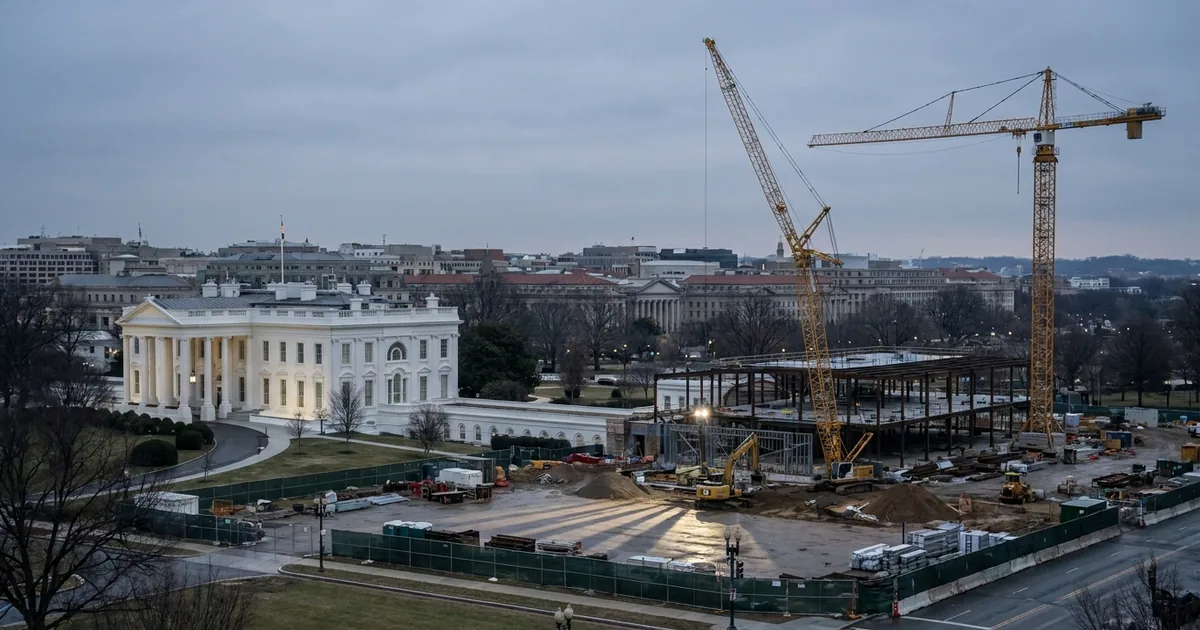
A federal appeals court ruled on Friday that President Donald Trump has no authority to build a $400 million ballroom at the White House without Congress signing off.
The ruling is a real constitutional rebuke, and it also lands roughly ten months after the wrecking crews finished with the East Wing, which is the part no court order can undo.
That gap between what the law says and what has already been built is the whole story here, and most of the coverage is treating it as a footnote.
What the D.C. Circuit Actually Held
The U.S. Court of Appeals for the District of Columbia Circuit split 2-1, with Judge Patricia Millett, an Obama appointee, and Judge Bradley Garcia, a Biden appointee, in the majority. They affirmed the preliminary injunction issued by U.S. District Judge Richard Leon and rested the decision on a point about property, not politics. The White House does not belong to whoever is living in it.
As CBS News reported on Friday, the majority wrote that “Each President is a temporary tenant, not the owner, of the White House and its Executive Residence.” The opinion goes out of its way to say the question is not whether a ballroom is a good idea. “Whether or not a massive ballroom should be constructed is for Congress to decide and is not a matter for Executive self-help,” the panel held.
That phrase, Executive self-help, is doing heavy lifting. It describes a method rather than a policy: act first, absorb the litigation later, and treat congressional authorization as a formality you can skip if nobody physically stops you. The panel is not ruling that the ballroom is ugly or wasteful. It is ruling that the process by which it appeared was not available to a president.
The Remedy Problem
Here is what a court can order: stop building. Here is what a court cannot order: unbuild.
The East Wing came down in October 2025. The 90,000-square-foot ballroom replacing it went up in a legal vacuum that the administration created and then defended. Friday’s ruling protects Congress’s authority over the White House going forward, and it restores nothing. The building that stood there for more than four decades is gone, and it stays gone whether or not the Supreme Court agrees with a word of this opinion.
That asymmetry is not an accident of timing. It is the incentive structure the strategy runs on.
The Courts’ Own Machinery Helped
The sequence deserves more attention than it is getting. Leon ruled in March that construction had to stop until Congress authorized it, which NPR covered at the time. Then, in April, an appellate panel granted an administrative stay that let the work continue while the appeal was pending.
An administrative stay is an ordinary, unremarkable procedural tool. It is meant to preserve the status quo while judges think. But when the disputed activity is pouring concrete, preserving the status quo means the status quo keeps changing, in one direction only, in favor of the party that moved first. Four months of construction happened under a stay that existed because the legal question was still open. By the time the question closed, the answer mattered less.
Rao’s Dissent Is the Road Map, Not a Footnote
Judge Neomi Rao, a Trump appointee, dissented, and the grounds matter more than the fact. She did not primarily argue that the president has the power to build the ballroom. She argued that the National Trust for Historic Preservation, the preservation group that brought the case, lacked standing to sue in the first place.
“The district court seized supervision of construction at the White House, and my colleagues affirm this judicial overreach,” Rao wrote.
Standing is the quiet way big cases end. A Supreme Court inclined to hand the administration a win does not have to endorse Executive self-help, or say anything about presidential authority over the Executive Residence, or write a sentence anyone could quote back at it in the next dispute. It can simply decide that a preservation nonprofit was never the right plaintiff, vacate everything below, and leave the constitutional question untouched for another decade. The ballroom gets finished. No precedent gets made. That is the cleanest available path, and Rao has already drawn the map.
Anyone reading Friday’s ruling as a durable win should be watching the standing question, not the merits.
Fourteen Days
The panel stayed its own ruling for 14 days so the administration can go to the Supreme Court, and Trump said on Truth Social that he will be “immediately appealing to the United States Supreme Court,” calling the decision “horrendous, politically motivated, and unlawful.” NBC News reported the 2-1 outcome within hours of the opinion landing.
So construction is not stopping today. The clock is the story: two weeks in which the legal blockade is suspended by the same court that just imposed it, and in which the concrete keeps setting.
Who Is Paying, and Why the Money Is Part of the Case
The ballroom was pitched as privately funded, which was the answer to every question about cost. That framing has always had a hole in it, and the ruling widens it.
The donor roster reads like a lobbying disclosure. Amazon, Meta, Apple, Comcast and Lockheed Martin have all been tied to the project, along with the family of Commerce Secretary Howard Lutnick, in accounting compiled by FactCheck.org. We covered one slice of this when YouTube paid $24.5 million toward the ballroom as part of a legal settlement, a payment that functioned as something other than philanthropy. The broader pattern of corporate money flowing into the People’s House was a democratic stress test before any judge got involved.
Private funding was also never the full picture. NBC News reported that congressional Republicans proposed $1 billion in taxpayer dollars to secure the structure, which is a useful reminder that “no public money” tends to mean no public money for the part that photographs well.
The constitutional argument the D.C. Circuit accepted is precisely about this. Congress controls development at the White House because Congress controls the money, and a project financed by regulated corporations with business before the administration is the exact scenario the appropriations power exists to sit between.
What Happens Next
If the Supreme Court takes the case on the merits and affirms, Congress gets a vote on a building that is largely finished. If it reverses, or if it makes the standing problem do the work, the ballroom opens and the precedent is that a president can demolish part of the White House and dare the system to respond in time.
Either way, the East Wing does not come back. The question worth asking is not who wins in two weeks. It is what a ruling is worth when it arrives after the thing it prohibits has already been done, and whether any court has an answer for a strategy built around exactly that.