
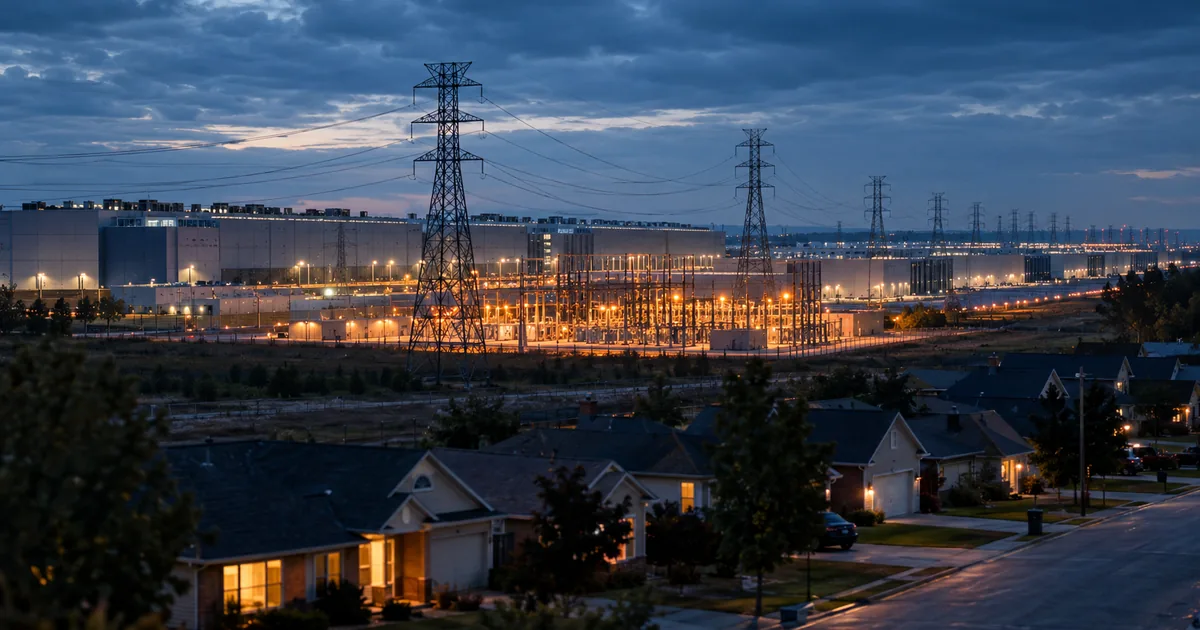
The House passed the Ratepayer Protection Act on Wednesday by a margin of 417 to 3, and nearly every account of the vote has described it as Congress finally forcing the AI industry to stop parking its electricity costs on your bill.
Read the bill and that is not what it does.
What it does is require state utility commissions to open a proceeding and consider whether to make large data centers pay, within a year of enactment. It does not require a single commission to actually adopt such a rule. It does not move a dollar. A 417 to 3 vote is not what near-unanimous agreement on a hard problem looks like. It is what a bill looks like when there is nothing in it to disagree with, six weeks out from a midterm in which electricity prices have become one of the few issues that reliably moves voters in both parties.
What the Bill Actually Requires
The legislation, sponsored by Representatives Gabe Evans of Colorado and Kathy Castor of Florida, sets a federal standard that state regulators must take up for electric customers drawing more than 100 megawatts, the scale at which a single facility starts to look like a small city on the grid. If a state adopts the standard, the rate design has to allocate the generation and transmission costs of serving those customers to the customers themselves rather than spreading them across households.
That “if” is the whole bill. The operative verb is that commissions shall commence consideration. There is no deadline for a decision, no default rule if a state declines, and no consequence for a commission that opens a docket, holds a hearing and closes it having changed nothing. The three members who voted no were progressive Democrats Summer Lee, Delia Ramirez and Rashida Tlaib, and Tlaib’s objection was that the bill fails to meaningfully protect communities and that she would rather see a moratorium on new construction.
The sharpest line came from a member who voted yes. Representative Veronica Escobar of Texas called the bill exactly what it is on the floor:
Truly the bare minimum. In fact, it’s kind of pathetic that all we’re going to do is make them pay their own energy costs.
She is right, and it understates the problem, because the bill does not make them pay their own energy costs either. It asks fifty state commissions to think about whether to.
Ohio Already Did the Real Version, Without Any Help From Congress
Here is the test that exposes the whole exercise. If states need federal permission to make data centers pay for the grid they require, then a state doing it before this bill existed should have been impossible. One already did. Ohio’s utility regulator approved a tariff in 2025 that puts large data center load on the hook for the capacity it reserves, which is a considerably stronger instrument than anything the House passed on Wednesday, and it did so under authority the state already had.
Every public utility commission in the country has that same authority. Rate design is the core of what these bodies do. The reason most of them have not used it is not a missing federal standard. It is that utilities earn a regulated return on capital spending, so a data center that triggers a billion dollars in new transmission is a profit opportunity for the utility, and commissions have been reluctant to disturb that. A bill instructing them to hold a proceeding does nothing about the incentive, and the incentive is the actual obstacle.
We flagged this bill in August, when it had no floor date and was being described as the one energy measure nobody opposed. It got its floor date. Nothing else about it changed.
It Codifies a Promise the Companies Already Made Voluntarily
The bill’s other function is to write the White House’s Ratepayer Protection Pledge into statute. That pledge was announced in March and signed by Amazon Web Services, Google, Meta, Microsoft, OpenAI, Oracle and xAI, who committed to funding the generation and infrastructure their projects require rather than passing the cost to ratepayers. It has since been expanded to more than two hundred utilities, developers and states.
Consider what codifying that actually means. The seven largest buyers of grid capacity in the country announced they would pay their own way. Congress then voted, 417 to 3, to ask state regulators to consider requiring the thing those companies said they were already doing. If the pledge is being honored, the bill is redundant. If it is not being honored, the bill contains no mechanism to find out and no penalty for anyone.
Consumer advocates noticed. Tyson Slocum, who runs the energy program at Public Citizen, called it a far cry from a comprehensive solution, and Food and Water Watch was blunter, describing the act as a cynical handout to Big Tech on the grounds that codifying a voluntary pledge is a way of settling the question in the industry’s favor while appearing to act against it.
The Senate Is Where This Was Always Going to Sit
Senator Jon Husted of Ohio has a companion bill. It has not received a vote. Majority Leader John Thune has indicated it would likely need to pass by unanimous consent given the floor time available, which is another way of saying there is no plan to spend real legislative capital on it. The House vote, taken under a fast-track procedure reserved for measures nobody intends to fight over, was never the beginning of a legislative process. It was the product.
Our position is straightforward. The problem here is real and it is getting worse. Electricity prices have been rising faster than inflation, the four largest hyperscalers are on pace to spend roughly $720 billion on data centers this year, and the cost of serving that load has to land somewhere. Congress responded to a genuine cost-of-living problem by passing a bill that instructs other people to hold meetings about it, and then let the coverage describe it as making data centers pay. That is not a small failure of ambition. It is the specific mechanism by which an issue voters care about gets defused without being addressed, and members of both parties got to vote for it precisely because it costs them nothing.
The useful reporting question for the next year is not whether this passes the Senate. It is which state commissions open dockets, which of those actually adopt a large-load tariff, and which quietly close the file. That is where the money is decided, and it was where the money was always going to be decided, with or without a 417 to 3 vote.
If your utility bill goes up next year, this bill will not be the reason it did not.