
Phone reviews spend thousands of words on cameras, chips and battery life, then give the radio a single line in the spec table. That line decides whether the phone works on the carrier you switch to next year, in the airport you land at next summer, or on a trail with no towers in sight. Since September 2025, it has also decided whether some phones take a SIM card at all.
Here are the five connectivity checks worth doing before you pay, roughly in the order they tend to cause trouble.
1. eSIM support, and whether the SIM tray is gone
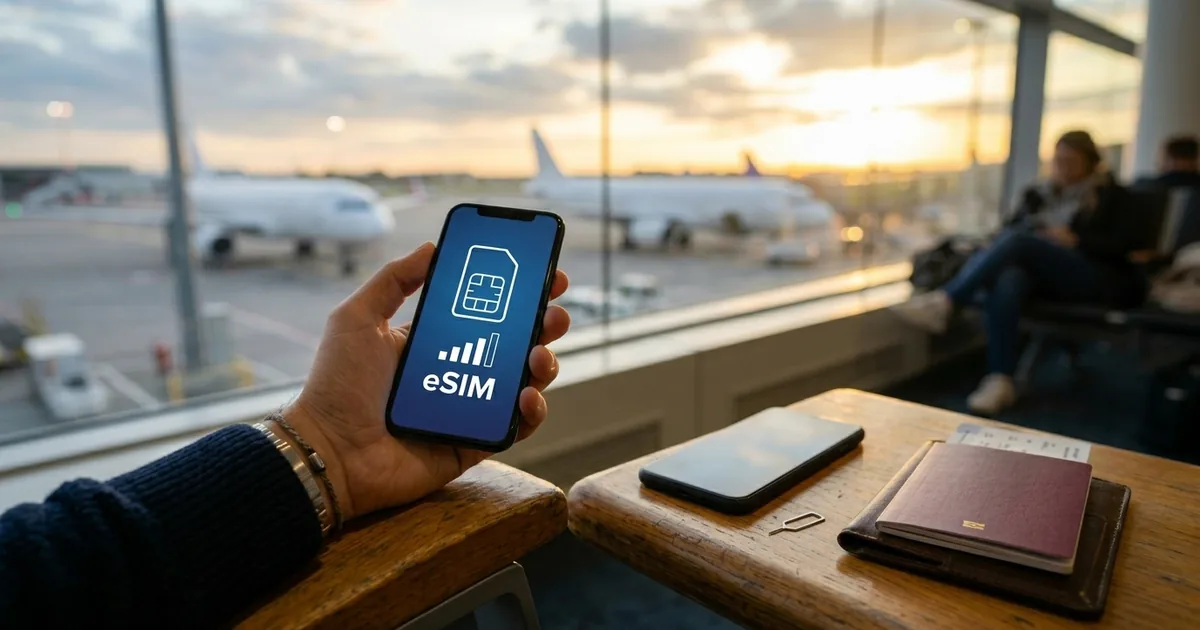
An eSIM is a SIM profile downloaded to a chip already inside the phone. You add a line by scanning a QR code or through a carrier app, and most current phones can store several profiles and run two lines at once.
For a growing number of buyers it is no longer optional. MacRumors reported that the iPhone 17, 17 Pro and 17 Pro Max sold in the United States, Canada, Mexico, Japan and several Gulf states ship with no physical SIM tray, and the iPhone Air is eSIM-only everywhere. On those phones, every line you ever use, including a local one abroad, has to arrive as an eSIM.
That is mostly good news for travelers. A travel eSIM can be installed at home before you leave and switched on when you land, while your regular number stays active for calls and texts. The catch is that support varies by model, and sometimes by the region a phone was sold in, so check the exact handset against a maintained compatibility list such as Holafly’s phone list before you assume it will work.
If you are weighing whether to wait for Apple’s next model, Live News Chat’s look at what to expect from the iPhone 18 is worth reading alongside this list.
2. Whether the phone is locked to a carrier
A locked phone accepts only SIMs and eSIMs from the carrier that sold it. That stops mattering right up until you try to add a foreign data plan or move to a cheaper provider.
US rules moved against buyers this year. In January the FCC granted Verizon a waiver ending its obligation to unlock phones automatically 60 days after activation, Broadband Breakfast reported. Under the policy that replaced it, Verizon unlocks postpaid phones once they are paid off and prepaid phones only after 365 days of paid service.
Our view: a phone that comes “free” with a two- or three-year installment plan is a loan, and the carrier lock is the collateral. If you travel or like switching plans, buy the phone unlocked, or get the date the lock comes off in writing before you sign.
3. The 5G bands for where you actually live
“5G” on the box tells you very little. Each phone supports a specific list of 5G and LTE frequency bands, and that list can differ between regional versions of the same model. In the US, the C-band frequencies AT&T and Verizon rely on (band n77) and T-Mobile’s 600 MHz low-band network (n71) are the two that most often separate a phone that works fully from one that falls back to slower LTE.
This bites hardest on grey-market imports and phones bought cheaply on holiday. Look up the exact model number, not the marketing name, on the manufacturer’s spec page and compare its band list with your carrier’s before you buy.
4. VoLTE and Wi-Fi calling
Most carriers have switched off their 3G networks, so ordinary voice calls now run over 4G using VoLTE. A phone can show full bars and still fail to place calls if the carrier has not approved that model for VoLTE, a problem that mostly hits imports and less common handsets. Run the phone’s IMEI through your carrier’s compatibility checker, or ask the store, before money changes hands.
Wi-Fi calling is the companion feature: calls and texts route over any Wi-Fi network when the cell signal is weak. It rescues basements and rural kitchens at home, and abroad it can connect you to home numbers over hotel Wi-Fi, though billing for those calls depends on your carrier’s roaming terms. Support depends on both the phone and the carrier, so confirm each.
5. Satellite messaging
The newest check is whether the phone can reach a satellite when there is no tower at all. The iPhone 14 and later include Emergency SOS via satellite, Google’s Pixel 9 line added Satellite SOS, and T-Mobile says its T-Satellite texting service works with more than 60 models, including the iPhone 13 and newer and the Galaxy S21 and up.

Coverage, cost and what you can send vary by country and carrier, and every service needs a clear view of the sky. For most people it should not decide between two phones. For hikers, rural drivers and anyone who travels off the grid, it is the one feature on this list that can matter in an emergency.
A two-minute check before you pay
Write down the exact model number, then confirm five things: eSIM support and whether there is still a SIM tray, lock status and when it ends, 5G and LTE bands against your carrier, VoLTE and Wi-Fi calling approval, and satellite features where you live. A phone that passes all five will keep working when you change plans, cross a border or lose signal, which is more than most spec sheets promise.