
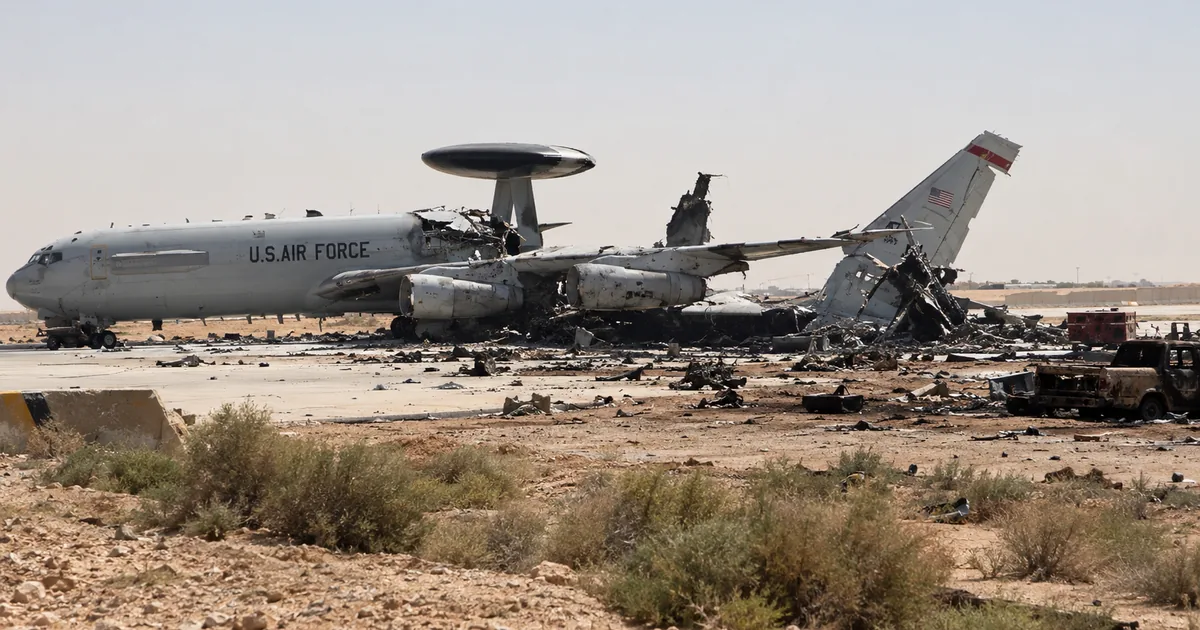
Photos from active-duty U.S. troops show a Boeing E-3 Sentry with its tail sheared off at Prince Sultan Air Base in Saudi Arabia, and barracks and trailers at Kuwait’s Camp Buehring reduced to hollow shells. Almost everyone is running them as a leak, a secret finally out. It is not a secret. The Pentagon’s own inspector general published the bill two days ago, and the House left town rather than vote on the man who ran the war.
The official line. Pete Hegseth and President Trump spent the summer pushing back on reports that the war was draining American munitions stockpiles.
The Pentagon’s own paperwork. “Hundreds of buildings and structures” damaged or destroyed in eight countries, nearly 60 aircraft lost, and “strategic inventory shortfalls” in munitions.
The photos reached CBS News from service members who spoke on condition of anonymity. One of them put it bluntly: “We’re standing there with our eyes closed getting punched in the face.”
Another said the drones and missiles were not a few strays slipping past the defenses. “We’re not defending these bases. We’re just watching them get destroyed.”
The Pentagon did not answer CBS when asked to comment.
The Receipt Was Already Public
On Tuesday, the Defense Department inspector general released its first report on Operation Epic Fury. It says, in CENTCOM’s own words, that Iranian strikes “damaged and destroyed hundreds of buildings and structures at U.S. bases in Kuwait, Bahrain, Qatar, UAE, Saudi Arabia, Iraq, Oman, and Jordan.”
Breaking Defense noted that this is the first comprehensive official accounting anyone has released publicly. So the photos are not a revelation. They are the pictures that go with a document the administration hoped would stay a PDF.
Lay the report next to what the public was told and the gap does most of the talking.
| What the record shows | Figure |
|---|---|
| Total cost of the war through June 29 | $33.4 billion |
| Munitions fired | $22.3 billion |
| Equipment losses | Up to $3.7 billion |
| Repairs to U.S. diplomatic facilities in four countries | About $184 million |
| Wounded, Pentagon count as of June 30 | 417 |
| Wounded, per late-August reporting | 774 |
| U.S. military dead, as of Aug. 27 | 18 |
That wounded line is the one to sit with. According to Military Times’ read of the report and later figures, the count nearly doubled in two months, from 417 to 774. Nobody held a press conference for the other 357.
Equipment losses alone come to about 11% of the war’s entire price tag. That is not what a defended base looks like. It is what the service member on camera described.
The House Skipped the Vote
Here is the part that turns a damage story into an accountability story. Rep. Thomas Massie, a Republican, forced an impeachment vote on Hegseth over the Iran war, due by Thursday. Speaker Mike Johnson’s answer was to cancel Thursday. CNBC reported that the House recessed early for the elections and will not return until Nov. 9.
GOP leaders say the timing has nothing to do with Massie. The calendar says otherwise. The report dropped Tuesday, the photos Tuesday and Wednesday, and the chamber cleared out before anyone had to put a name next to a yes or a no.
Our view is simple. Hegseth may or may not deserve impeachment, but members of Congress do not get to find that out by leaving the building. Troops should not have to hand their phones to reporters for the country to learn that an E-3 lost its tail. The Pentagon should publish a base-by-base damage assessment now, with operational details redacted where they genuinely need to be, and the House should come back and cast the vote it ran from.
Voters get their say on Nov. 3. The House scheduled its return for six days after that.