
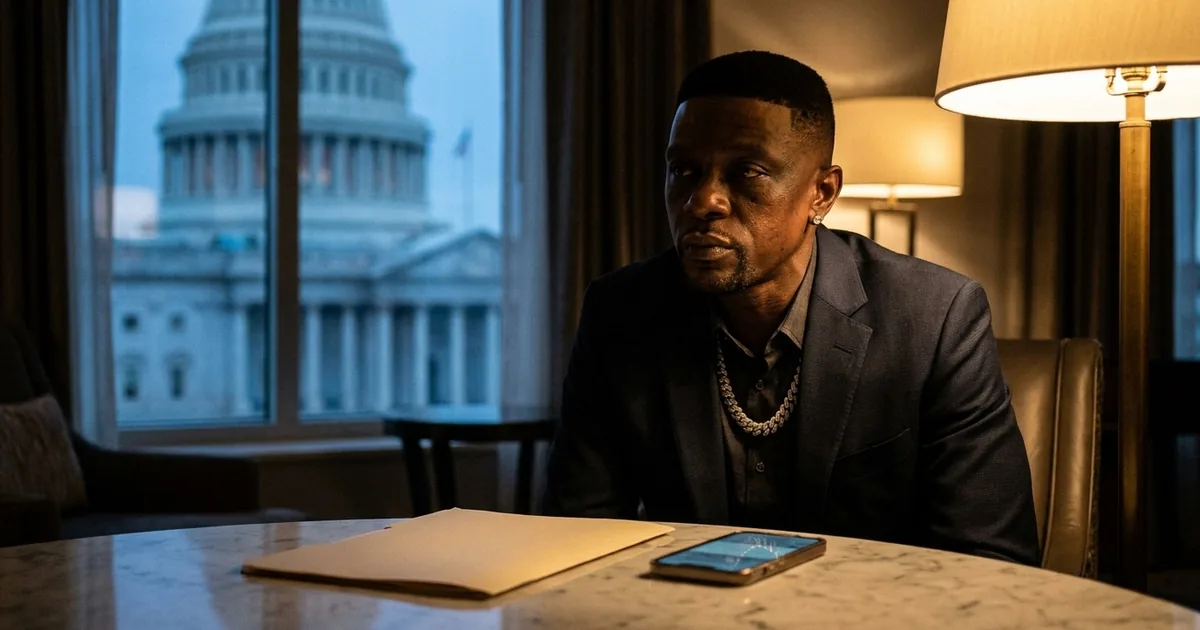
Torence Hatch, the Baton Rouge rapper known as Boosie Badazz, wired $600,000 to a pair of Washington operatives who told him they could get a presidential pardon, and on New Year’s Day his lawyer got a call saying Trump had already signed it.
No pardon ever existed, and the fight Boosie is now waging in public over his refund has done more to expose how clemency actually works in this White House than any congressional letter has managed.
The operatives were Jack Burkman and Jacob Wohl, a duo best known for staging failed smear hoaxes against public figures. That is the part everyone is laughing at. The part worth taking seriously is that their pitch was plausible enough to close a $600,000 contract, because in the current pardon system, it was not obviously a lie.
What Actually Happened
The timeline comes from a NOTUS investigation published July 13. Boosie’s camp reached JM Burkman & Associates in late September 2025 while he was facing a federal gun charge. The contract was signed September 30 for $600,000, with a clause returning half the fee if no pardon landed by January 31, 2026.
On January 1, Burkman called Boosie’s criminal defense lawyer, Meghan Blanco, to say the president had signed. Boosie has since described running around his house celebrating. Through the winter, Wohl and Burkman kept the story alive by name-dropping people they claimed were working the case: Laura Loomer, Mike Cernovich, Jack Posobiec, Erika Kirk, House Speaker Mike Johnson, Representatives Nancy Mace and Andy Biggs. Every one of them has denied any involvement, and Loomer publicly told Boosie flatly that pardons cannot be purchased. He thanked her for the honesty, which tells you how thin his information channel had become.
The relationship collapsed in March. Boosie demanded the $300,000 back, filed for arbitration through the American Arbitration Association, and has since taken the fight to social media in all caps, daring the firm to explain itself. Burkman’s firm has argued it owes nothing and has pleaded insolvency, pointing to federal fines from its earlier ventures. Boosie eventually got a sentence of time served on the gun case anyway, and says a separate clemency application filed directly with the White House is still pending.
A White House official gave Rolling Stone and other outlets a denial with unusual bite, saying the clemency team had never heard from Wohl or Burkman, does not support their work, and would warn any applicant that their involvement actively hurts the odds.
The Denial Is Also a Confession
Read that statement again. The White House is not saying the pardon process is insulated from private lobbying. It is saying these two particular lobbyists are not connected, and that hiring the wrong lobbyist damages your application. Which concedes the premise: there is a right lobbyist, and who you hire is a variable in whether a federal sentence gets erased.
That is the structural story, and it is not about Boosie at all. Under every modern administration before this one, clemency ran through the Justice Department’s Office of the Pardon Attorney. The process was slow and stingy, but it was a process: a published set of criteria, a requirement that applicants serve a meaningful portion of their sentence, evidence of contrition and restitution, a queue, a docket, a paper trail. It gave a person with no money and no connections a front door.
Trump’s second term moved that function into the White House. Ed Martin holds the pardon attorney title, but the review now runs through a small group of aides and lawyers who bring cases to the president directly. There is no central intake, no published standard, no docket a journalist or an inspector general can audit. NPR member stations reported this month that the effective pathway is now informal: call someone you know, reach a White House official, get in front of the president.
Remove the front door and you do not remove the demand. You privatize the entrance. And an entrance that is privatized gets priced.
A Market Nobody Regulates
The pricing is now visible in federal disclosure filings, which is the only reason we can see any of it. More than two dozen lobbying registrations touching clemency have been filed during this term, a category that barely existed before. Fees run from the low six figures to as much as $5 million. CBS News documented a Trump-linked firm whose first pardon client paid $500,000. Only a small fraction of these engagements has preceded an actual pardon.
Burkman and Wohl’s own filings make the point better than any critic could. Their firm reported $3.2 million in federal lobbying revenue for 2025. Two earlier pardon clients paid $92,000 and $15,000 and got nothing. But they also disclosed $960,000 on behalf of Joseph Schwartz, a nursing home operator who pleaded guilty in a payroll tax fraud scheme worth nearly $39 million, served roughly three months of a three-year sentence, and walked out with a Trump pardon. The White House says the pair had nothing to do with it. Believe that, and their sales pitch to Boosie still worked because the outcome was real. Somebody with a $39 million fraud conviction got three months. That is the advertisement, and no lobbyist had to write it.
This is the same monetization logic visible across the administration, from the family’s crypto ventures accumulating billions during the presidency to the access economy that has grown up around Mar-a-Lago. What is different about clemency is that the commodity being sold is not policy or attention. It is the erasure of a criminal conviction, the single most unreviewable power the Constitution grants one person.
Congressional Democrats have opened inquiries into whether specific pardons followed donations or business ties. Those investigations matter, but they are aimed at the wrong altitude. Proving a quid pro quo on any individual pardon is nearly impossible, because the pardon power has no statutory procedure to violate. There is no rule requiring an application, a review, a waiting period, or a written justification. A president can pardon anyone for any federal offense for any reason, including a bad one, and the only formal check is impeachment.
Why the Victim Here Is a Useful One
Boosie is not a sympathetic plaintiff in the conventional sense, and he is not asking to be. He is a felon with a federal gun conviction who tried to buy his way out and got taken. He has said as much, loudly.
That is exactly why the case is clarifying. Nobody has to argue about whether he deserved clemency. The only question on the table is whether the system he encountered is the one the public thinks exists. He came away convinced that $600,000 was a reasonable market price for a pardon, and he was wrong only about the vendor. Nothing in the White House response contradicts the price. It contradicts the seller.
The people who cannot run this play are the ones the old DOJ process nominally served: federal prisoners with no lawyer, no publicist, and no $600,000. Their applications sit in a queue that has effectively stopped mattering, because the decisions moved to a room they cannot reach. The clemency power was designed as a mercy valve for exactly those cases. It is now functioning as a redemption window for people who can afford a guide.
What to Watch
Boosie’s arbitration will probably end quietly, and the firm’s insolvency claim may mean he never sees the $300,000. The more consequential thread is disclosure. Because clemency lobbying is registered lobbying, every one of these engagements leaves a filing, and those filings are the closest thing to an audit trail this process has. The Senate database is currently doing the oversight work the Office of the Pardon Attorney used to do.
The question is whether anyone builds on it. A rapper’s public tantrum over a refund produced more documented detail about the price of access to this pardon system than months of institutional inquiry. That should be embarrassing for Congress. It is unlikely to be.