
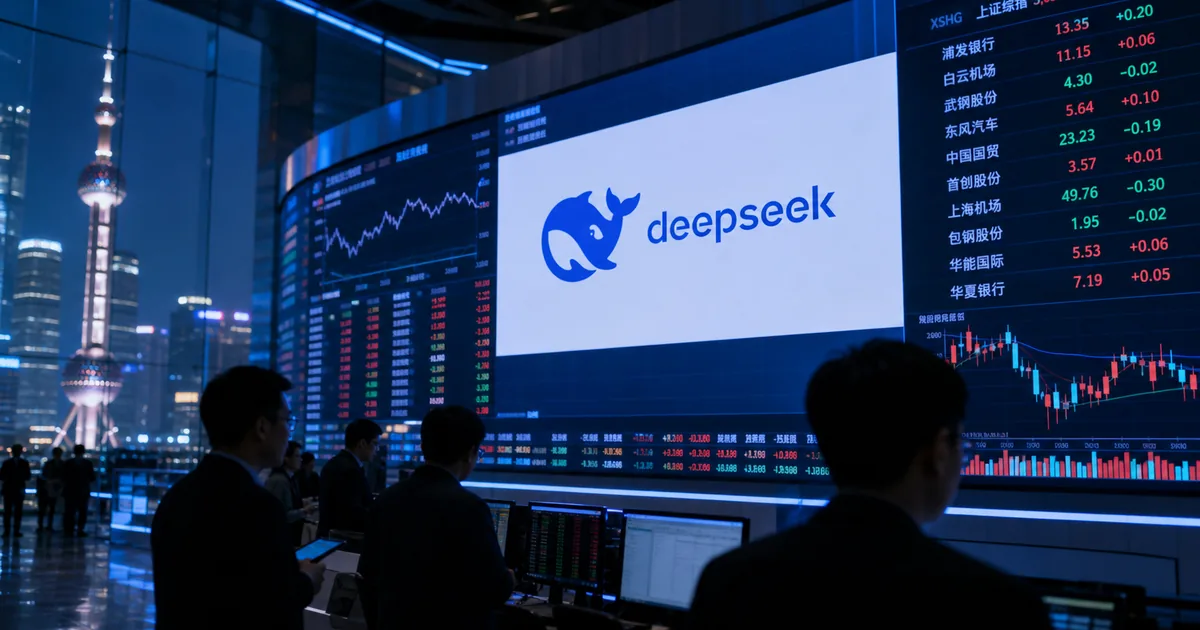
DeepSeek is raising fresh capital at roughly $74 billion ahead of an onshore listing, a valuation that has climbed from $50 billion in the span of about a month.
The number matters less than the structure underneath it, because this is not a startup shopping for growth capital. It is a Chinese AI lab being wired into the Chinese state’s capital plumbing at the exact moment its pricing is pulling revenue away from American model makers.
The Deal, and What Is Actually New About It
The sequence is unusually fast. DeepSeek closed a $7 billion round, its first ever outside capital after years of refusing it, and weeks later was reported to be in talks for another $1.5 billion at a materially higher mark. TechCrunch reported in July that the company is preparing a 2027 debut, with a filing possible before the end of this year. Bloomberg’s reporting, carried through Yahoo Finance, put the company in conversations with accounting firms and investment banks, working toward a complete financial report by the end of December.
Note what is missing from that sequence: any obvious need for the money. A company that spent three years declining outside investment, and that trained its breakout models for a reported fraction of what American labs spend, did not suddenly discover a funding gap. Something else is going on.
The Why: This Is an Integration Event, Not a Fundraise
Here is the structural read. DeepSeek’s backers already include Tencent and Beijing’s National Artificial Intelligence Industry Investment Fund. An onshore listing, widely expected to land on Shanghai’s STAR Market, does not diversify that ownership base. It deepens it. It plugs DeepSeek into a domestic capital pool that is policy-directed by design, on an exchange built specifically to fund technologies Beijing has designated as strategic.
That is the fifth W. DeepSeek is not going public to escape state capital. It is going public to institutionalize it, and to do so at a moment when the alternative sources are closed. American export controls bar Chinese firms from Nvidia’s best silicon. Western growth capital is politically radioactive in both directions. A domestic listing is the only door that is actually open, which is why the valuation can run this hot without a conventional investor base to discipline it. Reuters analysts have pointed to the flip side of that arrangement, which is that a shallow onshore capital pool sets a ceiling on how much any single champion can absorb.
The chip strategy confirms the reading. DeepSeek serves its cloud product on Huawei processors, routing around export controls rather than waiting them out, and Reuters reported in July that the company is developing its own inference chip. A model lab building silicon is not a normal product decision. It is what a company does when it has concluded that the hardware supply is a permanent political variable, and when it has access to the kind of patient, state-adjacent money that makes a multi-year semiconductor detour survivable.
The Pricing Is the Attack Surface
The competitive story reads differently once you accept that DeepSeek’s cost of capital is not set by markets. Its models sit at a fraction of American list prices, with V4 Flash running around $0.14 per million input tokens and $0.28 per million output, against flagship Western pricing that lands an order of magnitude higher on comparable workloads. Over the past year the two pricing curves have moved in opposite directions, with American flagship input costs climbing while DeepSeek cut prices sharply and extended context.
That divergence is the whole ballgame. American AI economics rest on an assumption that frontier capability commands a premium, and that inference margin eventually pays back the training spend. DeepSeek’s pricing is a direct assault on that assumption, and it is working at the volume layer where it hurts. On Vercel’s enterprise gateway in June, DeepSeek accounted for nearly 23% of tokens processed against Anthropic’s 32%. That is not a curiosity. That is a Chinese lab holding roughly a quarter of a serious Western developer channel.
Commoditizing inference is strategically useful to Beijing whether or not DeepSeek ever earns a good return on it. If AI capability becomes cheap and undifferentiated, the valuations of American labs, and the enormous capital expenditure programs those valuations underwrite, start to look badly calibrated. You do not need to win the frontier if you can make the frontier unprofitable to hold.
What This Costs the American Side
The uncomfortable part for US policymakers is that export controls produced a competitor that is harder to model, not an absent one. Restricting chips pushed DeepSeek toward efficiency, toward Huawei, and now toward its own silicon, while the political conversation in Washington has kept swinging between restriction and accommodation. We covered that whiplash when the Fable Mythos export ban was lifted, and the pattern has not improved since. Controls that move faster than they can compound give the target time to route around them.
There is a real consumer and enterprise upside here, and it deserves saying plainly rather than being buried under the geopolitics. Cheap, capable inference is good for the developers and businesses buying it. Price pressure on American labs is not automatically a national loss. But the terms matter, and buyers should be clear-eyed that a price set partly by state-adjacent capital and domestic industrial policy is not the same thing as a price set by competition. It can move for reasons that have nothing to do with the market.
The Question the Filing Will Answer
The listing documents, if they land as reported before year-end, will be the first time DeepSeek’s actual economics are visible to anyone outside the company. Every claim in the current argument, that the models are radically cheaper to serve, that the efficiency is real rather than subsidized, that the Huawei stack performs at scale, becomes checkable against audited numbers.
That is the thing worth watching, more than the valuation headline. If the financials show a company that genuinely serves frontier-adjacent models at these prices, the American cost structure has a problem that no export control fixes. If they show losses absorbed by patient state capital, then the cheap-AI threat is a policy instrument rather than a business, and it should be priced as one. Right now both stories fit the available facts, and Beijing has no particular reason to clarify which is true.