
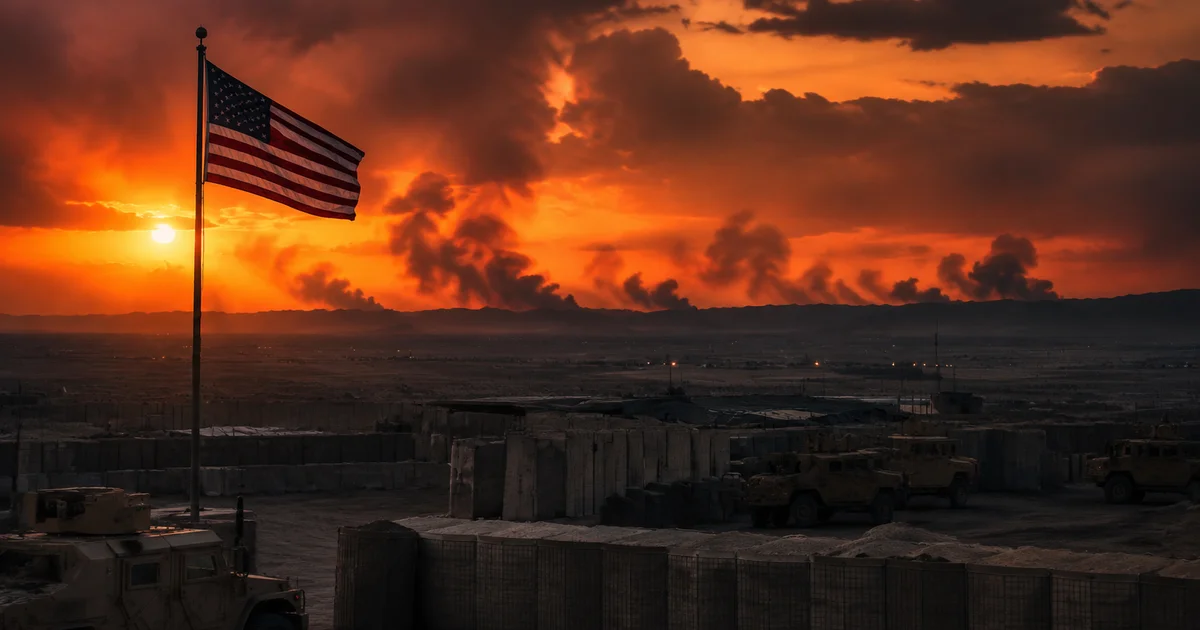
The Pentagon disclosed Monday that nearly 100 American service members have been injured in Iranian strikes since July 7, a figure that the Defense Department’s own casualty tracking database had listed at zero for most of the month.
The gap between what the military quietly acknowledged in a briefing and what its public-facing systems showed tells you everything about how this administration wants to frame the cost of a war it never asked Congress to authorize.
A Casualty Count That Contradicts Itself
Pentagon spokesperson Maj. Gen. Pat Ryder confirmed the injuries during a Monday briefing, telling reporters that the “vast majority” were minor concussive injuries and that 96% of those affected had returned to duty. But here is the problem: the Defense Casualty Analysis System, the Pentagon’s official public database for tracking combat injuries and deaths, showed zero wounded-in-action for July as recently as last week.
By Tuesday, that number had been updated to 32, still less than a third of the figure Ryder disclosed publicly. The Intercept reported that the discrepancy raises serious transparency questions about whether the Pentagon is systematically underreporting the human cost of the escalating conflict with Iran. The lag is not a clerical error. It is a pattern. During the early months of the Iran conflict, the same database repeatedly showed casualty figures well below what military officials were acknowledging in off-the-record briefings with reporters.
The “minor concussion” framing deserves scrutiny too. Traumatic brain injuries were classified the same way during the Iraq and Afghanistan wars, and thousands of veterans are now living with debilitating long-term cognitive effects that the military once dismissed as battlefield headaches.
The Ceasefire Is Dead, and the Toll Is Rising Fast
The injuries come as the monthslong ceasefire between the United States and Iran has decisively collapsed. U.S. Central Command has carried out nightly strikes on Iranian targets for more than a week, according to CNN’s live reporting on the conflict, saying it is targeting Iran’s ability to attack commercial shipping in the Strait of Hormuz. Tehran has responded by hitting U.S. assets across the region, striking bases in Jordan, Kuwait, Bahrain, and other allied nations.
The toll is not just concussions. Pvt. Isabella Gonzales, 19, and 1st Lt. Tyler James Feehan, 25, were killed in an Iranian attack on a military base in Jordan. A third service member died during the controlled detonation of a downed Iranian drone in Iraq. These are young Americans dying in a conflict that has no congressional authorization, no defined end state, and no public debate about what victory even looks like.
Stars and Stripes reported that the Pentagon has been updating its casualty tracking system in batches rather than in real time, a practice that ensures the public is always looking at a number that understates the actual toll. During previous conflicts, real-time reporting was standard. The shift to batch updates is a policy choice, not a technical limitation.
The Why: A Transparency Problem Built Into the War’s Architecture
The structural issue here is not incompetence in record-keeping. It is incentive. When the public cannot see casualty numbers in real time, the political pressure to de-escalate stays low. The Pentagon has a well-documented history of reclassifying combat injuries to minimize the visible cost of conflict, and the pattern is repeating itself now.
President Trump warned Tehran Monday that it would “pay” for the deaths of American service members, but the administration has not articulated what “paying” looks like beyond more nightly strikes. Gas prices have already crept back above $4 a gallon nationally, and the economic ripple effects of a full Strait of Hormuz disruption could dwarf anything the tariff wars have produced. The war is costing American families at the pump and costing American troops their health, and the accounting on both fronts is deliberately opaque.
Congress Is Starting to Notice
Time reported that the injury toll has generated bipartisan scrutiny on Capitol Hill, with lawmakers from both parties demanding a full accounting and questioning whether the Defense Casualty Analysis System is being deliberately delayed. Several senators have called for hearings on the casualty reporting gap, and at least two House members have introduced legislation that would require real-time public updates to the casualty database within 72 hours of any combat injury.
The administration’s response so far has been to emphasize the “minor” nature of most injuries and the high return-to-duty rate. But “return to duty” is not the same as “recovered.” Service members with concussive brain injuries often do not show symptoms for weeks or months. The military’s own research, published through the Uniformed Services University, has shown that repeated mild TBIs produce cumulative neurological damage that standard return-to-duty evaluations are not designed to catch.
If this conflict continues to escalate without congressional debate, the gap between the Pentagon’s public numbers and the reality on the ground will only widen. And for the families of the nearly 100 service members who came home with concussions they never signed up for, “minor” is not the word they would use.