
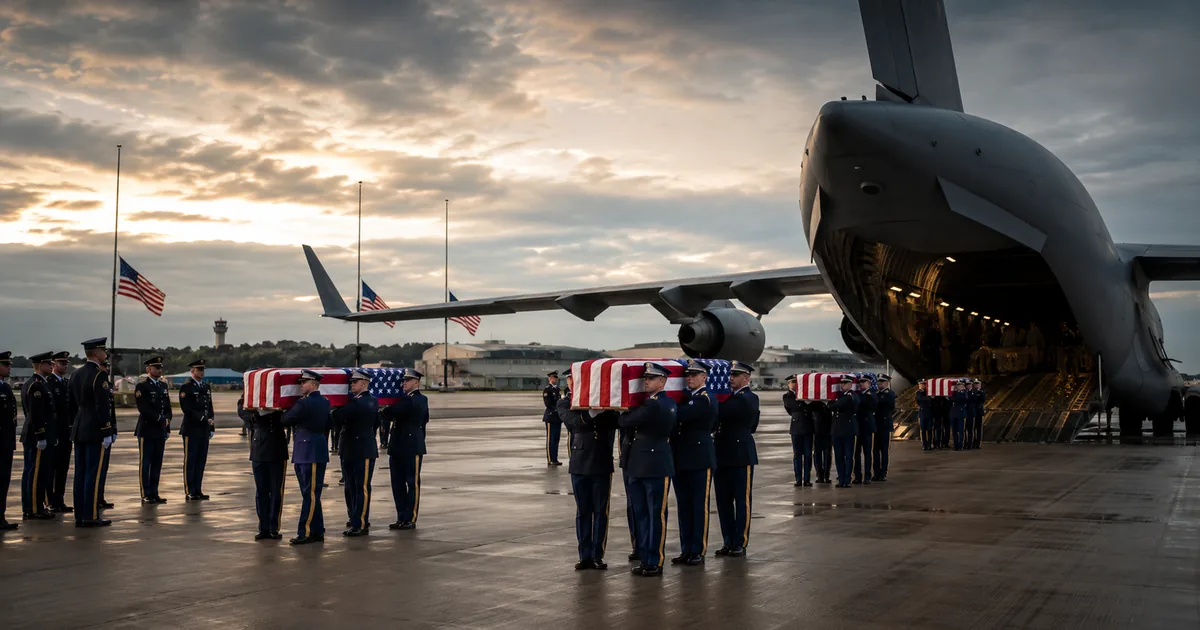
President Donald Trump stood on the tarmac at Dover Air Force Base on Tuesday for the third time since launching the war in Iran, saluting the flag-draped transfer cases of four American service members killed in the past five days.
The ceremony was a somber punctuation mark on a week that has forced the White House to confront the accelerating human cost of a conflict the administration once framed as a limited, air-dominant operation.
Who the Country Lost This Week
The four soldiers honored at Dover represent the latest casualties in what the Pentagon now acknowledges has cost $37.5 billion and shows no sign of winding down.
Three Army soldiers died after an Iranian drone strike hit Muwaffaq Salti Air Base in Jordan on Friday: 1st Lt. Tyler James Feehan, 25, of Ewa Beach, Hawaii; Pvt. Isabella Gonzales, 19, of Carrollton, Texas; and Sgt. Angel S. Rampersad, 28, of New York City. A fourth, Sgt. Michael Emmanuel Swinton, 30, of Fayetteville, North Carolina, was killed on Sunday during the controlled detonation of a downed Iranian attack drone at Erbil Air Base in Iraq.
Gonzales, at 19, is believed to be the youngest American service member killed in the conflict. She had been deployed for fewer than three months.
A Conflict Fought “Largely in the Air” Is Still Killing Troops on the Ground
The Washington Times reported Tuesday that 17 U.S. service members have now died in the Iran war, with more than 480 wounded since the conflict began on February 28, when the United States and Israel launched coordinated strikes on Iranian military and nuclear infrastructure.
That casualty count complicates the administration’s central narrative. Defense Secretary Pete Hegseth has repeatedly described the campaign as an air war, one fought with standoff weapons, drones, and carrier-based strikes that keep American boots out of the line of fire. The reality on the ground tells a different story. Every one of the 17 dead was stationed at a forward operating base in Iraq, Jordan, Kuwait, or Bahrain, close enough to Iranian drone and missile range that no amount of air superiority provides full protection.
The pattern is now familiar: Iran’s Islamic Revolutionary Guard Corps launches volleys of one-way attack drones at U.S. positions in partner nations, the kind of low-cost, high-volume saturation attacks that overwhelm point defense systems. The Jordan strike that killed three of the four honored on Tuesday hit during a shift change, according to CBS News, a timing vulnerability that mirrors the Tower 22 attack playbook from early 2024.
The Political Weight of Dover
The dignified transfer is among the most politically charged rituals a wartime president can attend. Trump’s decision to be present, joined by First Lady Melania Trump, signals the White House recognizes the growing scrutiny around casualties. His first two transfers, in March and May, drew smaller crowds and less press attention. This one arrived against the backdrop of a congressional fight over a $67 billion supplemental spending request and public polling that shows support for the war eroding below 40 percent.
Trump spoke briefly with the families of the fallen on the flight line but made no public statement. The silence was itself notable. In previous transfers, Trump offered brief remarks to reporters; this time, the White House press pool was kept at a distance, and no questions were taken.
The political calculus is shifting. Democrats on the Senate Armed Services Committee have begun calling for a formal Authorization for Use of Military Force vote, arguing that the February strikes were launched under executive authority that has now stretched five months beyond any reasonable interpretation of imminent threat. Republicans, meanwhile, are split between hawks who want escalation and a growing caucus that views the casualty trajectory as unsustainable heading into the 2026 midterms.
The Why: An Air War That Cannot Protect Its Own Bases
The structural failure the dignified transfers keep exposing is a mismatch between strategy and geography. The United States is waging an air campaign against Iran while maintaining thousands of troops at fixed bases within range of the very weapons that campaign is supposed to neutralize. Patriot and THAAD batteries intercept the majority of incoming projectiles, but “the majority” is not “all,” and a single drone that gets through a shift-change gap or detonation protocol failure is enough to produce a flag-draped transfer case at Dover.
Until the Pentagon either withdraws those forward-positioned troops to safer standoff distances or achieves the kind of air dominance that genuinely suppresses Iran’s drone and missile production capacity, the transfers will continue. Neither option is on the table. Withdrawal would signal retreat; suppression would require a ground component the administration has ruled out. The troops at Muwaffaq Salti and Erbil are absorbing the contradiction.
What Comes Next
The war has now produced 17 confirmed deaths and hundreds of wounded, a toll that remains modest by historical standards but is rising on a steepening curve. Seven of the 17 have died since the ceasefire collapsed on July 8. If that pace holds through August, the death toll will surpass 30 before Congress returns from recess, a threshold that historically triggers the kind of public backlash that reshapes war policy.
For Tyler Feehan, Isabella Gonzales, Angel Rampersad, and Michael Swinton, the policy debate is academic. Their families met the President on a tarmac in Delaware on a Tuesday afternoon, and the country owes them more than a ceremony. It owes them an honest accounting of why they were in harm’s way and what, exactly, their sacrifice is buying.