
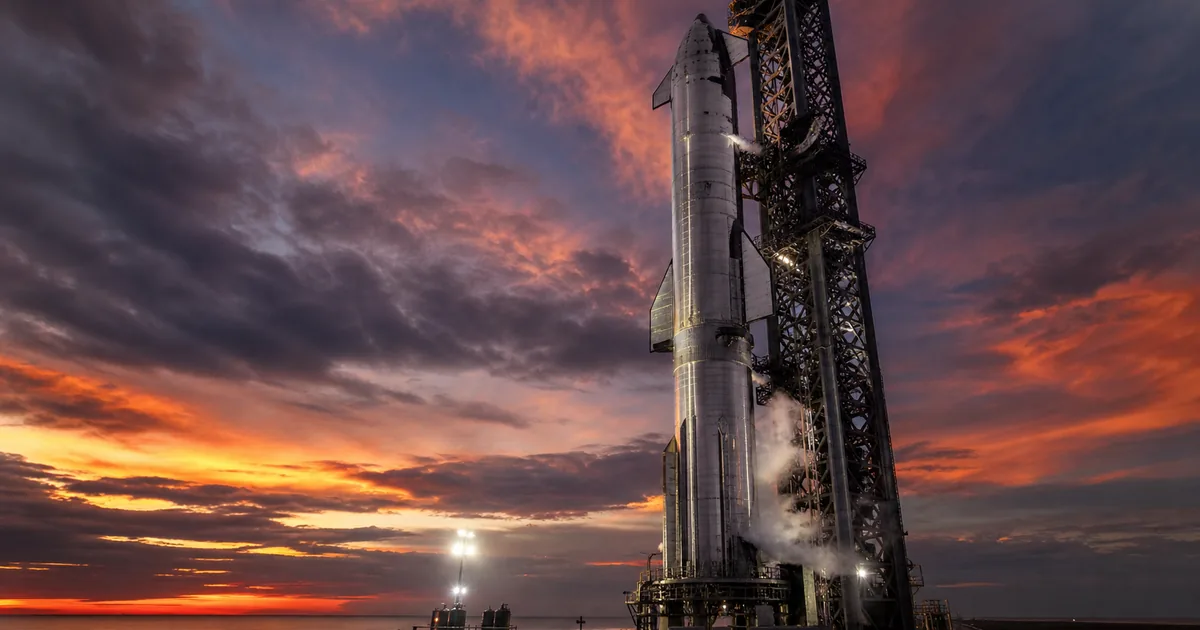
SpaceX will attempt to launch Starship on its 13th test flight tonight from Boca Chica, Texas, with a 90-minute window opening at 6:45 p.m.
ET. The mission, already delayed twice, carries stakes that go beyond the usual test-flight nerves: Flight 13 is supposed to deploy the first batch of production Starlink V3 satellites, a milestone that could reshape the economics of SpaceX’s satellite internet business.
Two Scrubs, Two Problems
The original July 16 launch attempt ended in an abort at the last second when several of the Super Heavy booster’s 33 Raptor 3 engines failed to ignite at startup. SpaceX pulled the rocket back to its integration tower, swapped out two engines, and rolled back to the pad for a July 23 retry. Weather killed that attempt before the engines ever had a chance to prove themselves.
Tonight’s window is the third try in nine days, and SpaceX is running up against a NASA deadline that CNN reported adds institutional pressure on top of the technical challenge. The company has not disclosed what specifically caused the engine ignition failures on July 16, saying only that the replacement Raptors were installed “out of an abundance of caution.”
Why V3 Satellites Change the Math
Previous Starship test flights deployed dummy payloads or performed ship-catching maneuvers that generated spectacular footage but no revenue. Flight 13 is different. The 20 Starlink V3 satellites aboard represent the first operational payload for Starship, and if the deployment works, SpaceX plans to extend the satellites’ solar arrays and connect them to the existing constellation via high-capacity laser links.
V3 satellites are significantly larger and more capable than the current V2 Mini units that ride on Falcon 9. They need Starship’s cavernous payload bay to fly at all, which means the entire next generation of Starlink depends on Starship working reliably. A successful deployment tonight would validate not just the rocket but the business case for Starlink’s expanded capacity.
The Reuse Record Adds Context
Starship’s struggles this month contrast sharply with Falcon 9’s relentless reliability. Earlier in July, SpaceX flew a Falcon 9 booster for its 36th time, extending a reuse record that no competitor is close to matching. The company’s 85th Falcon 9 launch of 2026 lifted off from Vandenberg on July 21, a pace that makes orbital launches look almost routine.
That reliability is what makes Starship’s growing pains tolerable for SpaceX financially. Falcon 9 generates the revenue that funds Starship development, and the Starlink constellation it carries produces the recurring income that gives Elon Musk room to iterate through engine failures and weather scrubs without existential consequences.
The FAA Factor
Starship’s test-flight cadence depends on more than engineering. The FAA grounded the program after Flight 12’s booster anomaly earlier this year, and each flight requires a fresh launch license that incorporates lessons from the previous mission. The engine-ignition failure on July 16 did not trigger a formal investigation because the abort system worked as designed and no hardware was damaged, but it did prompt questions about whether SpaceX is pushing its Raptor 3 engine design too aggressively.
The regulatory dynamic matters because SpaceX is simultaneously competing for NASA’s Artemis lunar lander contract milestones and for commercial launch customers who are watching Starship’s reliability curve closely. Every scrub and delay feeds the narrative that Starship is years away from the operational tempo SpaceX has promised, even as Falcon 9 demonstrates what that tempo actually looks like when a vehicle matures.
Competition Is Watching
Blue Origin’s New Glenn rocket completed its first orbital mission earlier this year, and United Launch Alliance’s Vulcan Centaur is flying commercial payloads. Neither vehicle competes directly with Starship on payload capacity, but they offer customers an alternative that does not come with the test-flight volatility SpaceX is still working through. For government customers in particular, redundancy in launch providers is a policy priority, not just a market preference.
The European Space Agency’s Ariane 6 is also ramping up flights, giving institutional customers outside the U.S. a non-SpaceX option for the first time in years. Starship’s eventual cost advantage, if it achieves full reusability, could make all of these competitors irrelevant on price. But that advantage is theoretical until the vehicle demonstrates the rapid turnaround that makes it possible.
What to Watch Tonight
The launch window opens at 6:45 p.m. ET, with a SpaceX livestream beginning about 30 minutes earlier. Beyond the engine ignition sequence that tripped up Flight 13’s first attempt, the critical moments will be the satellite deployment itself and whether the V3 units successfully extend their solar arrays in orbit.
If this works, SpaceX will have accomplished something no other launch provider has managed: deploying a production satellite constellation from a vehicle still technically in its test phase. If it fails, the company is back to the integration tower for another round of engine swaps, and the V3 constellation timeline slips further into the second half of 2026. Either way, tonight is the most consequential Starship flight since the first successful booster catch on Flight 5.