
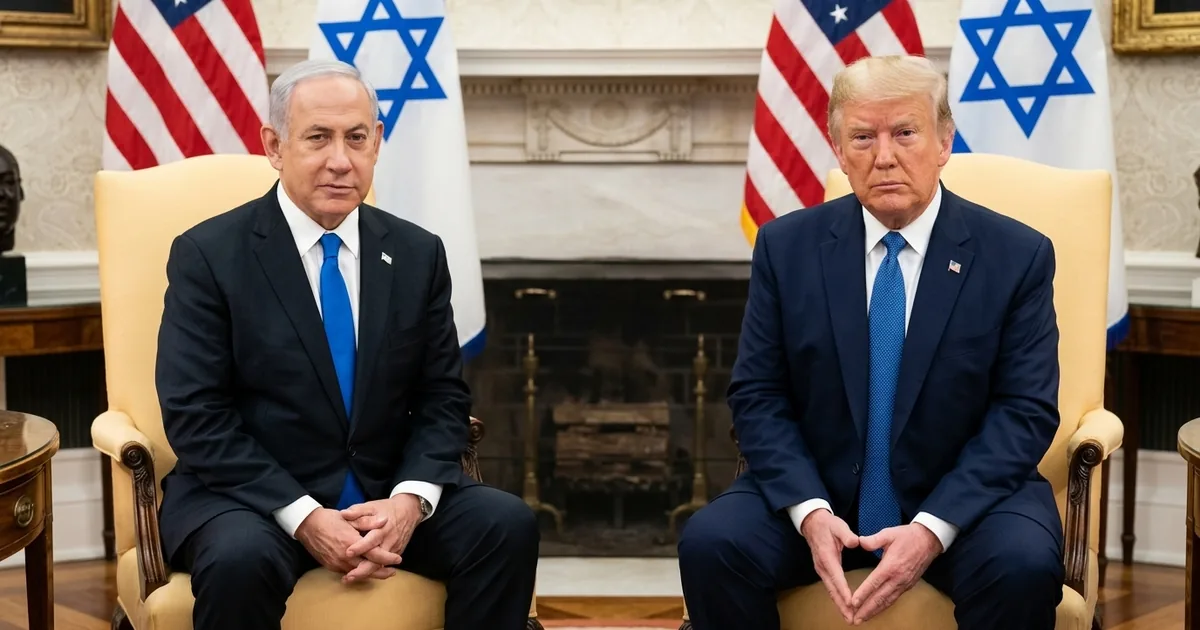
President Donald Trump hosts Israeli Prime Minister Benjamin Netanyahu at the White House on Tuesday morning, their first face to face since the war with Iran began, and the meeting lands at the precise moment both men need something out of it.
American strikes on Iran have been paused for days now, nobody involved will call it a ceasefire, and the reason has less to do with diplomacy than with the domestic arithmetic closing in on both leaders.
What Is Actually on the Table
The sit-down is set for 11 a.m. in Washington. As NPR reported ahead of the visit, this is Trump’s first in-person meeting with Netanyahu since hostilities with Iran broke out in late February, and the agenda runs wider than the war: a framework for Lebanon and a possible expansion of the Abraham Accords are both on the list.
Iran is why the room matters. The United States stopped striking and Tehran stopped as well, with neither side reporting attacks across three consecutive days. Al Jazeera described mediators led by Qatar and Pakistan working to close the gap between Washington and Tehran and revive an interim ceasefire that has already collapsed once.
Tehran will not describe any of this as negotiation. Iran’s foreign ministry spokesperson said the country currently has no talks with the United States, and that its only formal channel is with Oman, over the future of the Strait of Hormuz. Trump’s framing is the exact mirror image. He has said the halt came at Iran’s request, and warned that American strikes resume if a new agreement does not materialize.
Read those two positions next to each other and the shape of the problem appears. Both governments are describing the same pause as the other side’s concession. That is not diplomatic theater for its own sake. It means neither leader believes he can sell a compromise at home as anything other than a win extracted from a weaker opponent, which is a very difficult precondition for signing one.
The Off-Ramp Nobody Wants to Name
What actually moved Washington toward the table is not a change of heart. It is a cost curve.
The war has become expensive in the specific ways American voters notice. Defense Secretary Pete Hegseth put the price at roughly $37 billion with a $67 billion supplemental request behind it, the Pentagon has been tracking more than 100 injured service members, and pump prices crossed $4 a gallon on the back of the Hormuz disruption. Those three numbers are the real negotiators in the room. A conflict that costs money, casualties, and gasoline in an election cycle generates its own pressure toward an exit, regardless of what anyone says about resolve.
That pressure explains the peculiar substance of what is being worked out. According to CNBC’s reporting on the pause, the compromise under discussion centers on Iran allowing vessel transit through the Strait of Hormuz under fewer restrictions. Strip away the language about deterrence and regional architecture and the deal on offer is largely about shipping lanes, which is to say about the price of oil, which is to say about the price of gas. The stated stakes are strategic. The operative stakes are economic.
Netanyahu’s Clock Runs on a Different Schedule
Netanyahu arrives carrying his own set of pressures. NBC News characterized the visit as landing at a politically fraught moment for the Israeli prime minister, and the trip itself is a familiar instrument: a leader under domestic strain standing beside an American president as a demonstration of indispensability.
This is where the two men’s interests diverge in a way the photographs will hide. Trump needs the war to wind down on a timetable that reads as strength. Netanyahu needs the alliance visible and the campaign against Iran unfinished on terms he considers acceptable. Those are not the same objective, and the gap between them is exactly the space a ceasefire has to fit into.
Trump said earlier this month that Netanyahu “knows who the boss is” ahead of the visit. It is a revealing line, less about Netanyahu than about how Trump wants this meeting understood at home: not as an allied consultation but as a demonstration of leverage over an ally.
Why the Pause Is Fragile
A halt in strikes is not a settlement, and the last few weeks have already shown how quickly it comes apart. Our coverage of the strike pause and the parallel diplomatic push tracked an earlier version of this same hopeful moment. Iranian drone activity aimed at Saudi Arabia, Jordan and Iraq has continued alongside the quiet, which is a reminder that “pause” describes the American and Iranian strike tempo, not the state of the region.
There is also a structural problem that no summit fixes. An interim ceasefire negotiated through third parties, with each side publicly denying it is negotiating, has no enforcement mechanism and no domestic constituency in either capital. It survives only as long as both leaders find it more useful than the alternative. The moment the political value flips, so does the policy, and neither has committed to anything that would make reversal costly.
That is the institutional weakness worth watching more than any statement that comes out of Tuesday’s meeting. Wars that end because the accounting turned unfavorable can restart the same way.
What to Watch After the Cameras Leave
The measure of this meeting is not the language in the readout. It is whether anything happens in the following 72 hours that binds either side: a named mediator with an actual mandate, a schedule for talks that both capitals confirm, a Hormuz transit arrangement specific enough to be verified. Absent one of those, Tuesday produced a photograph and a pause that continues until it does not.
The more uncomfortable question sits underneath all of it. If the thing that finally pushed Washington toward diplomacy was the combination of a $37 billion bill, injured troops and $4 gasoline, then the ceasefire is not really a policy. It is a budget decision wearing a policy’s clothes, and budget decisions get revisited every quarter.