
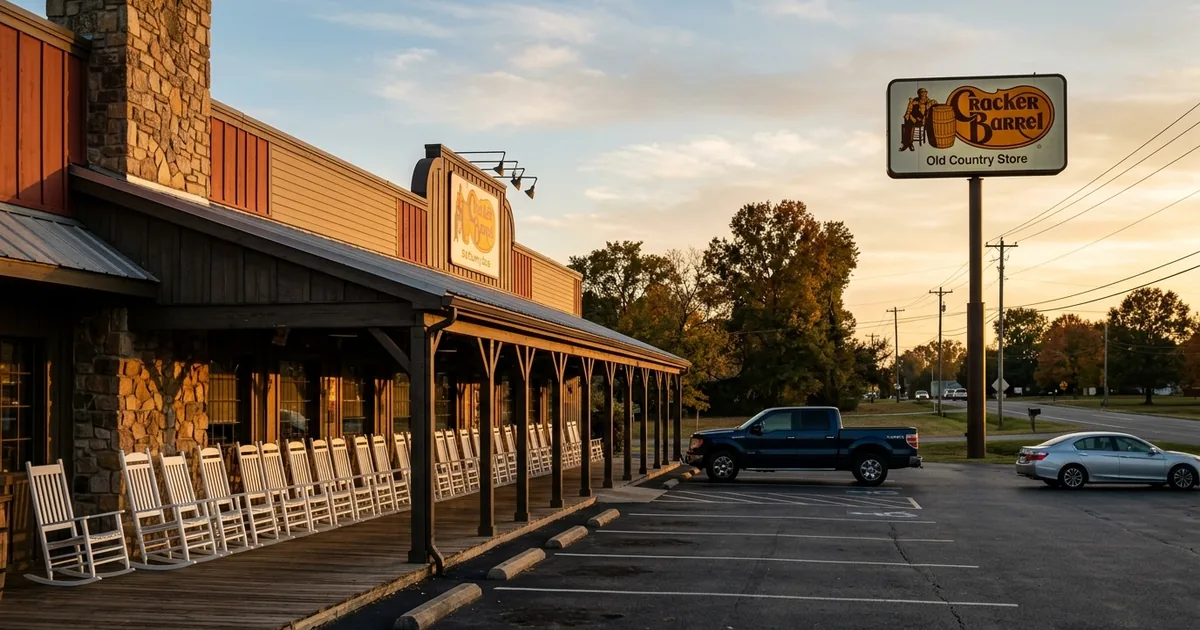
Cracker Barrel announced Monday that chief executive Julie Felss Masino is stepping down effective August 10, closing out a tenure that will be remembered almost entirely for a logo nobody outside the company asked her to change. The company did not give a reason, which is its own kind of answer, because the numbers have been giving the reason out loud for three straight quarters.
What the Company Actually Announced
Masino leaves the CEO role and the board on August 10 and stays on in an advisory capacity through October 9 to hand off. Replacing her is David Deno, most recently chief executive of Bloomin’ Brands, the parent of Outback Steakhouse, with earlier stops at Best Buy and Yum Brands. CNN reported the transition as arriving nearly a year after the rebrand that turned a 55-year-old roadside chain into a political argument.
The short version of that argument, for anyone who managed to miss it: in August 2025 Cracker Barrel unveiled a simplified logo that dropped Uncle Herschel, the old man leaning against a barrel, in favor of a cleaner wordmark meant to read better on highway signs and phone screens. Within days the redesign had been labeled “woke,” the president had weighed in, and, as CBS News documented at the time, the company reversed course and restored the original.
The Part Everyone Gets Wrong
The convenient story is that a CEO was fired over a logo. That story is wrong, and the financials say so.
A logo controversy is a two-week event. What happened to Cracker Barrel was not two weeks. Comparable sales fell 4.7% in fiscal Q1 2026 with traffic down 7%, and then it got worse: Yahoo Finance reported the chain’s steepest traffic decline since the rebrand, a 10% drop against a 7% comparable-sales decline in fiscal Q2. Guests did not stop coming because a sign changed and then changed back. They stopped coming and kept not coming.
The rebrand is better understood as the moment a pre-existing problem acquired a face. Cracker Barrel was already fighting the same squeeze pressing every mid-priced sit-down chain: menu prices raised past what the core customer thinks the food is worth, a value proposition that stopped being obvious, and a dining room whose median customer age keeps climbing. The redesign was an attempt to solve that by looking younger. It backfired because it asked the existing customer base to accept a change while giving them nothing new in return.
When a Brand Becomes a Political Constituency
Here is the structural piece worth naming, because it will happen again to somebody else.
Cracker Barrel’s identity was never only commercial. For a large slice of its customers, Uncle Herschel functioned as a cultural marker, and removing him read as a side being taken. Once a consumer brand becomes a proxy in the culture war, ordinary brand management stops being ordinary. The design review that any marketing department runs quarterly turns into a loyalty test with a national audience, and the executive who signs off on it is no longer making a business decision that can quietly fail. She is making a public one that can only fail publicly.
We have watched adjacent versions of this play out in media, where CNBC’s logo refresh and MSNBC’s rebrand to MS NOW both drew heat far out of proportion to the pixels involved. The pattern is consistent: when an audience feels ownership over an institution’s symbols, the symbols stop being the company’s to change.
Masino understood this too late and said so plainly. In a November 2025 interview she described feeling “fired by America,” adding that all she wanted was to help people love the brand the way she loved it. Forbes assembled the full timeline from redesign to reversal to exit. It is a genuinely sympathetic line and also a diagnosis of the miscalculation: she thought she was talking to customers. She was talking to a constituency.
Why the Board Waited a Year
Shareholders voted to keep Masino after the debacle. The board kept her after that. Then, roughly twelve months later, it did not.
That delay is informative. Firing a CEO in the middle of a culture-war news cycle would have handed the boycott a trophy and confirmed that outrage sets personnel policy at Cracker Barrel. Waiting until the story cooled let the board act on the traffic numbers rather than the noise, which is both better governance and better optics. The company also ran a corporate restructuring during fiscal Q1 2026 targeting $20 million to $25 million in annualized savings, and Fox Business tracked the sales and traffic slump continuing well past the point where a logo could be blamed.
Hiring Deno tells you what the board thinks the actual problem is. He is not a brand visionary. He ran Bloomin’ Brands and did finance and operations at Yum and Best Buy. That is a turnaround operator’s résumé, hired to fix pricing, throughput and unit economics, and the choice is a quiet admission that Cracker Barrel’s trouble is on the plate and the check, not on the sign.
What Deno Inherits
The new CEO takes over a chain that has spent a year apologizing and still cannot get people through the door. The apology worked in the sense that the logo came back. It did not work in the sense that mattered.
The interesting question is whether Deno can make any visible change at all now. The lesson every executive just absorbed is that touching a legacy brand’s iconography is a career risk with no offsetting upside, which is exactly the wrong lesson for a business that needs to reach customers who are not already in the parking lot. A company too frightened to change is not a stable company. It is a declining one with better public relations.
Uncle Herschel is back on the sign. Whether anyone under 50 is coming inside to see him is the question Deno gets paid to answer.