
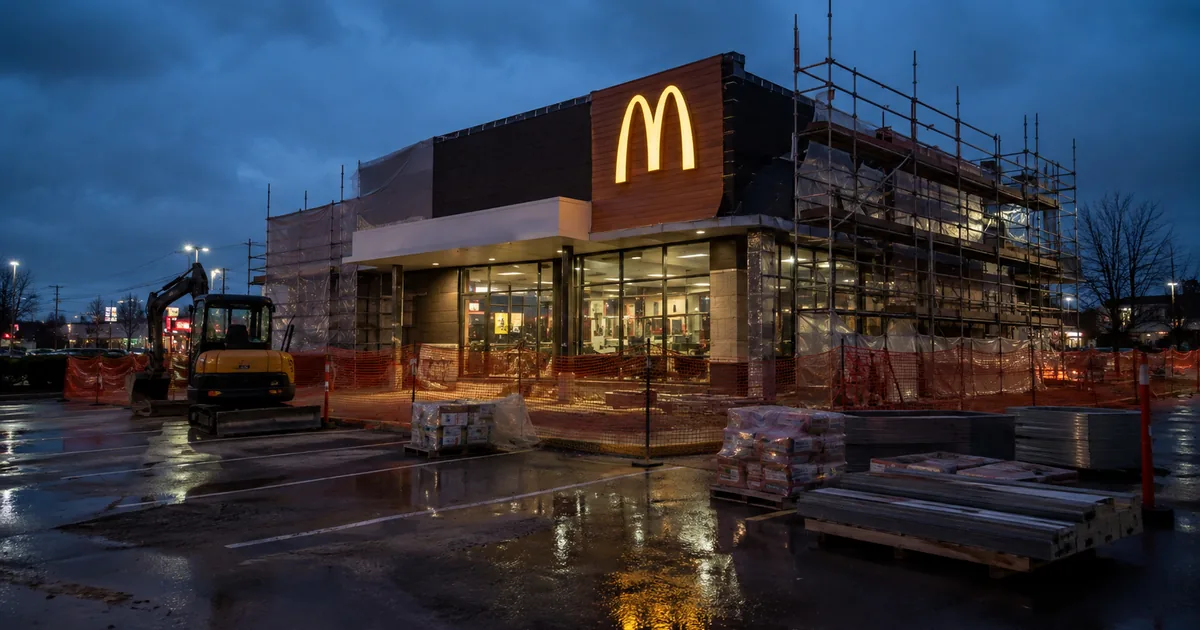
McDonald’s held an investor day on Tuesday, announced a decade-long plan to rebuild its restaurants around new technology and a protein-heavy menu, and watched its stock fall about five percent to a four-year low. The headline that ran on wire copy across the country was that McDonald’s is betting $8.5 billion. McDonald’s is not betting $8.5 billion. It is asking its franchisees to bet roughly twice that in the United States alone, and offering $8.5 billion of cushioning spread across 46,000 restaurants in every country it operates, over ten years.
That distinction took about four minutes of arithmetic and it is the entire story.
The company wants each operator to spend around $800,000 per location on the upgrades it calls Next. That sits on top of the $400,000 to $450,000 a standard remodel costs, and the ten-year remodel cycle happens to be arriving in 2027 and 2028. Call it $1.2 million a restaurant. Multiply by the US footprint and you get something close to a $16 billion ask domestically, against $8.5 billion of global support, of which $5 billion lands before 2030.
| Per US restaurant | Amount |
|---|---|
| “Next” modernization upgrades | $800,000 |
| Standard remodel, cycle due 2027-2028 | $400,000 to $450,000 |
| Total asked of the operator | about $1.2 million |
| Promised extra cash flow, per year | $100,000 |
| Average annual franchisee cash flow today | about $500,000 |
Read the last two rows next to each other. The company projects its technology will lift efficiency by 250 basis points, which it converts into about $100,000 of additional cash flow per store per year. Set $100,000 a year against $1.2 million of outlay and the raw payback is twelve years. McDonald’s says the payback is approximately four years “after partnering,” and partnering is doing a great deal of work in that sentence. It means the rent relief and capital support are what close the gap between twelve and four, which makes the $8.5 billion less a bet than a discount coupon on a bill the company is issuing.
The Part Where You Ask Who Has $1.2 Million
Here is the number that should have led every story. In McDonald’s own franchisee survey this year, nearly eight in ten operators said their cash flow was not sufficient to support their required reinvestment obligations. Ninety-five percent reported profitability down year over year. Ninety-seven percent said the company’s plan was not working. Chief executive Chris Kempczinski has acknowledged operator cash flow is down about ten percent from its post-pandemic highs, and average annual US franchisee cash flow sits around $500,000.
So the ask is roughly two and a half years of an average operator’s entire cash flow, delivered to a group that told the company in writing that it cannot fund the obligations it already carries. Investors, who are not sentimental people, worked this out on Tuesday afternoon and sold. One analyst cut his price target from $345 to $310, citing doubts about franchisee buy-in. The stock is now on its seventh consecutive weekly loss.
The systems question is more interesting than the stock question. A franchise model works because the operator has skin in the game and local judgment. Push capital demands past what the operator can generate and you do not get better restaurants, you get consolidation: the small operators sell to the big ones, and the big ones behave like regional corporates with none of the local judgment the model was built to buy. McDonald’s is not describing that outcome in its investor materials, but it is the predictable second-order effect of asking people for money they have already said they do not have.
Our view: the plan may well be correct on the merits. Kitchens do need work, and the strategy itself is coherent. What is not defensible is the framing. Announcing a $16 billion capital call as an $8.5 billion investment, and letting that number run uncorrected through a day of national coverage, is a communications choice, and the people it obscures the bill from are the ones who have to pay it. Franchisees will find the money somewhere. There are only so many places it can come from, and one of them is the menu board.