
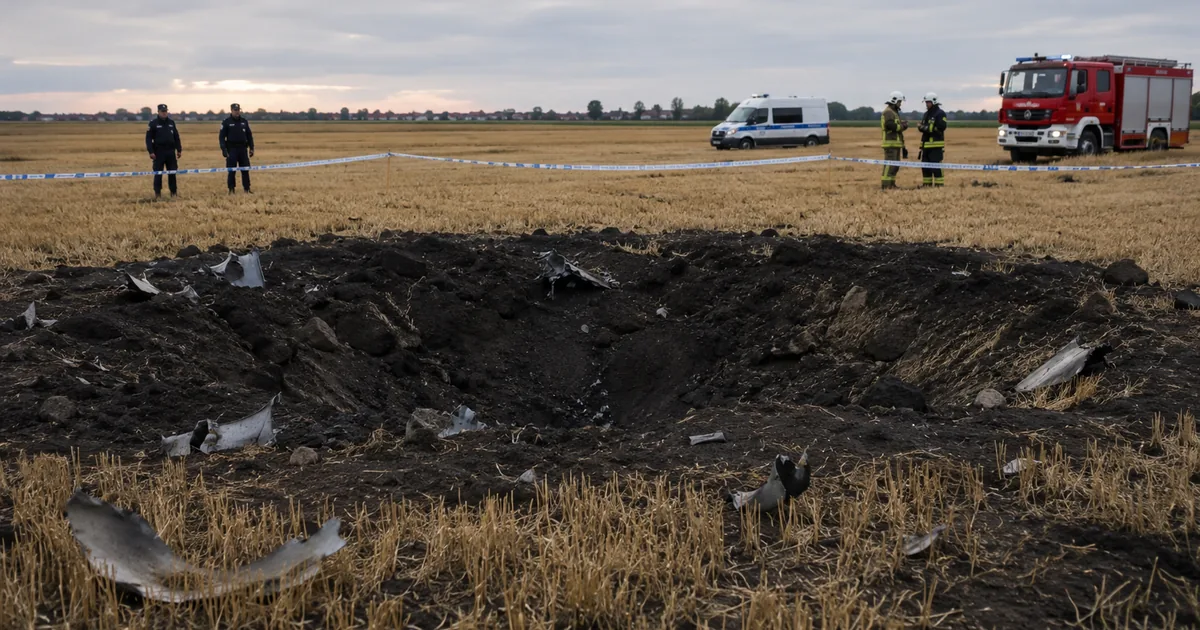
A Russian cruise missile crossed roughly 100 kilometers into Polish territory early Thursday and detonated in a field in Lublin province, leaving a crater about 10 meters wide and five meters deep.
Prime Minister Donald Tusk named the weapon type and pointed at Moscow within hours, and then Warsaw declined to reach for the alliance mechanism it triggered last September over something far smaller.
Thirteen Minutes of Alarm and a Field Near Tarnawa-Kolonia
Polish air defense tracked the object at 3:40 a.m. and lost its radar signature six minutes later. The alarm ran for about 13 minutes. F-16s were already airborne, scrambled around 2 a.m. as Russian long-range bombers began working over western Ukraine, and an Mi-24 helicopter crew later found the impact point. Reconnaissance aircraft went up as well, supported by allied aerial refueling aircraft operating out of Germany.
The wreckage came down between the villages of Tarnawa-Kolonia and Tokary, with debris scattered across roughly 200 meters of open field and the nearest buildings some two kilometers away, according to reporting by Notes From Poland. Grzegorz Trusiewicz, the Lublin prosecutor handling the case, put the crater at around five meters deep. Nobody in Poland was hurt.
Tusk was blunt about the part that is settled and careful about the part that is not. All indications point to a Russian Kh-101 cruise missile, he said, while adding that Poland “will want to be 100% certain: what kind of missile, who launched it.” He also noted there had been no immediate danger, because the missile fell on undeveloped land. Ukrainska Pravda reported that the Polish government’s working assessment is Russian.
Note what that sentence structure protects. The attribution is offered as near certainty and the confirmation is deferred, which keeps Warsaw’s options open in both directions for as long as the forensics take.
The Night’s Actual Body Count Was in Ukraine
The missile that landed in Poland was a stray round from one of the largest combined barrages of the war. The Kyiv Independent counted 74 cruise, ballistic and hypersonic missiles alongside 284 Shahed-type drones, with strikes registered on Kyiv, Lviv and Kryvyi Rih. At least eight people were killed and more than 50 injured. Three of the dead were children, killed with their parents in a single home. The Polish impact site sits about 150 kilometers northwest of Lviv, which is to say the missile did not travel far off its axis to end up inside a different security guarantee.
Ukraine’s acting foreign minister, Andrii Sybiha, used the Polish crater to argue about supply rather than about alliance obligations, calling it “yet another convincing evidence that strengthening Ukraine’s air defense is now an urgent necessity.” That framing is self-interested and also correct on the mechanics. Every missile Ukraine cannot intercept is a missile with some probability of continuing west.
The 2022 Crater That Taught Warsaw What Ambiguity Is Worth
Poland has been here before, and the memory is a large part of why today looks the way it does.
On November 15, 2022, an explosion at a grain facility in Przewodow killed two Polish civilians, the first deaths on NATO soil attributable to the war. The early assumption was Russian. Polish prosecutors eventually concluded that the projectile was a Ukrainian S-300 air defense missile that had gone off course while trying to intercept a Russian strike, and the case was later suspended over what Polish officials characterized as a lack of cooperation from Kyiv.
That outcome usually gets filed as an embarrassment for everyone who moved too fast. It functioned as a release valve. A lethal incident inside NATO territory, with an owner nobody wanted to name, resolved into an accident caused by the victim’s own ally, and the alliance never had to decide anything at all. Ambiguity did the diplomatic work that no member state wanted to do out loud.
Certainty Raises the Price of Pulling the Lever
Compare the response function across incidents, because the pattern runs backwards from what you would expect.
In September 2025, when roughly 20 Russian drones crossed into Polish airspace, Poland invoked Article 4 and pulled its allies into formal consultations, an escalation we covered at the time as Russian drone incursions putting Poland on edge. Drones are cheap, deniable and individually trivial. Thursday’s incident involved a single cruise missile that flew about 100 kilometers into a NATO member state and left a five-meter hole in the ground, which by any military measure is the more serious breach. The formal response has so far been quieter. Tusk convened a coordination group, spoke with European leaders who offered solidarity and readiness to help, and waited on the lab work.
That inversion is not timidity, and it is not a contradiction. It is what the incentive structure produces. Article 4 consultations are cheap when the facts are murky, because “we need to talk about this” commits nobody to anything in particular. They get expensive the moment attribution is clean, because a confirmed Russian missile detonating inside allied territory converts consultation into a question about what the alliance will actually do, and our read is that no capital around that table wants that question asked while the honest answer is still uncomfortable.
Naming the missile quickly and calling the meeting slowly is therefore not incoherence. It banks the credibility of having been honest about attribution while holding open the option to do very little about it.
The Admission Inside the Defense Minister’s Statement
The most consequential quote of the morning was the least dramatic one. Defense Minister Wladyslaw Kosiniak-Kamysz called it an extremely difficult night for Poland’s air defense, surveillance and threat detection systems.
Strip the diplomacy out of that. Poland saw the missile, tracked it for six minutes, had fighters already in the air, was reportedly prepared to shoot it down, and it still detonated in a Polish field. Detection worked. Interception did not happen. The distance between those two facts is the real security story, and it is the only part of this that does not depend on whose missile it turns out to be. An alliance that can reliably see what is coming and cannot reliably stop it has a capability problem that no consultation format repairs.
The CNN account of the barrage lays out the asymmetry plainly enough: Russia can saturate a defended airspace with volume, and volume is what produces strays.
What Happens When the Forensics Come Back
The lab work will most likely confirm what Tusk already said out loud. At that point Warsaw holds something it has not held before: a verified case of a Russian weapon detonating on allied soil, with no dead civilians to force a response and no attribution fog to shelter in.
That is an awkward position for an alliance built on the premise that an attack on one is an attack on all. Clean facts, no casualties, and a completely free choice about whether to call it an attack in the first place. What Poland decides to do with that choice over the coming days will tell Moscow more about the working boundaries of Article 5 than any communique issued this year.