
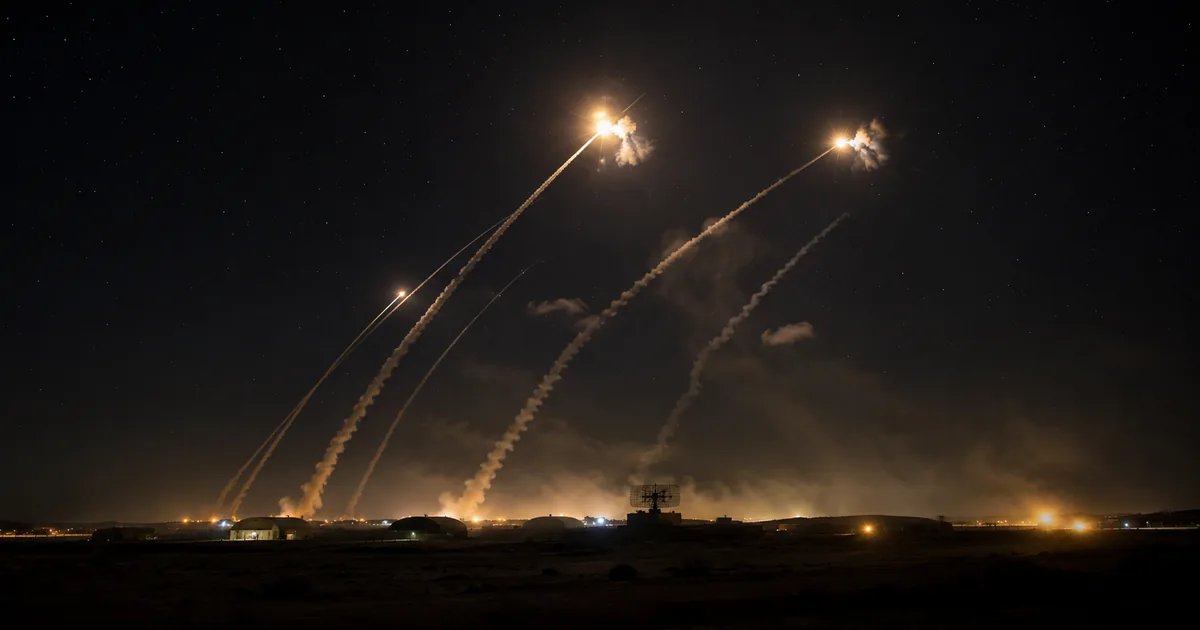
United States forces began striking Iranian targets on Wednesday night, roughly a day after Iran’s Islamic Revolutionary Guard Corps launched ballistic missiles at American troops in what Central Command called an attempted surprise attack. Every missile was intercepted and nobody was hurt, which is what makes the sequence more important than the damage: for the first time in this war, Iran did not wait to be hit.
Central Command described the operation as a powerful response to Tuesday’s attempted Iranian attacks on American forces based in the Middle East, and CNBC reported that the first munitions flew at 8 p.m. stateside. Trump had telegraphed it hours earlier. “We’ll be hitting them hard,” he told a Fox News reporter Wednesday morning. “They’re going to get a beating.”
Joint American and Saudi strikes also hit Iran-allied militias in Iraq that had been going after oil facilities in Riyadh and Saudi Arabia’s Eastern Province. Al Jazeera reported that Iraq’s Popular Mobilisation Forces put its own losses at a minimum of 20 killed and 32 wounded.
Iran Went First, and That Is the Part Worth Slowing Down On
Through most of this conflict the choreography ran in one direction. Washington struck, Tehran answered, and the interval between the two was the only variable anyone bothered to forecast. Iran’s role in that pattern was reactive by design, because reacting is cheaper politically and it lets you cast every launch as self-defense.
Late Tuesday broke it. Revolutionary Guard forces fired ballistic missiles from Iranian territory at American positions in the Gulf region with no American strike to answer for. Jordan’s air defenses intercepted five of them, according to that country’s armed forces, and the Guard’s air force said it had gone after Muwaffaq Salti Air Base and a Central Command facility in Jordan. Nothing was damaged. Nobody was hurt. Jordan’s military said afterward that it would not tolerate any threat to the security of the country.
A first strike that hits nothing still tells you something a retaliatory strike cannot. Tehran spent scarce munitions, under a naval blockade, to establish that it is willing to open a round rather than close one. That is a decision about leverage, not about the target.
A Pause Nobody Signed
The thing that died Tuesday night was never a ceasefire, and calling it one has made the last week much harder to read.
After 13 days of escalating American airstrikes, the Pentagon abruptly suspended the campaign late on a Friday. Iran then said it would hold its own fire for exactly as long as Washington held its. Al Jazeera laid out what the halt actually was at the time: two unilateral announcements, running in parallel, resting on nothing.
There was no text. No signatures, no verification regime, no monitors, no agreed definition of what would count as a violation, and no third party with standing to say who broke it. Compare that to the memorandum of understanding the two governments actually signed in mid-June, which had numbered articles, including one on safe passage for commercial shipping through the Strait of Hormuz. Trump declared that document over at the NATO summit in Ankara, reimposed a naval blockade on Iranian ports, and revoked a sanctions waiver on Iranian oil exports. A signed agreement with provisions lasted about five weeks. The unwritten follow-on lasted days.
Arrangements like that create an incentive to defect, and specifically to defect first. With no mechanism to establish who violated the terms, the party that moves first gets to frame whatever comes back as the escalation rather than the opening. Iran moved first. Central Command’s phrase for it was “attempted surprise attack,” and every American strike since has been characterized as a response. That framing is now locked in, and it was sitting there for whichever side reached for it.
The timing sharpened the point. The missiles flew the same day Trump hosted Israeli Prime Minister Benjamin Netanyahu in the Oval Office for talks centered on Iran, a meeting we covered while the pause was still nominally holding. Whatever Tehran concluded that meeting was for, it did not conclude that the lull was worth protecting.
Muwaffaq Salti Was Not a Random Choice
That base has a recent history. Three American service members were killed there in an Iranian attack earlier this month, which we wrote about at the time, and a fourth died in Iraq during a controlled detonation of an unexploded Iranian drone.
Going back to the same target with the same weapon and getting nothing is a statement about capability as much as intent. It also frames the question American planners have to answer next, which is whether an interception rate like that holds as launch volumes climb. Five missiles is a probe, and it was answered by Jordanian air defense rather than by anything the Pentagon controls. Defense that works every time is indistinguishable from defense that works until it doesn’t.
Congress Already Voted on This, Twice
Six days before any of it, both chambers weighed in. The House approved a nonbinding resolution from Representative Pramila Jayapal calling on Trump to end the war, 214 to 208, with no voting Democrat opposed and four Republicans crossing over. The Senate came within two votes of discharging a binding joint resolution from Senator Chris Van Hollen that would have halted American involvement, falling 49 to 47. As Stars and Stripes reported, a majority of voting members across both chambers said the same thing in two votes that produced opposite outcomes, because the procedural bar in each chamber was different. It was the second time the House had passed such a measure.
The pause arrived days later and looked, to a lot of people, like a response to that pressure. Then Iran fired, and the reversal cost the administration nothing. A president who restarts a war he had just paused normally owns the reversal. This one gets to point at a missile launch instead, and the congressional vote that preceded it has been overtaken by an event it had no power to prevent.
That is the durable problem underneath this week. The War Powers Resolution hands Congress a clock and a vote, and the clock resets every time the shooting does. Van Hollen’s resolution had to clear a committee discharge to matter. Resuming the war had to clear nothing.
What Comes Next
The Revolutionary Guard’s statement was not written to leave room. As long as threats against Iran continue and what it called illegal and vicious actions by American forces against its interests continue, it said, the resistance will continue. That is a commitment to open-ended reciprocity with no exit condition attached to it.
The cost is already being priced. Trump’s warning alone moved the market before a single munition landed: Brent crude futures closed 7.9% higher Wednesday at $90.74 a barrel and West Texas Intermediate settled up 6.6% at $84.46. Americans have been absorbing that arithmetic at the pump for weeks, where gas crossed four dollars a gallon as the war ground on.
The next pause, whenever it comes, will almost certainly be announced the way this one was: two statements, no document, and both governments free to read it however serves them that week. The question worth asking now is whether anyone in either capital still wants the kind of agreement that would be inconvenient to break.