
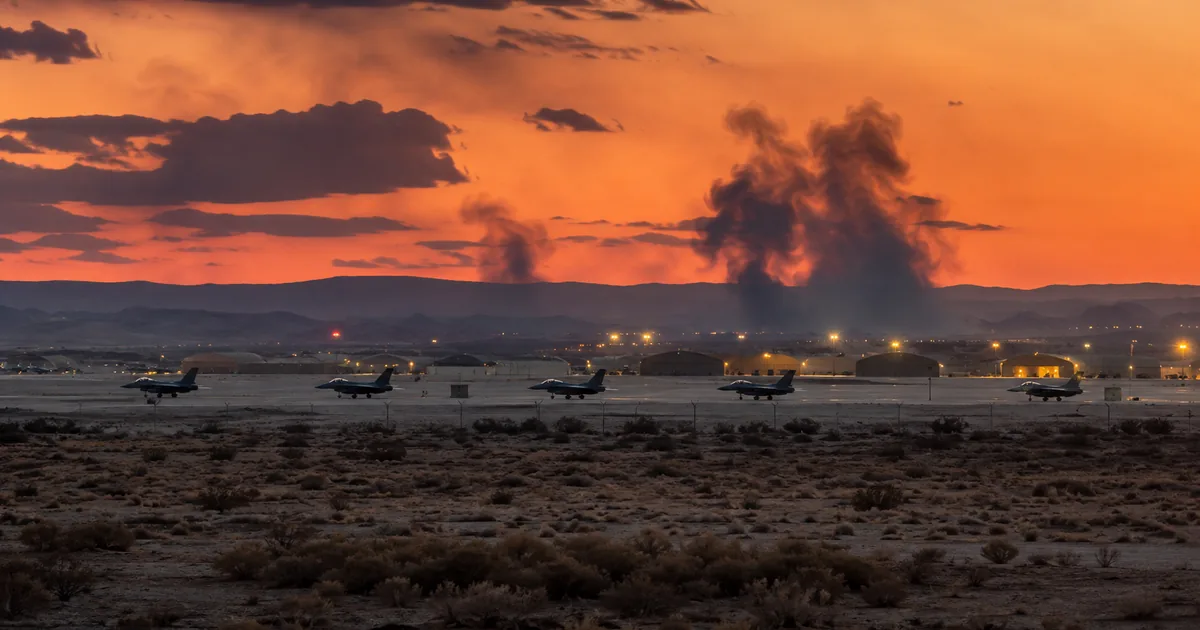
Two American service members were killed in action in Jordan on Friday and a third remains missing after Iranian ballistic missiles and drones struck Muwaffaq Salti Air Base, a critical installation that hosts US fighter jets and serves as a forward staging point for regional operations.
The attack marks the first American combat deaths from direct Iranian fire since March and pushes the total US military death toll in the conflict to 16.
What Happened at Muwaffaq Salti
US Central Command confirmed on Saturday that at least two Iranian ballistic missiles hit the Jordanian base during a combined assault that also included drone attacks. Four additional service members were medically evacuated to Jordanian hospitals but have since been discharged, CENTCOM said in a statement reported by NBC News. Others were evaluated for minor injuries and returned to duty.
“On July 17, two U.S. service members in Jordan were killed in action as U.S. Central Command and partner forces defended against Iranian ballistic missile and drone attacks,” the military statement read. The names of the fallen are being withheld until 24 hours after their families have been notified, per standard military protocol.
The missing service member’s status adds an agonizing layer. Search and recovery operations are ongoing, but CENTCOM has not disclosed whether the individual was lost during the initial strike or in subsequent operations. The command said it would provide updates “as appropriate,” language that suggests the search could take days in a volatile operational environment.
Why Jordan, and Why Now
Muwaffaq Salti is not some remote outpost. It is the primary US air operations hub in Jordan, positioned to provide strike and surveillance capability across Iraq, Syria, and the broader theater. Hitting it was a deliberate escalation from Tehran, a signal that Iran is willing to target American military infrastructure directly rather than relying solely on proxy forces across the region.
The timing matters. This attack followed weeks of intensifying exchanges. Earlier this month, Iran launched strikes against more than 300 targets across Gulf nations near the Strait of Hormuz, a dramatic widening of the conflict’s geographic footprint. The Jordan strike extends that pattern to a facility housing US combat aircraft, raising the operational stakes for both sides.
The structural driver here is Tehran’s calculus that direct confrontation is now less costly than restraint. After the killing of a senior IRGC commander earlier this year, Supreme Leader Khamenei publicly committed to teaching the US “unforgettable lessons.” The Jordan attack is the latest installment in that promise, delivered with precision-guided munitions rather than the militia rockets that characterized the earlier phase of this conflict.
The Diplomatic Fallout Is Already Moving
Iran’s Deputy Foreign Minister Kazem Gharibabadi told state television on Saturday that Iran is suspending its commitments under the memorandum of understanding with the United States, accusing Washington of violating its own obligations, Bloomberg reported. That MoU, negotiated earlier this year as a narrow framework to prevent miscalculation, was already fragile. Its suspension removes the one thin channel that both sides had maintained for de-escalation.
The White House has not yet issued a formal response to the Jordan attack. But the political pressure is immediate and bipartisan. When three American troops were killed in a similar strike in March, NPR reported that President Trump said more casualties were “likely” and ordered expanded retaliatory strikes. That cycle of escalation has not produced deterrence. Sixteen dead Americans later, the evidence suggests it has produced the opposite.
What Comes Next
The missing service member is the most immediate unknown. Recovery operations in an active threat environment carry their own risks, and the outcome will shape the next 48 hours of political and military decision-making in Washington.
Beyond the individual tragedy, the Jordan attack exposes a structural problem in US Middle East force posture. Muwaffaq Salti was supposed to be deep enough behind the front lines to be secure. The fact that Iranian missiles reached it, and killed Americans inside it, means the threat envelope has expanded past what the current defensive architecture was designed to handle. The question facing the Pentagon is no longer whether to reinforce Jordan but whether any forward base in the region can be credibly defended against Iran’s growing ballistic missile capability without a fundamental shift in air defense investment. The current Patriot and THAAD deployments were designed around proxy-grade threats, not a state military willing to fire medium-range ballistic missiles at a base inside an allied nation.
Sixteen families have now received the worst possible news since this conflict began. The missing service member’s family is still waiting. Whether their grief translates into a policy reassessment or another round of tit-for-tat strikes will define the next phase of a war that keeps widening despite every assurance that it would not.