
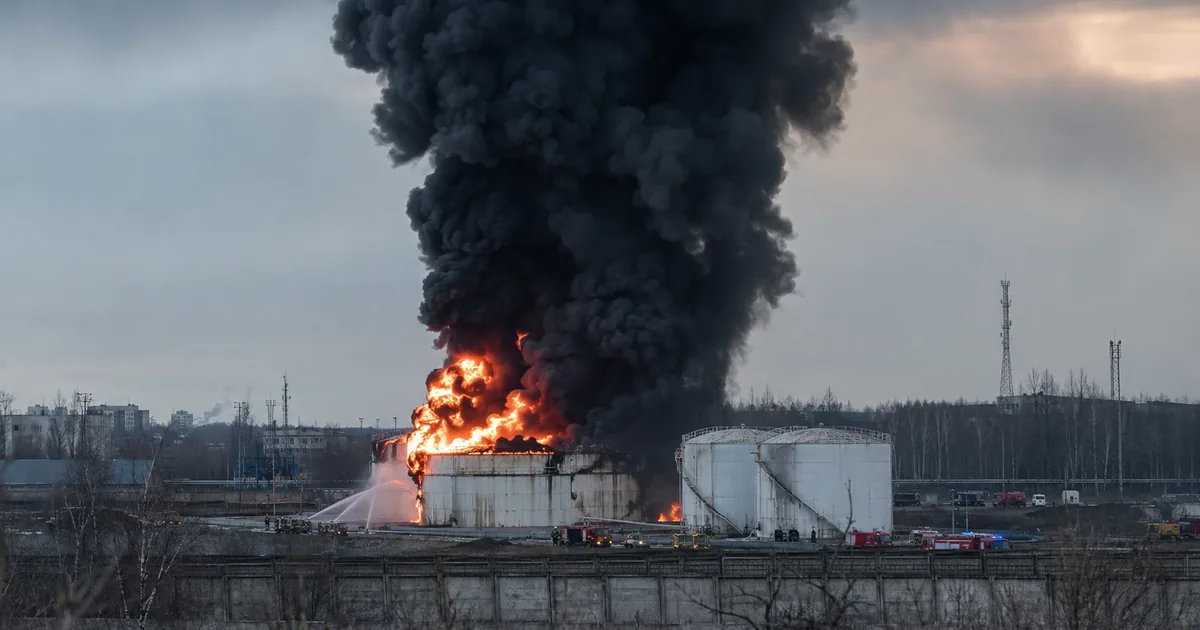
Eight people were killed and more than 60 wounded across western Russia early Saturday after Ukrainian long-range drones struck an oil depot outside Moscow and two warehouse complexes hundreds of kilometers from the front.
The targets tell you more than the casualty count does: Kyiv is no longer aiming at the Russian capital for the symbolism of it, it is methodically dismantling the supply chain that keeps Russian drones flying.
What Actually Got Hit
The most visible strike landed at an oil depot in Noginsk, northeast of Moscow, where fire forced the evacuation of a nearby maternity hospital and a residential building, Moscow region governor Andrei Vorobyov said. The site holds 24 storage tanks with a combined capacity of 11,500 cubic meters of gasoline, kerosene and diesel, and the smoke column was visible from inside Moscow’s city limits. NPR reported Saturday that eight people died and more than 60 were wounded across the affected regions, with most of the deaths concentrated among warehouse workers.
Those warehouses belonged to Wildberries, Russia’s dominant online retailer. One sits in Kotovsk in the Tambov region, roughly 220 miles from the Ukrainian border. The other is in Elektrostal, in the Moscow region. Both burned. The Kyiv Independent documented the oil depot fire and the logistics-center strikes as part of a single coordinated overnight wave that sent hundreds of drones toward the capital region.
Volodymyr Zelensky claimed the logistics hits directly. Writing on Telegram Saturday, the Ukrainian president said long-range strikes had destroyed two significant logistical facilities in the Moscow and Tambov regions, and he named the reason: those sites were used to move sanctioned components into Russian drone and navigation-equipment production.
That sentence is the whole story. It is also an admission, from Kyiv, about something Western governments would rather not discuss out loud.
The Sanctions Regime Leaks, So Ukraine Is Plugging It With Explosives
Russia is not manufacturing the guidance chips, the flight controllers, or the navigation modules inside its Shahed-derivative drones from scratch. It buys them, through intermediaries, in violation of export controls that on paper should have starved the program years ago. The components arrive through commercial logistics networks. Warehouses. Distribution centers. The same infrastructure that moves consumer goods for an online retailer.
Ukraine has evidently concluded that it cannot wait for customs enforcement in third countries to catch up. So it is doing sanctions enforcement kinetically. When Zelensky says a warehouse was handling sanctioned components, he is describing a target set that Western policy created by failing to close, and that Ukrainian drones are now closing at the cost of civilian warehouse workers who almost certainly had no idea what was in the pallets.
That is an uncomfortable thing to write, and it should be. Seven of the eight dead were warehouse staff. The legal question of whether a logistics node handling embargoed military components counts as a lawful military objective is genuinely contested, and the fact that Moscow has spent four years flattening Ukrainian apartment blocks does not settle it. Both things are true at once.
The Energy Campaign Is the Real Pressure Point
The Noginsk depot fits a much larger pattern, and it is the pattern that actually threatens the Kremlin’s ability to keep fighting. Ukrainian long-range drones have struck Russian oil refineries close to 200 times in the first half of 2026, roughly eleven times the rate over the same stretch of 2025. May alone produced 16 successful refinery hits.
The results have shown up where Russians live rather than where they fight. Fortune documented fuel shortages reaching Siberia, thousands of miles from any front line, with regional authorities imposing rationing and gas station queues becoming routine. Deputy Prime Minister Alexander Novak has publicly acknowledged Moscow is reviewing fuel export agreements to protect domestic supply, which is bureaucratic phrasing for a country that can no longer comfortably sell abroad what it needs at home.
Refined product exports are one of the few revenue streams sanctions never fully closed. A Foreign Policy assessment of the campaign’s economic toll reaches the same conclusion Ukrainian planners did: hitting refining capacity damages the war budget in a way that hitting the Kremlin’s front lawn never would. Crude in the ground earns nothing. Refining is where the money is made, and refining units are large, hot, hard to hide, and expensive to replace under sanctions that block the Western catalytic-cracking equipment they need.
Why Moscow’s Air Defense Keeps Losing This Math
Russian air defense around Moscow is dense and, by most accounts, technically capable. It also cannot win an economics contest. A long-range Ukrainian strike drone costs a fraction of the interceptor fired at it, and Ukraine can generate hundreds per night. Saturday’s wave followed a July 7 raid in which more than 430 drones targeted the Moscow region, and a July 13 sequence that Moscow Mayor Sergei Sobyanin put at 350 tracked aircraft.
The defensive burden is compounding. Every drone that gets through forces a wider protective umbrella, and every widening pulls systems away from the front and away from the refineries themselves. Moscow’s four commercial airports have repeatedly gone dark during these waves, halting hundreds of flights, which is its own quiet form of economic attrition against a capital whose residents have spent most of this war insulated from it.
Zelensky has been explicit that scale is the point. He told the Financial Times that when the number flying toward Moscow stops being one hundred and becomes one thousand, Putin will understand. Whether that theory of coercion works is unproven. Russia’s leadership has absorbed a great deal without blinking, and reporting on the refinery campaign has repeatedly cautioned against reading fuel lines as a sign the Kremlin is close to folding.
What This Escalation Actually Buys
The symmetry with Russia’s own campaign is impossible to miss, and Ukrainians have been living the receiving end of it for four years, including the July strike on Kyiv that killed 13 people in a single night of missiles and drones. Kyiv’s leadership has calculated that a war fought entirely on Ukrainian territory is a war Ukraine loses slowly, and that the only lever it fully controls is making the cost visible inside Russia.
The strategic logic is sound. The moral ledger is messier, and pretending otherwise does nobody any favors. What is worth watching over the next several weeks is not the nightly drone counts, which have become background noise, but whether Russian domestic fuel rationing spreads from peripheral regions into the industrial core, and whether the Kremlin’s answer is negotiation or a further escalation against Ukrainian civilian infrastructure heading into winter.
Neither side is close to running out of drones. Only one of them is running out of refining capacity.