
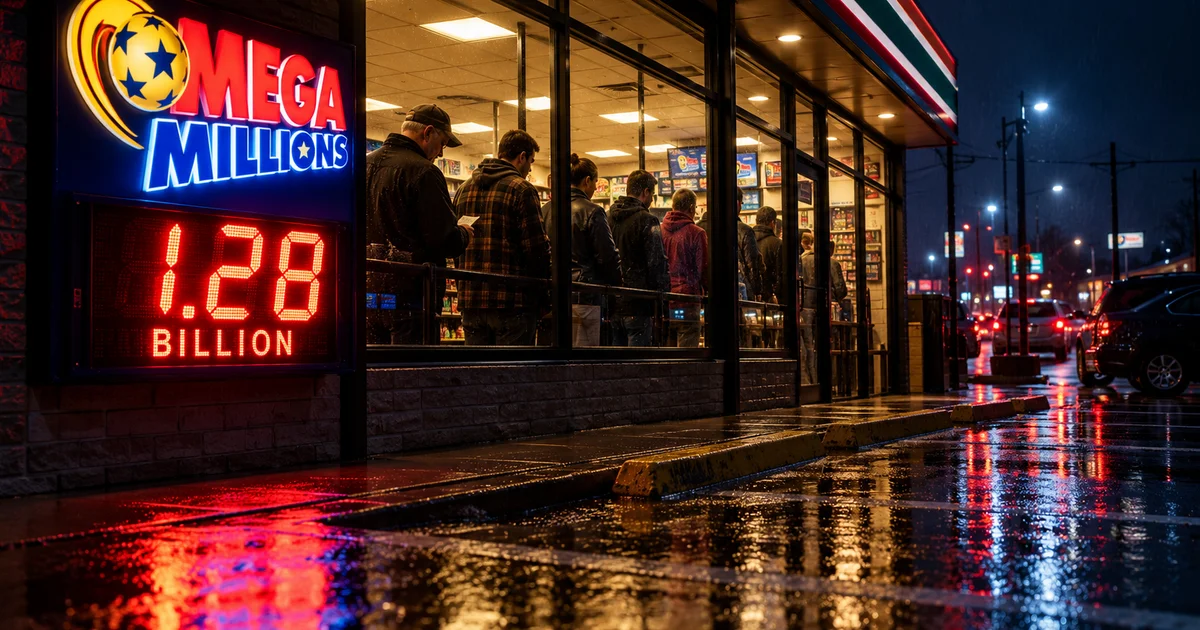
The Mega Millions jackpot sat at a staggering $672 million heading into Friday night’s drawing, and after the balls dropped, not a single ticket matched all six numbers.
The winning combination was 22, 34, 45, 48, 55, with a Mega Ball of 14, and while plenty of players picked up smaller prizes, the grand prize will now roll forward to an even larger sum for the next drawing on Tuesday, July 22.
The Tenth-Largest Jackpot in Mega Millions History
Friday’s $672 million prize was already making history before anyone even scratched a ticket. It ranked as the tenth-largest jackpot in Mega Millions history and the single largest lottery prize of 2026 so far. The cash option, for anyone who wanted the money now instead of spread across 30 annual installments, stood at $293.3 million. Even after taxes, that is a life-altering pile of money.
The jackpot has been building since no one hit the top prize on Tuesday, July 15, when the numbers 2, 4, 10, 48, 56, and Mega Ball 22 similarly failed to produce a winner. That drawing had offered $637 million. Before that, the prize had been climbing steadily for weeks.
Why These Jackpots Keep Getting Bigger
There is a structural reason lottery jackpots now routinely hit nine figures, and it has nothing to do with luck getting worse. In 2017, Mega Millions changed its number pool, increasing the range of possible Mega Ball numbers from 15 to 25. That single tweak pushed the odds of winning the jackpot from 1 in 259 million to 1 in 302.6 million (the current odds sit at 1 in 290.4 million after a subsequent adjustment). Longer odds mean more drawings without a winner, which means bigger rollovers, which means more ticket sales driven by the spectacle of a massive number on the marquee.
It is, in other words, working exactly as designed. The lottery is a business, and bigger jackpots sell more tickets. The all-time Mega Millions record remains the $1.602 billion prize won by a single ticket in Florida back in August 2023, a number so large it almost stops registering as real money.
The Math That Nobody Wants to Hear
Your odds of winning Mega Millions are, to put it gently, not great. At 1 in 290.4 million, you are statistically more likely to be struck by lightning twice, become a movie star, or be attacked by a shark than to match all six numbers. A breakdown of Friday’s results showed that while thousands of tickets won smaller prizes ranging from $2 to $1 million, the jackpot itself remained firmly out of reach.
But lottery economics have never been about rational expected value. They are about the permission to dream for a few days. Two dollars buys you 72 hours of imagining a different life, and by that measure, it is cheaper than almost any other form of entertainment. The problem, as behavioral economists have pointed out for decades, is that the people who can least afford to spend on lottery tickets are often the ones who spend the most.
What Happens Tuesday
The next Mega Millions drawing is scheduled for Tuesday, July 22, and the jackpot will be significantly larger than $672 million. Exact estimates typically get announced a day or two before the drawing, but the trajectory is clear: without a winner, the prize will continue its march toward the three-quarter-billion mark.
The last time a Mega Millions jackpot climbed past $700 million was October 2024, when a $740 million prize was eventually claimed. If Tuesday’s drawing also produces no winner, this jackpot could start generating the kind of national frenzy that sends people who never play the lottery to their nearest gas station. That is the whole point, of course, and the lottery knows it. It is the same kind of mass spectacle energy that drove millions of viewers to the World Cup final earlier this month, except instead of watching athletes compete, you are watching ping-pong balls determine your financial future.
If you do play, the standard advice about financial windfalls applies: tell no one, hire a lawyer before cashing the ticket, and do not quit your job on day one. But honestly, at 1 in 290.4 million, the more practical advice is simpler: enjoy the daydream, hold the ticket loosely, and keep your day job firmly intact.