
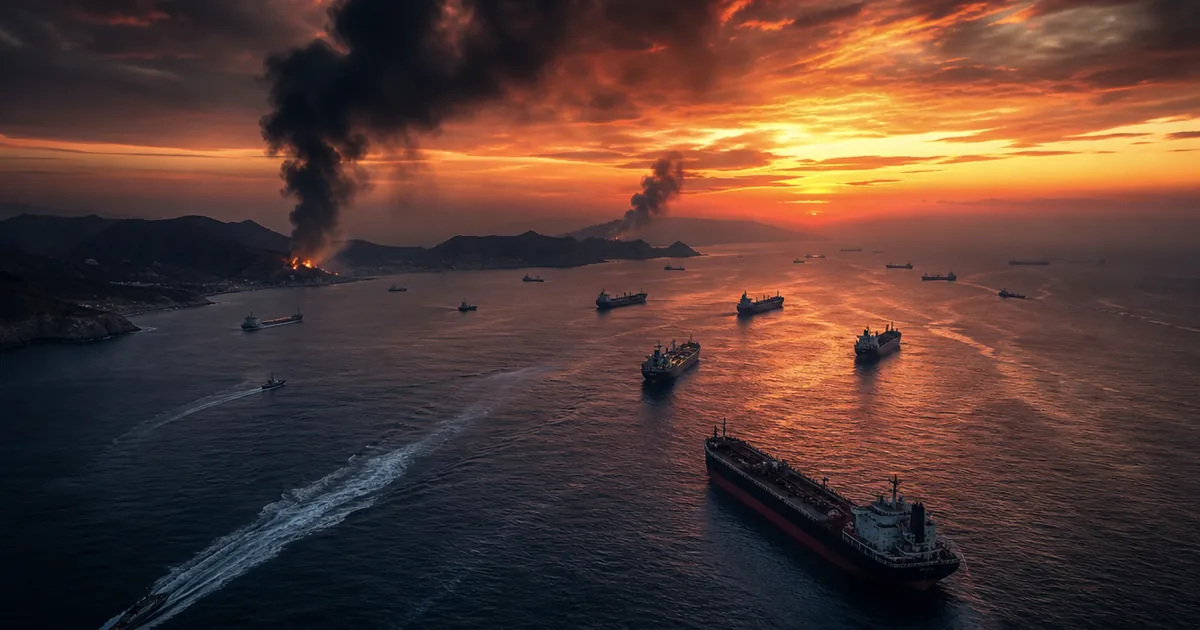
Iran unleashed waves of missile and drone attacks across the Persian Gulf on Sunday, targeting military installations in Qatar, the UAE, Bahrain, Kuwait, and Oman while also claiming strikes on Jordan, in the most significant regional escalation since the Strait of Hormuz crisis began in June.
The attacks came after CENTCOM confirmed that U.S. forces struck more than 300 targets inside Iran over three consecutive nights, according to NPR, an unprecedented pace of operations designed to degrade Tehran’s ability to threaten commercial shipping in the strait.
How the Escalation Unfolded
The cycle of violence has its own grim logic. Iran attacked a commercial vessel in the Strait of Hormuz on Saturday night. The U.S. responded with airstrikes on Iranian air defense systems, radars, and over 60 small boats operated by the Revolutionary Guard. Tehran then declared the Strait of Hormuz “closed until further notice,” a claim that U.S. officials immediately rejected. And on Sunday morning, Iran launched simultaneous attacks on five Gulf states, specifically targeting bases and facilities that host or support American military operations.
The Iranian army said it struck a Patriot air defense system in Kuwait, a satellite and early-warning site in Qatar, and fuel storage facilities used by U.S. forces in Bahrain, using what it described as “a large number” of military drones. The Gulf Cooperation Council condemned the strikes as “treacherous” and a continuation of Iran’s approach to undermining regional security.
The Hormuz Question
The Strait of Hormuz is the choke point through which roughly one-fifth of the world’s daily oil consumption passes. Iran’s claim that it has closed the strait is partly performative. The U.S. Navy is actively escorting commercial vessels through the waterway, and there is no indication that traffic has fully stopped. But the distinction between “closed” and “extremely dangerous” matters less to energy markets than the reality that insurers are repricing risk and shipping companies are rerouting cargoes.
Oil prices have already reflected the instability. Every new round of strikes adds another risk premium to global crude, which filters through to gasoline, diesel, and the broader cost of everything that moves by truck, ship, or plane. The economic impact extends far beyond the Gulf. It reaches into every American household the next time they fill up their car.
A Ceasefire That Never Really Held
What makes this round of fighting particularly alarming is that it follows the collapse of a U.S.-Iran ceasefire that President Trump declared “over” earlier this month. That ceasefire was always fragile, built on a memorandum of understanding that Tehran accused Washington of violating. But its failure has removed the last diplomatic guardrail between the two countries. The fighting is now operating without any formal framework for de-escalation.
This is the third consecutive weekend of U.S.-Iran exchanges of fire. Each round has been bigger than the last. The progression from targeted strikes on maritime assets to carpet-bombing 300 targets to simultaneous multi-country attacks represents a conflict that is accelerating, not stabilizing.
The Gulf States Caught in the Middle
Al Jazeera reported that air-raid sirens activated in Bahrain and Kuwait during the Iranian strikes, a sound that most residents of those countries have never heard outside of drills. Qatar, which has carefully positioned itself as a mediator in regional conflicts, now finds itself a direct target of Iranian military operations. The UAE, home to Dubai’s financial center and Abu Dhabi’s sovereign wealth apparatus, faces a threat calculus that could reshape its approach to Iran diplomacy entirely.
These are not countries accustomed to being on the receiving end of missile attacks. The Gulf states host the backbone of American power projection in the Middle East, and Iran’s willingness to strike those facilities directly represents a significant threshold crossing. It suggests that Tehran has calculated that the costs of restraint now exceed the costs of escalation, a dangerous place for any conflict to reach.
The fundamental question this week is whether the current trajectory leads to a negotiating table or a wider war. The signals, for the moment, all point in the wrong direction.