
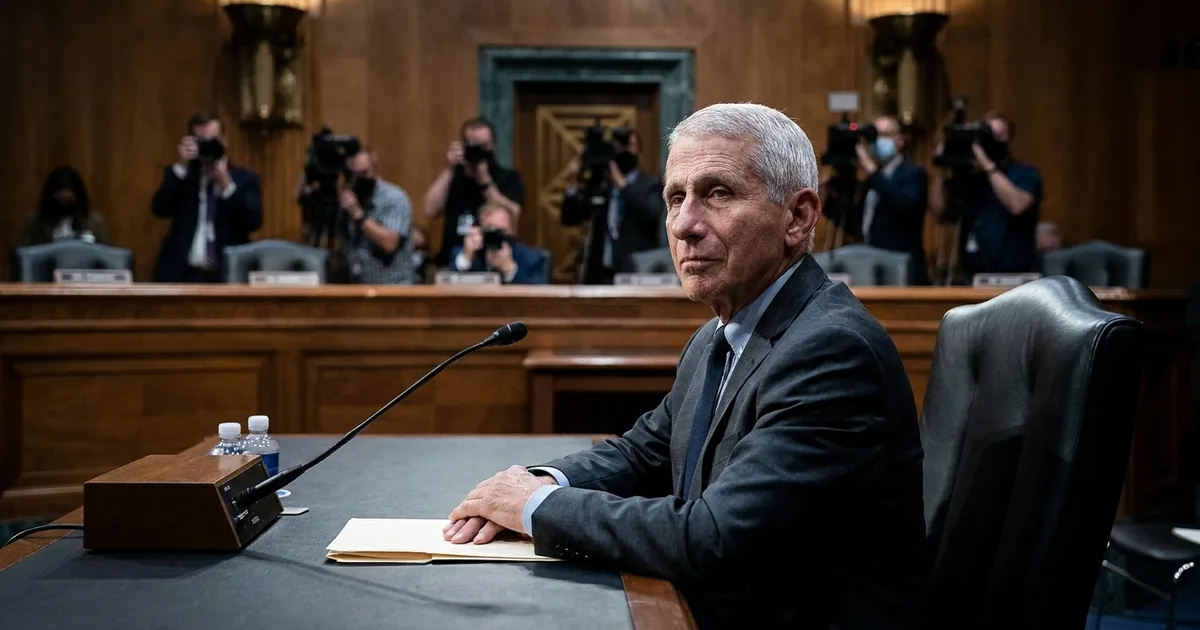
Anthony Fauci sat in a Senate hearing room on Wednesday and said almost nothing, invoking his Fifth Amendment right against self-incrimination more than 100 times rather than answer questions about COVID-19 origins.
The part that got clipped and shared was the chaos, a chairman ordering Capitol Police to remove a witness’s lawyer. The part that actually decides how this ends is a pardon Joe Biden signed 18 months ago.
Senator Rand Paul, who chairs the Homeland Security and Governmental Affairs Committee, has spent years trying to establish that US-funded work at the Wuhan Institute of Virology contributed to the pandemic and that the National Institutes of Health obscured its role. On Wednesday he asked Fauci whether his actions “lead to the largest man-made plague in history.” Fauci, who ran the National Institute of Allergy and Infectious Diseases from 1984 to 2022, answered by accusing Paul of an obsession with prosecuting him, then stopped answering at all. Al Jazeera walked through the exchange and counted the refusals past 100 across roughly three hours.
Paul said the committee will vote next week on holding Fauci in contempt of Congress.
The Pardon Is Not the Shield People Think It Is
Biden issued Fauci an unconditional preemptive pardon in January 2025, covering federal offenses from 2014 onward. At the time it was read as a permanent exit from legal jeopardy, insurance against a second Trump administration turning the NIH into a prosecution target.
It also created a problem that Fauci’s own lawyers now have to argue around. The Fifth Amendment protects a witness from being compelled to give testimony that could be used to incriminate them. Remove the possibility of prosecution and, as a general matter, you remove the basis for the privilege. That is why immunity grants exist: prosecutors trade away the ability to charge someone in exchange for the ability to make them talk. A pardon accomplishes something similar for the conduct it covers. Paul called Fauci’s invocation unsupported for exactly that reason, and as The Hill laid out in a survey of his remaining legal exposure, it is not a frivolous argument.
The counterargument is narrower than Fauci’s supporters would like, but it is real. A pardon covers past conduct, not future conduct, and a false statement made under oath on Wednesday is future conduct. Senate Republicans said as much, and they are right about it. Every answer Fauci gave was a fresh opportunity to be charged with perjury or making false statements to Congress, in a Justice Department that has shown a specific appetite for prosecuting people the president dislikes. That is not a hypothetical exposure. It is the entire reason a witness in his position hires the kind of lawyer who tells him to stop talking.
There is also a question about scope. A preemptive pardon covering unspecified offenses over an eight-year window has almost no litigated history behind it, because presidents have rarely written them. Whether it reaches state charges is settled: it does not. Whether its language covers every theory a motivated prosecutor might construct is not settled, and no witness wants to find out live on C-SPAN.
What a Contempt Referral Actually Does
A committee contempt vote is not a charge. If Paul’s committee approves a referral and the full Senate concurs, the matter goes to the US attorney for the District of Columbia, who decides whether to present it to a grand jury. That discretion is where most congressional contempt referrals go to die, and it is worth naming who holds it right now. The Justice Department has spent this year as an instrument of the administration’s grievances, from fraud charges against the Southern Poverty Law Center to the contested confirmation of Todd Blanche, the president’s former personal lawyer, as attorney general.
So the honest read on where this goes is not the legal question. It is the political one. A referral against Fauci would land in the most sympathetic possible department, which makes an actual prosecution more plausible than the historical base rate suggests, and makes the base rate the wrong thing to reason from.
Congress has a cleaner tool available and nobody is reaching for it. Both chambers can grant use immunity to a witness under 18 U.S.C. 6005, which forecloses the Fifth Amendment objection entirely and forces testimony on pain of contempt that courts will actually enforce. It requires a two-thirds committee vote and a court order, and it costs the requesting side something: immunized testimony cannot later be used to build a case. That trade tells you what a committee wants. Immunity buys answers. Contempt buys a fight. Paul is choosing the fight.
The Hearing Was Not Designed to Produce Information
Removing a witness’s attorney from the room is the detail that gives the game away. Paul directed Capitol Police to eject David Schertler after Schertler tried to speak without recognition, and Schertler later described the proceeding as an obsessive vendetta in comments Rolling Stone collected as the hearing came apart. Committee chairmen do control the floor and counsel do not have a speaking role, so the ruling was procedurally available. It was also a choice, made in front of cameras, in a hearing where the witness had already stopped answering and there was no informational cost to letting a lawyer finish a sentence.
Six years past the outbreak, the origins question remains genuinely unresolved, and it deserves a serious accounting: what NIH funded, through which intermediaries, with what oversight, and what officials knew about the gap between the two. That accounting requires documents, subpoenas to institutions rather than individuals, and testimony from people whose careers do not depend on the answer. None of that is what Wednesday was.
What Wednesday produced was a clip. Fauci’s refusal will be evidence of guilt to people who already believed it and evidence of persecution to people who already believed that, and neither group learned anything about a coronavirus.
The Precedent Nobody Is Weighing
Strip out the personalities and there is a live constitutional question here worth more attention than it is getting: whether a broad preemptive pardon can be used to strip a witness of the privilege against self-incrimination and compel testimony under threat of jail.
If Paul’s theory prevails, a president’s act of protection converts into a tool of compulsion. Pardon a former official, and Congress gains the power to make them testify about everything the pardon covered. If Fauci’s position prevails, a preemptive pardon becomes something closer to permanent silence, protected from prosecution and protected from questioning too, which is a strange outcome for a document meant to close a chapter rather than seal it.
Neither result is obviously correct, and both will outlast this hearing. Biden issued preemptive pardons to several people in January 2025, including members of the January 6 committee and his own family. The rule that gets made here applies to all of them, and to whoever the next president decides to protect on the way out the door.
Paul’s committee votes next week. The more useful question than whether Fauci gets a contempt referral is whether anyone in the room is still trying to find out where the virus came from.