
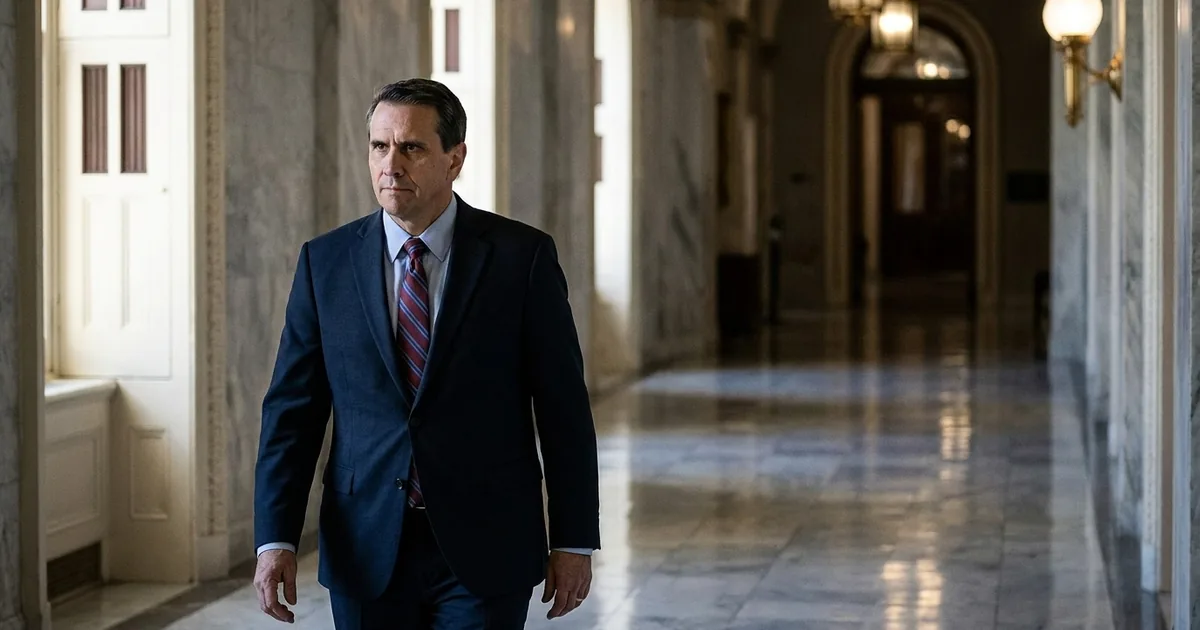
President Donald Trump said Thursday he has “no objection” to temporarily withdrawing Todd Blanche’s nomination for attorney general, and the threat was not aimed at Democrats.
It was aimed at two Republican senators who want the Justice Department to narrow a settlement that shields the president’s own tax filings from audit, which tells you exactly which of the two things Trump values more.
The Nomination Is the Hostage, Not the Prize
Most confirmation fights are about the nominee. This one is not, and the coverage has mostly buried that. Blanche has been running the Justice Department as acting attorney general since Trump removed Pam Bondi in April, and an acting attorney general can serve indefinitely at a president’s pleasure. Losing the confirmation vote costs the administration almost nothing operationally. Blanche keeps the office and keeps the powers.
So when Trump posted that he has “no objection to temporarily withdrawing Todd’s name, if they do not do the right thing”, he was not conceding. He was pointing out that he holds a card the Senate cannot take from him. He went further and floated renominating Blanche after Sens. John Cornyn of Texas and Thom Tillis of North Carolina leave the Senate in the new year, which is a fairly direct way of saying he intends to wait out the only two people currently able to stop him.
Cornyn and Tillis are both departing. That is the entire mechanism here. Two Republicans with no re-election to protect are the last friction in a chamber that has otherwise processed this administration’s nominees without incident, and the fight they picked is not about Blanche’s qualifications at all.
What the Senators Actually Want
The Senate Judiciary Committee postponed its vote on Blanche this week because Cornyn wanted something in writing. Not a policy assurance, not a hearing commitment. A written confirmation from the Justice Department that it would strip specific provisions out of a settlement.
That settlement resolved a lawsuit Trump himself filed against the IRS over the leak of his tax returns, and Blanche brokered it in May. It is worth sitting with that arrangement for a second: the president sued a federal agency, and his own deputy negotiated the terms on which the government would settle with him. The version that emerged included a nearly $1.8 billion “anti-weaponization” fund to compensate people who believed the federal government had unfairly targeted them, which the Justice Department abandoned in June after bipartisan objections. We covered why that fund drew a bad-faith sanctions fight in the first place.
The fund is gone. The other provision is not. It gives Trump and others effective immunity from audits and enforcement actions tied to tax returns filed before the settlement, and depending on how the language reads, it may sweep in his family members and their businesses. Cornyn’s ask is narrow and specific: make the text say it covers existing audits only, and does not immunize future filings. Tillis wants the anti-weaponization fund killed permanently rather than shelved.
Neither senator is asking for anything a normal administration would treat as a concession. They are asking the Justice Department to write down that the president is subject to future tax law. The administration’s refusal to put that in writing is the story.
Why This Reads Differently Than a Normal Confirmation Standoff
There is a version of Washington where a president trades a settlement clause for a cabinet confirmation and calls it a Tuesday. Nominees are currency. Presidents spend them.
This one is not being spent, and the reason is that the immunity provision is worth more than the office. An attorney general confirmed by the Senate carries institutional legitimacy that an acting one does not, but legitimacy is a soft asset. Audit immunity for filings already submitted is a hard one, and it does not expire when the administration does. A future Justice Department can fire an attorney general. Unwinding a signed settlement is a different and much slower problem.
Read that way, Trump’s math is not reckless. It is coherent. He is trading a title he does not functionally need for a legal shield that outlasts his term. The senators understand this, which is why they want it in writing rather than in a press release, and why the administration keeps declining to provide it.
The institutional cost lands somewhere else. Blanche has now spent months running the Justice Department without Senate confirmation while the president publicly treats his elevation as a bargaining chip in a dispute over the president’s own tax exposure. Every prosecutor working under him is operating inside that arrangement. That is corrosive in a way no single vote captures, and it does not resolve itself when the standoff ends.
What Happens Next
Blanche met with the holdouts this week and the two sides are still talking, so nothing is final. Trump has not formally withdrawn anything. NPR reported that he said he “may” pull the nomination temporarily, which is the kind of hedge that leaves room for a deal.
If a deal happens, watch the language, not the announcement. The difference between “existing audits” and “audits arising from returns filed before the settlement date” is a few words and several years of exposure. It was the same drafting question at Blanche’s confirmation hearing two weeks ago, and it has not moved since.
If no deal happens, the more interesting question is whether Trump actually waits until January. Two senators leave, the arithmetic changes, and a renominated Blanche sails through a committee with no holdouts left in it. The cost of waiting is five months of an unconfirmed attorney general, which the last four have already shown to be survivable.
Which raises the question the Senate has mostly avoided asking out loud: if confirmation is optional, what exactly is the committee’s leverage in any of this?