
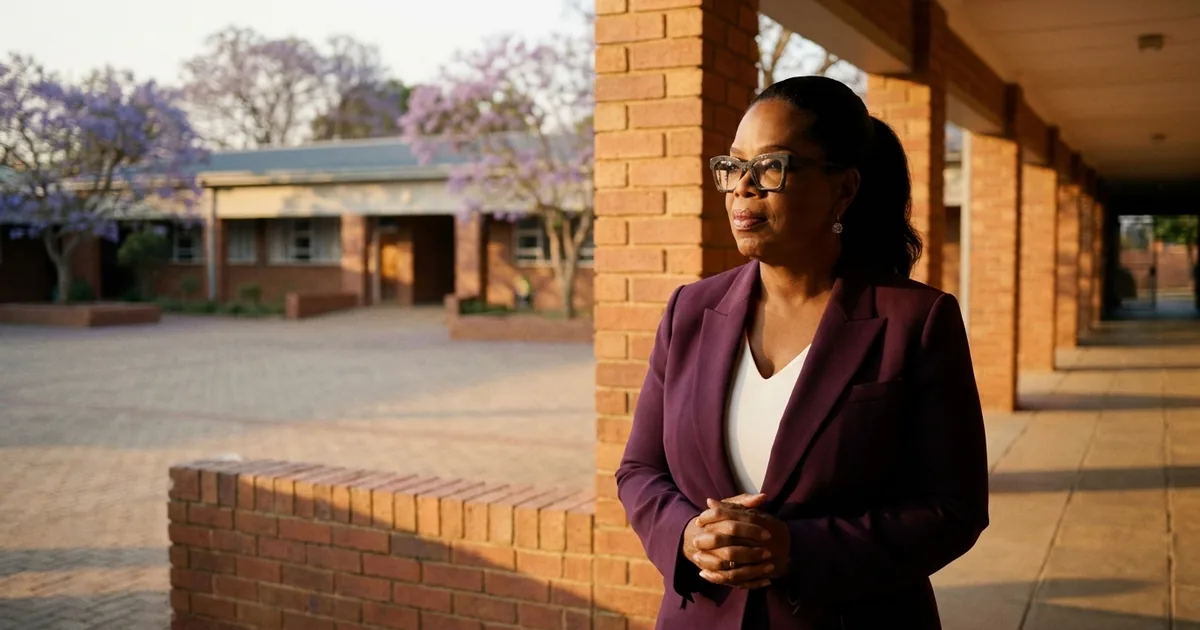
Oprah Winfrey will wind down the Leadership Academy for Girls at the end of the 2027 school year and hand the campus back to South Africa’s Gauteng education department, ending a 20-year experiment that cost her roughly $40 million to build and considerably more to run. The headline reads like a retreat. The numbers underneath it read like someone finally admitting that the most expensive model in education philanthropy was never the one that reached the most girls.
The Handover Was Always in the Contract
Winfrey’s organization says the transfer to Gauteng was written into the original partnership agreement, which is the detail most of the coverage has skipped past and the one that reframes everything else. This is not a foundation collapsing or a benefactor losing interest. It is a scheduled endpoint arriving, roughly on time, in a deal signed two decades ago.
The academy opened in 2007 after Winfrey spent years developing it, a project she has said grew out of conversations with Nelson Mandela. NPR covered the opening in January 2007, when the school was being discussed mostly in terms of its price tag and its founder’s involvement in details down to the thread count. More than 1,000 girls have been admitted since. The inaugural class of 72 graduated in 2011, and every one of them earned a place at university.
Current students are not being dropped. Winfrey’s team told outlets that the girls already enrolled will finish with academic and financial support intact, and that students in lower grades will move to top South African schools with tuition covered through graduation. That is a more expensive wind-down than a closure notice usually implies, and it is the part that suggests this was planned rather than triggered.
Why a Scholarship Model Reaches More Girls
Here is the arithmetic that made the decision. A residential academy carries the highest per-student cost structure in the sector. You are not funding tuition. You are funding dormitories, kitchens, security, grounds, medical staff, counselors, transport, and a full boarding operation, for a fixed and small number of students, forever. Winfrey has poured hundreds of millions into the campus over its life.
A scholarship program funds the marginal cost of a seat at a school that already exists. The buildings are built. The teachers are hired. Every additional rand goes to a girl rather than to a boiler. A representative for Winfrey said the new model will let double the number of girls access education, and given the cost difference between the two structures, double is probably conservative.
“The dream was never simply to build a school,” Winfrey said in the statement announcing the change. “It was to invest in the limitless potential of young women.” That is the language of someone who has decided the building was a delivery mechanism rather than the point.
The Trade Nobody Is Naming
Which brings us to the part worth being honest about, because “twice as many girls” is not a like-for-like trade and treating it as one flattens what the academy actually did.
The boarding model was not chosen for prestige. It was chosen because a residential campus removes a girl from whatever her home circumstances are for the duration of her education. Poverty, unsafe households, the pressure to leave school and earn or marry: a scholarship does not touch any of that. It pays for a desk. The girl still has to get to it every morning, from wherever she started.
That is the trade. Winfrey is exchanging depth of intervention for breadth of reach. For a student whose main barrier is money, the scholarship is strictly better, and there are far more of those students than the academy could ever house. For the student the academy was built for, the one whose barrier was her environment, the swap is a downgrade dressed as an expansion.
Both things are true, and it is possible to think this is the right call anyway. Twenty years of data on your own graduates is a reasonable basis for concluding that the model you can scale beats the model you can perfect. ABC7 reported that the academy’s own follow-up found nearly all surveyed graduates went on to higher education and described the effect as transforming their families. That is a strong result from a small sample, and the obvious next question is what happens when you take the money that produced it and spread it across four times the students.
What This Signals About Celebrity Philanthropy
The named-campus model has always had an incentive problem baked into it. A building carries your name. A scholarship fund does not, or at least not in the way a gate and a crest do. Donors get talked into permanence because permanence is visible, and visibility is what keeps a project funded.
Winfrey is walking away from the visible version at 72, on a schedule she agreed to before the school opened, and handing a functioning campus to a public education department rather than letting it decay or selling it. Compared to the usual arc of a celebrity institution, which tends to end in a quiet defunding and a dead website, that is a fairly disciplined exit.
The scholarship program starts after the current OWLAG students graduate. The number to watch is not how many girls get funded in year one. It is whether the completion rate holds when the support is a check instead of a campus.