
What seems like an unadorned deck today (a handful of colours, some repeated symbols, and royalty who are easily overlooked) provides answers to very practical questions about the creation, handling and recognition of cards. Historical packs demonstrate that it wasn’t always this way. Card makers explored alternatives and players’ conventions eventually shaped what became typical.
Suits Were Never Inevitable
Many will know the suits of hearts, diamonds, clubs, and spades but these represent only one of several traditions. The Cloisters Playing Cards, dated to approximately 1475–1480 by the Metropolitan Museum of Art, use hunting equipment as suit symbols. Horns, dog collars, hound tethers, and game nooses make up the suit symbols.
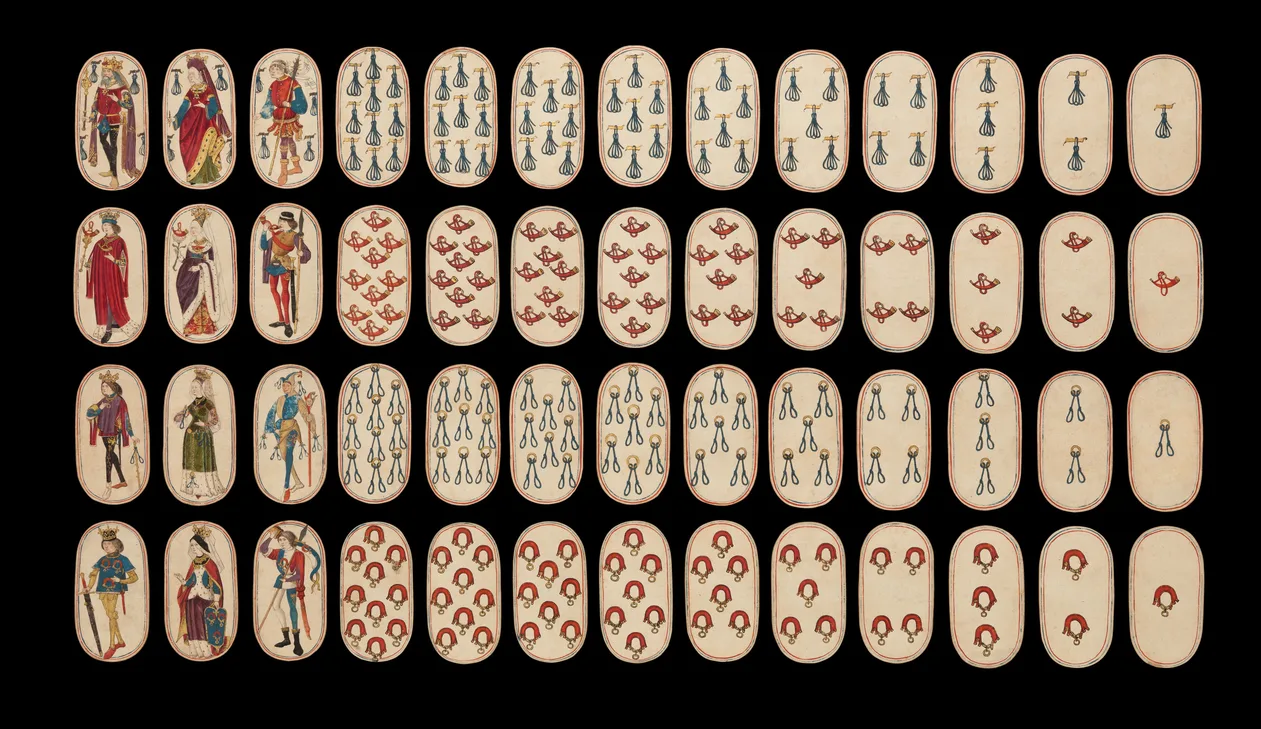
The pack contains 52 cards. Each suit includes a king, a queen, a knave, and ten numbered cards. The numbers of the cards are indicated through repetitive suit symbols. A graphic serves to categorize; repeating the graphic provides the quantity.
The cards were constructed out of layers of paper with paint, silver and gold applied to their surfaces. The museum suggests that based upon appearance alone, the deck appears little used and was possibly developed for a collector rather than an actual gaming deck.
The museum’s assessment places limits on what this particular deck can illustrate. An elaborately decorated surviving deck does not necessarily depict the cards used to play daily games.
Simple Forms Facilitated Repetition of Designs
Most French playing cards were made using stencils before the 19th century. Number cards required only one colour and were placed according to established guidelines; court cards often had to utilize 4 or 5 colours. Stencils allowed card makers to apply the same areas of colour repeatedly, while the outlines of face cards were printed from woodblocks.
There is a significant visual difference between a number card and a portrait of royalty. One uses repeated, identifiable marks that indicate placement; the other allows for decoration such as clothing, faces, patterns and objects. These require different amounts of area on a small card.
A compact suit symbol is able to be identified at various sizes and can be repeated throughout a page. A royal portrait is able to contain more decorations. Production provided practical rationale to differentiate important information from decorative elements.
Indices Provided Better Means for Reading Cards
Indices are the name given to the small rank and suit indicators located near a card’s corners. The International Playing-Card Society reports that a larger acceptance of indices began after 1860. The society lists examples of experimentation with miniaturized card faces, border marks, and large numerals. Ultimately, placing a small sign in two diagonally opposite corners proved to be the most widely accepted means of indexing cards.
It becomes evident why indices serve a useful purpose when viewing a fan of cards. When viewed side-by-side, most of each card is covered by overlapping cards; however, enough of each card is exposed to identify the value of each card via the index. Colour provides another method for distinguishing information quickly. A guide to card decks from GipsyTeam describes a four-colour scheme: red hearts, blue diamonds, green clubs, and black spades. Each suit maintains its traditional form while receiving a distinct colour, allowing identification by either feature.
Both features improve an individual’s ability to read information from a limited space. Corner marks and additional colours do not alter a card’s identity; they simply enhance clarity regarding that identity.
Court Cards Can Be Reversed
Double-headed court cards have a practical benefit: rotating the card upside down leaves another upright head in view.
Examples of 19th century courts from various manufacturers demonstrate how to make these reversals occur. The World of Playing Cards shows Woolley (circa 1850) courts where only the top portion of each person is shown in duplicate, creating a very noticeable seam. Other manufacturers redrew their figures to combine the two halves in one design.
By doing this, the artists changed the composition of the image — clothing and hand positioning needed to accommodate the new orientation, so the figure was no longer shown in full. The resulting images create a combination of illustration and design for identification.
It might be easy to assume all unusual characteristics on today’s court cards are intentional symbolism. However, these manufacturing adjustments offer other possibilities – perhaps some unusual features come from being copied and/or repositioned. An unusual feature can be evidence of a previous version of an image rather than something intended by the most recent manufacturer.
Each Side Was Used for Different Purposes
A deck’s front tells us what card we’re looking at; the back usually conceals the identity of the card. In order to conceal the identities while handling cards face down, backs should match across all cards in a deck.
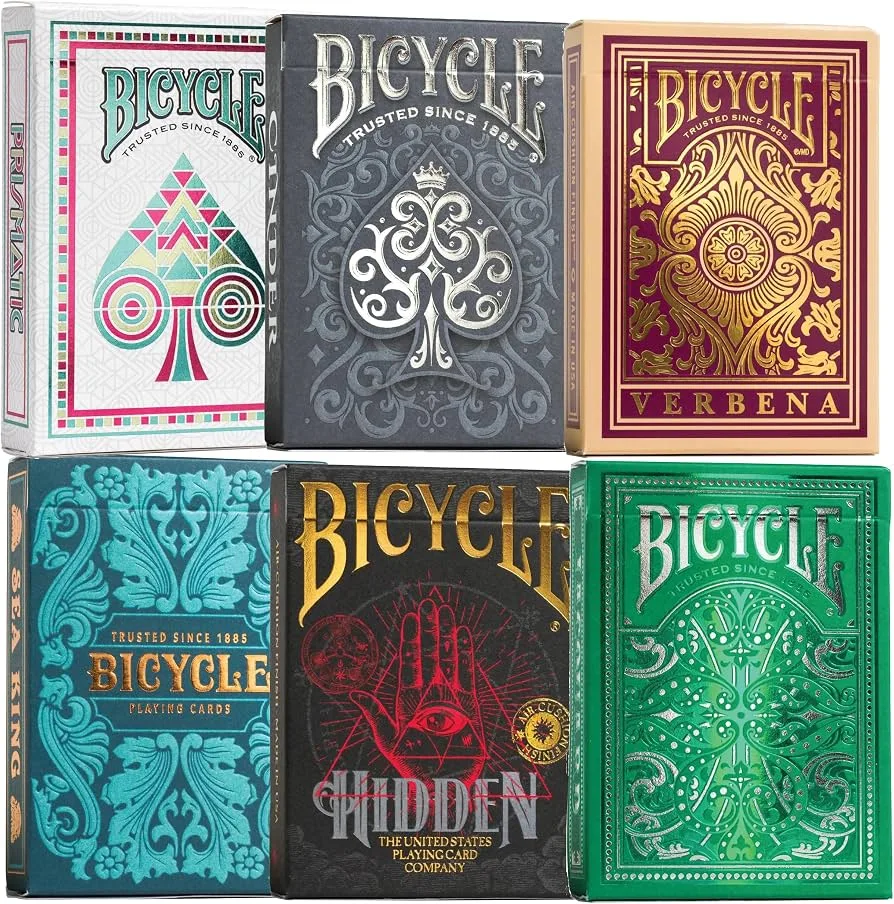
Patterns on card backs did not exist as part of the standard format for all time. MIT’s French Playing Cards project states that French card backs remained blank until the 1820s. After they were used for playing, when they got too worn out, their blank backs provided space for other uses.
Some uses included book catalogues, labels for records associated with legal matters, merchant business cards, and educational materials such as practice writing/spelling/grammar work. Using old backs like this illustrates the physical aspect of a deck’s past — a playing card was just another piece of paper that would last long enough to keep.
Card games were related to the broader historical development of printing and record-keeping. Collectively, suits, indexes, reversible portraits and re-used backs illustrate an item that satisfied multiple purposes. Choices made by the people who produced and used cards have been preserved within their recognizable form.