
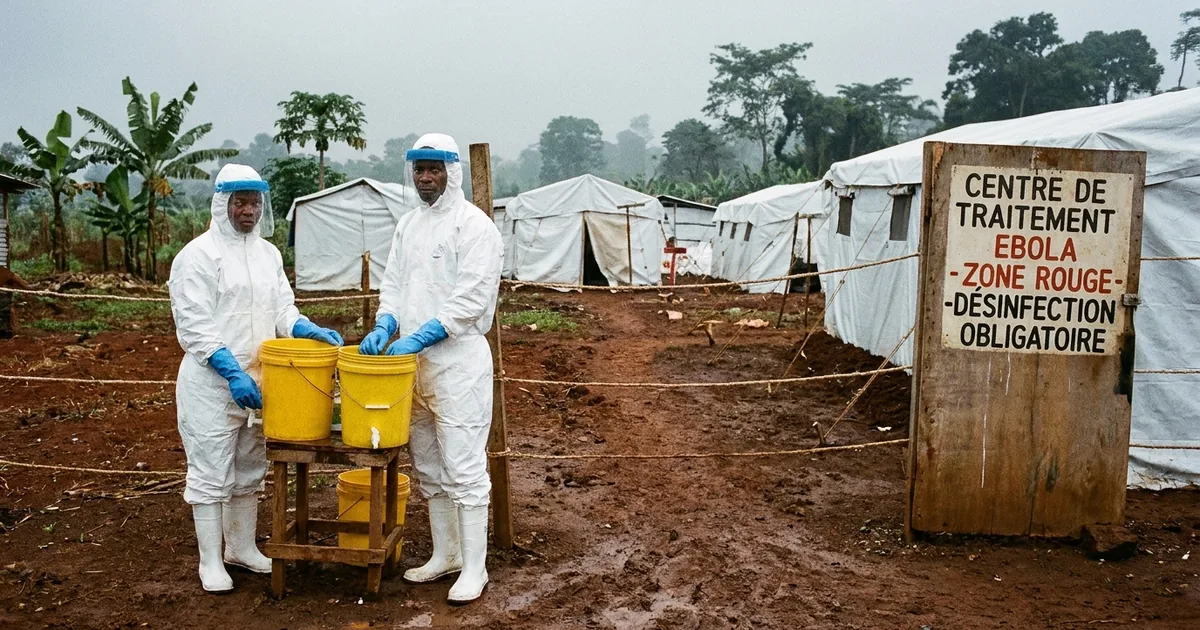
Congo’s health ministry counted 12,021 confirmed Ebola cases and 5,904 deaths on Thursday, which makes this the second-largest Ebola outbreak ever recorded. The total is not the number to watch. Since the World Health Organization’s last full count on October 20, Congo has added about 63 confirmed cases and 33 deaths a day, the line is not bending, and fighting 25 kilometers from the response hub in Bunia is pushing responders out.
The headline: 12,021 confirmed cases, 5,904 deaths, eight provinces reached, and no approved vaccine or treatment for the Bundibugyo virus.
The count underneath: about 63 new confirmed cases and 33 deaths every day for 37 days, and 65 cases a day across the last ten.
Thirty-Seven Days, One Line
Start with the arithmetic, because the headlines skip it. The WHO’s October 23 update counted 9,704 confirmed cases and 4,687 deaths as of October 20. Thursday’s ministry figures are 12,021 and 5,904. That is 2,317 cases and 1,217 deaths in 37 days, or 62.6 cases and 32.9 deaths a day.
Congo’s public health institute had put the toll at 11,376 cases and 5,568 deaths on November 16, so the last ten days added 645 cases and 336 deaths, 64.5 and 33.6 a day. The WHO logged 67 new confirmed cases in the single 24 hours to October 20. Three measurements across five weeks, one rate. At 62.6 a day, the outbreak adds another 1,000 cases about every sixteen days.
AP calls it the fastest-growing Ebola outbreak in history. Fastest is a statement about the past. A spike peaks and falls, and this is a plateau, which is harder to see in a headline and harder to end in the field.
The Date Nobody Has Printed
AP says the outbreak is on track to pass the West African epidemic’s death toll of 11,000. Nobody has said when. The CDC’s account of that epidemic, built on WHO figures, counts 28,652 suspected, probable and confirmed cases and 11,325 deaths as of March 31, 2016. Congo’s 5,904 is 5,421 short of that. At 32.9 deaths a day, 5,421 takes 165 days, which lands on or around May 10, 2027.
That is our straight-line arithmetic, not a forecast, and it has two caveats that pull in opposite directions. West Africa’s count includes suspected and probable cases while Congo’s is confirmed only, so a death nobody tested never reaches the number, and responders said in June that the true scale was still unknown. If the real toll is higher, the date moves earlier. If the daily rate falls, it moves later. Nothing in the three measurements above says the rate is falling.
By raw size, Congo stands at 42 percent of West Africa’s cases and 52 percent of its deaths.
Where the Dying Happens
The WHO update carries a figure the milestone coverage left out. Of the 482 deaths reported since its previous update, 307 occurred in communities and 175 in treatment centres. Divide it out and 64 percent of those deaths happened outside a treatment centre. The WHO’s own reading is that the pattern continues to highlight challenges “in early case detection and timely access to appropriate care.”
Here is why that matters if you have never followed an Ebola outbreak. The virus spreads through the blood and other body fluids of people who are sick or have died, so a death at home is a loss and also a new exposure for whoever washes and buries the body. With no approved vaccine or treatment for Bundibugyo, the response has only the old tools: isolate patients quickly, monitor people who may have been exposed, bury the dead safely. We explained in August why the licensed vaccines do not help here: they target a different species of the virus. Every one of those old tools depends on a team reaching the village.
A Hospital Under Crossfire
Reaching the village takes roads. On Thursday morning fighting between the Congolese army and the rebel group CRP resumed in Iga-Barrière, a mining town about 25 kilometers north of Bunia, sending new waves of displaced people toward the city that runs the Ebola response. The CRP was founded last year by Thomas Lubanga, the warlord the International Criminal Court convicted in 2012 of recruiting children under 15, and it is one of more than 100 armed groups in eastern Congo.
Fighting earlier this week had already stopped teams reaching some communities, disrupted monitoring of exposed people and left some treatment centers short of staff, WHO Ebola incident manager Catherine Smallwood said Wednesday. About a dozen people, including two WHO personnel and Congolese health officials, were evacuated to Bunia on Tuesday after three days trapped in a hospital in Akwe amid crossfire.
Picture the system described above with those facts applied: a tracing team that cannot leave its compound, a burial crew that cannot reach the house, a clinic with half its nurses. That is how 63 a day stays 63 a day. Africa CDC said on November 15 that the outbreak was still not under control.
What We Think
The milestone invites the wrong picture, a number racing up a chart toward a record. We think the accurate one is a constant rate of infection and death held in place by a war the response cannot ignore. Money and staff do not change the rate if they cannot travel the road to Akwe. So the question for donors, the UN mission and every government with a seat at the WHO is how much of the Ebola budget is security: escorts, safe corridors, a Bunia that stays open.
The risk is not confined to Ituri. The WHO’s October update counts cases in five countries since the May 15 declaration, Congo, Uganda, France, Kenya and Nigeria, and still advises against restrictions on travel or trade. We covered Kenya’s first Ebola death in October, and the 1,830 cases we reported in July are now 12,021, 6.6 times the count.
Watch two numbers from here: the daily confirmed count, 63 and holding, and the share of deaths happening in communities, 64 percent in the WHO’s last report. If the second falls, the response is reaching people. If neither moves by spring, May 10 is the date to remember.