
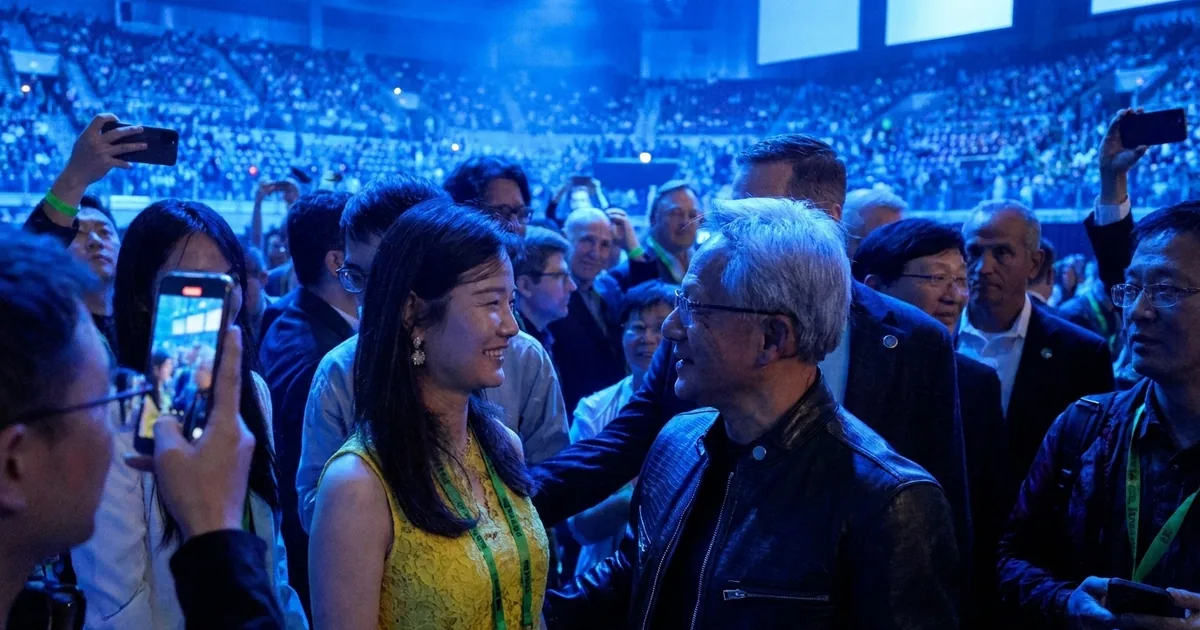
China’s Ministry of State Security approached Alice Huang for information and was in contact with her while she was in a relationship with Nvidia chief executive Jensen Huang, intelligence officials told congressional staff on Tuesday. The same briefers described her husband, Shanghai investor Kang Wei, as a Chinese intelligence asset. What they did not find, they said, is evidence that Beijing sent her after Jensen Huang in the first place.
That last line is the one most outlets put in the headline, and it is the least important part of the briefing. Beijing does not need to plant someone beside the head of the world’s most valuable chip company if it can approach whoever ends up there. Every account of the session comes from people familiar with a classified briefing, so here is what is on the record, what rests on anonymous sources, and who has actually been held to account.
The framing since early November
A suspected Chinese spy, close to the chief executive of the world’s most valuable chip company, passing information about U.S. AI chips to Beijing.
What briefers told staff Tuesday
China’s spy service approached her and was in contact with her during the affair. They found no evidence it directed her to target him, and said the relationship may have been amorous rather than a coordinated operation. Officials said that could change with new information.
What Beijing Got
Officials said the Ministry of State Security approached Huang for information, as Chinese law can compel, and that she was in contact with the agency during the affair. The two main accounts of the briefing differ on how much that produced. The Journal’s reporter, as quoted by Mediaite, said the U.S. has no indication she disclosed significant intelligence. MLQ’s summary of the Times says officials did not dispute that she passed information once the relationship began. Both can be true only if what she passed was small, and nobody has said what it was.
Then there is her husband. Briefers described Kang Wei, whose data center plans the Journal put above $9 billion in China, as an asset “often in touch” with the service. No public document backs that up and he has not been charged. Taken at its word, though, the government is saying both people in that marriage had a line into Chinese intelligence while one of them was close to Nvidia’s chief executive.
Our read: “spy” is a charge nobody has brought, and we will not pin it on a woman charged with nothing. But “no evidence China directed her” is not a clean bill for Beijing. By the government’s own account, Chinese intelligence reached the partner of the most important executive in American AI, stayed in touch with her through the relationship, and counted her husband as an asset. That is access, and access is what intelligence services are built to get. The House and Senate intelligence committees have asked to see a March 30 classified memo on her ties that was not part of the briefing. They should get it, and the public should see whatever of it can be declassified.
Six Claims, Six Standards
Coverage keeps arguing over whether Huang is “a spy” as if that were one question. It is six claims, made by different parties and held to different standards. We built the ledger below from the Singapore government’s statement, the Commerce Department rule and the accounts of Tuesday’s briefing.
| Claim | Who made it | Where it stands on Nov. 25 |
|---|---|---|
| She passed information about U.S. AI chips to China’s spy agency | Unnamed officials, in a memo the Times described on Nov. 6 | Not retracted. The Journal’s account of Tuesday says no indication she disclosed significant intelligence |
| Beijing directed her to target Jensen Huang | No official on the record; it is the premise of most headlines | Briefers found no evidence of it |
| Her husband, Kang Wei, was a Chinese intelligence asset | Anonymous briefers | “Often in touch” with the service, per the Journal’s account; “at least at times” an asset, per the Times. No document public |
| She knowingly gave Singapore police inaccurate information to downplay her role | Singapore’s Ministry of Home Affairs, on the record, Nov. 12 | Stern warning and a re-entry ban, with insufficient evidence for an offense over the server declarations |
| Megaspeed servers were diverted toward restricted users | Commerce, in its Nov. 23 rule: a “significant risk” of diversion | Seven entities listed. Nobody charged. Singapore’s probe of the company and six people is open |
| She is a spy | Nobody has charged it; the attorney general said the Justice Department had not concluded whether she was one | No charge anywhere |
Read the last column and one pattern stands out. The only claim with a penalty attached is that she misled Singapore police about her role at Megaspeed, and Singapore wrote that she was not investigated for espionage. Every claim about China’s role rests on anonymous briefers, which is why the March 30 memo matters.
Who She Is
Alice Huang, also known as Huang Le, is a Hong Kong resident who helped set up Megaspeed in 2023, a Singapore cloud computing firm that became an Nvidia cloud partner and so got access to scarce AI chips. Singapore authorities called her the company’s then-CEO, chairperson and one of its key controllers, even though corporate records dropped her as a director in November 2023. Megaspeed says she left on Aug. 30, 2025.
She has said nothing publicly in recent reporting. Bloomberg reported on Nov. 12, citing anonymous sources, that she is in Beijing, which has not been independently confirmed. We laid out the Singapore and Commerce record in our earlier timeline; this is the version updated through Tuesday.
The Timeline
| Date | What happened |
|---|---|
| 2023 | Huang helps set up Megaspeed; Nvidia certifies it as a cloud partner |
| 2024 | Commerce opens an export-control inquiry into Megaspeed |
| February 2025 | Singapore police and customs open an investigation into false server declarations |
| June 24, 2025 | Commerce agents check Megaspeed with Huang present; Singapore interviews her and holds her passport |
| August 30, 2025 | The date Megaspeed says she left |
| February 26, 2026 | Singapore finds insufficient evidence of an offense, returns the passport, bars her from re-entry |
| November 6, 2026 | The Times reports a memo identifying a businesswoman close to Jensen Huang as passing chip information to China’s spy agency |
| November 12, 2026 | Jensen Huang resigns as Nvidia CEO; Singapore publishes its statement |
| November 13, 2026 | Treasury Secretary Scott Bessent says Commerce holds the pen on blacklisting Megaspeed |
| November 23, 2026 | Commerce adds Megaspeed to the Entity List; Jensen Huang is back at Nvidia eleven days after resigning |
| November 24, 2026 | Intelligence officials brief congressional staff; Singapore’s prime minister says Huang was released for lack of a basis to prosecute |
517 Days and the Paper Trail
The part of this scandal with paper behind it is the export case. Commerce’s rule says the seven entities, spread across Singapore, Malaysia and Thailand, were added because of the “significant risk” of diversion of advanced computing commodities, and licenses will be reviewed under a presumption of denial. Shipments under existing orders get a 30-day savings clause that runs to Dec. 23.
Do the arithmetic on how we got here. Federal agents were in Megaspeed’s office on June 24, 2025. The listing came on Nov. 23, 2026: 517 days later, and about 22 months after Singapore opened its own case. It also came 10 days after Bessent told reporters that Treasury, the Pentagon, State and the trade representative had wanted the listing for months and that Commerce had the pen.
Singapore’s prime minister, Lawrence Wong, said on Tuesday that Huang was released because there was no basis for further prosecution, that the chips Megaspeed bought never physically entered Singapore, and that Singapore still needs more information from the United States. That is a small ally saying it asked Washington for help and is still waiting.
This is where the accountability that can be measured sits. The question of what China got may take months to answer. The question of why the one agency able to list a company that Treasury, State and the Pentagon wanted listed took 517 days to do it has an answer now, and Commerce Secretary Howard Lutnick is the person who can give it.
Questions Readers Keep Asking
Was Alice Huang in contact with Chinese intelligence?
Yes, according to the officials who briefed congressional staff on Nov. 24. They said China’s Ministry of State Security approached her for information and was in contact with her during the relationship, but that they found no evidence it directed her to target Jensen Huang.
Has Alice Huang been charged with anything?
No. Singapore declined to prosecute, issued a stern warning and barred her from re-entry for giving police inaccurate information about her role. The U.S. has charged no one in the case, and the Justice Department has a criminal investigation into Megaspeed itself.
Can Megaspeed still buy Nvidia chips?
Nvidia says it put the company on its own no-sell list in June 2025. Since Nov. 23, U.S. exporters also need a license to ship to it, and Commerce will presume to deny one.
What is Jensen Huang facing next?
He is scheduled to meet privately with House committees and to testify before the Senate Banking Committee on Dec. 3, according to Newsmax’s account of the briefing.
Those hearings are where the open facts get tested. Members can ask Jensen Huang what he knew about Kang Wei and when, ask what Alice Huang passed to Beijing, and ask for the March 30 memo. They can also ask Commerce why the listing waited 517 days.