
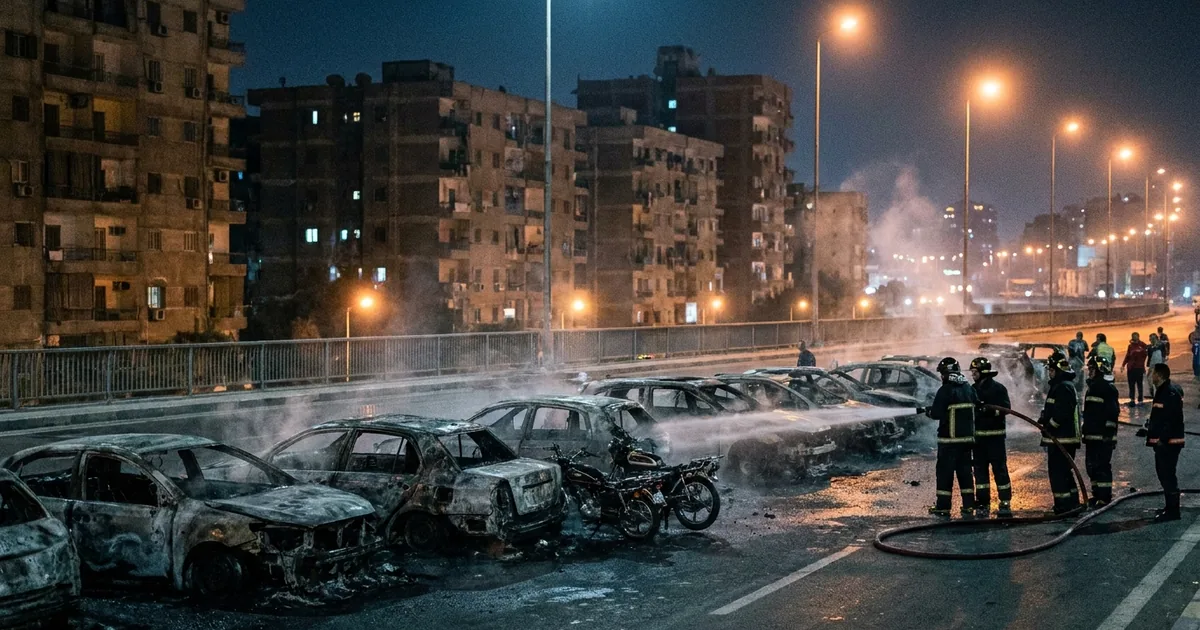
A fuel tanker overturned on Cairo’s Ring Road on Wednesday evening, and the fire that followed killed at least 31 people, according to Egypt’s Health Ministry.
- The fire started above a tunnel in Warraq, a working- and middle-class district of Giza on the Nile’s west bank, the ministry said.
- Egypt’s Petroleum Ministry says the privately operated tanker veered off the road and crashed before exploding.
- Prosecutors counted 27 cars and motorcycles burned and are using DNA tests to identify victims who carried no surviving papers.
- The health minister called the toll preliminary, and said it could rise.
Here is what the first wave of coverage skipped. Egypt’s own agencies and state media gave different accounts of how one vehicle ended up killing 31 people, and the official numbers shifted all evening. We have not seen anyone put those side by side, so here they are.
Egypt’s Own Accounts of the Crash Do Not Match Yet
Start with the cause. The BBC reported that Al-Ahram, the state-owned newspaper, citing sources with knowledge of the investigation, said a high-voltage cable fell in front of the tanker, the driver lost control, and the truck crossed the central reservation and overturned. The Telegraph carried the same story from local media, with the truck heading from the Marg district toward Warraq.
Al-Ahram ran a second version. Al-Monitor quotes the paper saying a preliminary inspection indicated the driver lost control of the steering wheel and the truck struck a concrete barrier before exploding. No cable in that one. The Petroleum Ministry says only that the tanker veered off the road and crashed.
So that is three descriptions of one crash from state sources within hours. They may turn out to be compatible. They do not agree yet, and the difference decides who answers for it. A power line that came down points at whoever owns the power line. A failed steering system or a driver’s error points at the contractor that operated the truck. The BBC’s own summary is the plain one: officials have not given an account of how the fire broke out.
The Casualty Figures Moved All Evening
If you are quoting a number, say when and from whom. Here is what each outlet attributed to the Health Ministry or prosecutors on Wednesday.
| Reported by | Dead | Injured |
|---|---|---|
| Gulf News, first ministry statement | Not given | 10 |
| Gulf News, initial toll | 21 | 15 |
| BBC | 30 | 19 |
| The National | 30 | 25 |
| Associated Press, latest | 31 | 21, revised down from 25 |
The dead count climbed from 21 to 31, and the health minister has said it may rise again. The injured count went the other way, landing at 21 after the 25 that, the AP says, initial statements carried. That reads like a count being reconciled, not a contradiction, and we are not claiming more than that. But 15, 19, 21 and 25 were all in circulation at once.
Two Days of Egypt’s Road Deaths in One Fire
Scale helps here. Al-Monitor, citing the national statistics agency, reports 5,829 road deaths in Egypt in 2025, up 10.8% from 5,260 the year before. Divide 5,829 by 365 and the country averages about 16 road deaths a day. Thirty-one people dying on one stretch of one road in one evening is roughly two days of the entire national average, delivered in a single fire that burned 27 vehicles. Earlier this month, the same report notes, two passenger trains collided in Giza, killing at least seven and injuring more than 100.
What the Prosecutors Should Publish
We think the cause line should stay open until prosecutors close it. The cable story rests on unnamed sources in a state-owned paper, and that same paper carried a different mechanism. Egypt’s public prosecutor has opened an investigation and asked for DNA samples from the dead. It should publish what it finds: the contractor’s name, whether the tanker was cleared to run that route at that hour, who owns the line that reportedly fell and when it was last inspected, and a final count that separates the identified dead from the unidentified. None of that is an accusation of a cover-up. It is the minimum record a fire that killed 31 people should leave behind.
Until it exists, the clearest account on the page comes from a man who was only stuck in traffic. “It was a huge fire, the cars got stuck together because of the fire,” Ahmed Sameer told the AP, after watching at least eight bodies carried out of the burned cars.