
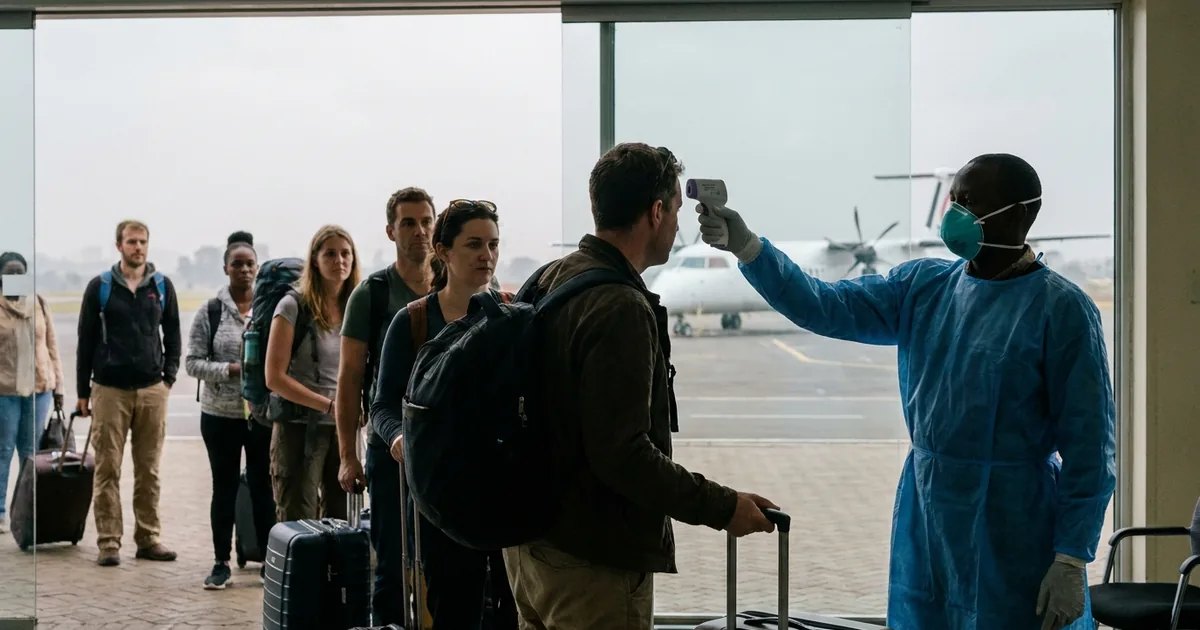
Kenya recorded its first Ebola death late Monday, and the man who died had passed routine health screening at Nairobi’s main airport on Saturday, a month into an illness that had already taken him through several hospitals in Congo.
Here is what Kenya’s health ministry has established so far:
- The patient was a Kenyan citizen who had lived in the Democratic Republic of Congo for seven years and fell ill about a month before he travelled.
- He went by road from Congo to Kampala, Uganda, and flew Jambojet flight 8523 to Nairobi on Saturday, October 3.
- After screening at Jomo Kenyatta International Airport, a relative and a friend drove him to Nairobi Hospital, where he was isolated.
- Tests at the National Virology Reference Laboratory and KEMRI confirmed the Bundibugyo strain, which has no approved vaccine or treatment.
- He died late Monday. Authorities have identified 28 contacts and are tracing 23 passengers and four crew from his flight.
Every early report leads with the contact count. The more important detail sits in the ministry’s own timeline, which Citizen Digital laid out on Tuesday. Kenya says it had screened 652,584 travellers by Tuesday and tested 267 samples, with one positive. That one positive walked through the screening desk at Jomo Kenyatta, got into a relative’s car and was identified only when doctors at a private hospital saw bleeding under his skin. The airport did its job as designed, and the design missed him.
The Screening Desk Saw Him First
Health Minister Aden Duale announced the case on Tuesday, and the facts he gave are precise. The man had been treated at several hospitals in Congo before he set off overland for Kampala. He boarded a Jambojet flight there and landed in Nairobi on Saturday. He underwent routine public health screening on arrival, then left the airport with a relative and a friend, who drove him to Nairobi Hospital. There he presented with fever, chills, intense fatigue, painful swallowing and bleeding under the skin at injection sites, according to the ministry.
Doctors suspected viral hemorrhagic fever and isolated him. That call is the part of the system that worked. The labs confirmed Bundibugyo, the strain driving Congo’s outbreak, and the ministry notified the World Health Organization under the International Health Regulations. The patient died despite supportive care, and The Associated Press reported that he was to be buried within 24 hours under safety protocols. The ministry’s director, Patrick Amoth, said contacts will stay in isolation for 21 days and be released only after testing negative.
“I wish to reassure the public not to panic, as all systems are in place to mitigate the spread of the disease.”
Aden Duale, Kenya’s Health Cabinet Secretary, October 6, 2026
Our read is that the systems were in place, and this case shows which of them counted. The two mobile laboratories Kenya deployed sit at the Busia and Lwakhakha road crossings on the Ugandan border. This patient made his road journey inside Congo and Uganda and crossed into Kenya by air. Airport screening of this kind is built to catch a traveller who is visibly sick or running a fever at the moment he reaches the desk, and a month into his illness this one still got through. What caught him was a clinician who knew what bleeding at an injection site can mean, and a reference lab that could confirm it within days.
He Came Through a Country Declared Ebola-Free in August
Uganda is the other half of this story, and almost nobody has said anything about it yet. Uganda recorded 20 cases and two deaths earlier in the outbreak, and Reuters reported that the WHO declared it free of the disease in August. Before Tuesday, according to the AP, there had been no active cases anywhere outside Congo since Uganda declared its outbreak over. This patient travelled overland into Uganda and flew out of Kampala, which means Ugandan health authorities now have a list of their own to build: who drove him, where he stayed, who stood near him at the gate. None of the early reports carried a statement from Uganda’s health ministry.
Bundibugyo Still Has No Vaccine
The strain matters as much as the route. Congo’s outbreak was declared in mid-May, and Reuters puts it at more than 8,000 cases and more than 4,000 deaths, the largest Ebola outbreak the country has ever recorded. The AP calls it the fastest-growing Ebola outbreak in history, and the WHO has warned it could become the deadliest. Bundibugyo is a rare species with no approved vaccine or treatment, and trials are under way in Ituri province, the epicenter. As we reported in August, every licensed Ebola vaccine targets a different species, which leaves isolation and contact tracing as the main tools Kenya has.
That puts a date on Kenya’s exposure. Ebola’s incubation period runs up to 21 days, which is why Amoth’s isolation period runs that long. Counted from Saturday’s flight, the passengers and crew of flight 8523 clear on October 24 if no one falls ill. The 28 family and hospital contacts were exposed later, across the days he spent in Nairobi, so their window closes nearer the end of the month. Until then the case count in Kenya is one, and the honest answer to whether it stays at one is that nobody knows yet.
Washington Built Kenya a Quarantine Ward for Americans
The American angle is not a travel story yet, and it should not be turned into one. In May, STAT reported, the US imposed its first travel ban over an Ebola outbreak, barring most foreign travellers who had been in Congo, Uganda or South Sudan in the previous 21 days. Kenya was not on that list. Whether Washington adds it should turn on one question, whether any of the contacts tests positive, and not on Nairobi’s place as the region’s main air hub. A single imported case, isolated and confirmed within days, is the last line of the system holding, not a sign that it has collapsed.
The American Ebola project Kenyans actually know about is a different one. The US funded a 50-bed quarantine centre at the Laikipia Air Base in Nanyuki, meant to hold Americans exposed to Ebola abroad, and the protests against it turned deadly in June when police opened fire on demonstrators. Kenyan courts issued orders blocking the plan. The man who landed on Saturday was Kenyan and would never have been sent there. What protected Nairobi this week was a clinician and a laboratory, and that is where Kenya’s partners, Washington included, should be putting their money now. A regional epidemic travelling on a scheduled flight is the scenario the global health emergency the WHO declared in May was meant to prepare everyone for.
Duale told Kenyans not to panic, and on the evidence so far that is the right advice. The patient was isolated once he reached the hospital, the samples were run, and the contacts were named within days. But the line that “all systems are in place” needs one correction before it hardens into the official story. The airport system was in place and he went straight through it, so the next three weeks of tracing rest on doctors and laboratories, the part of the system that actually found him.