
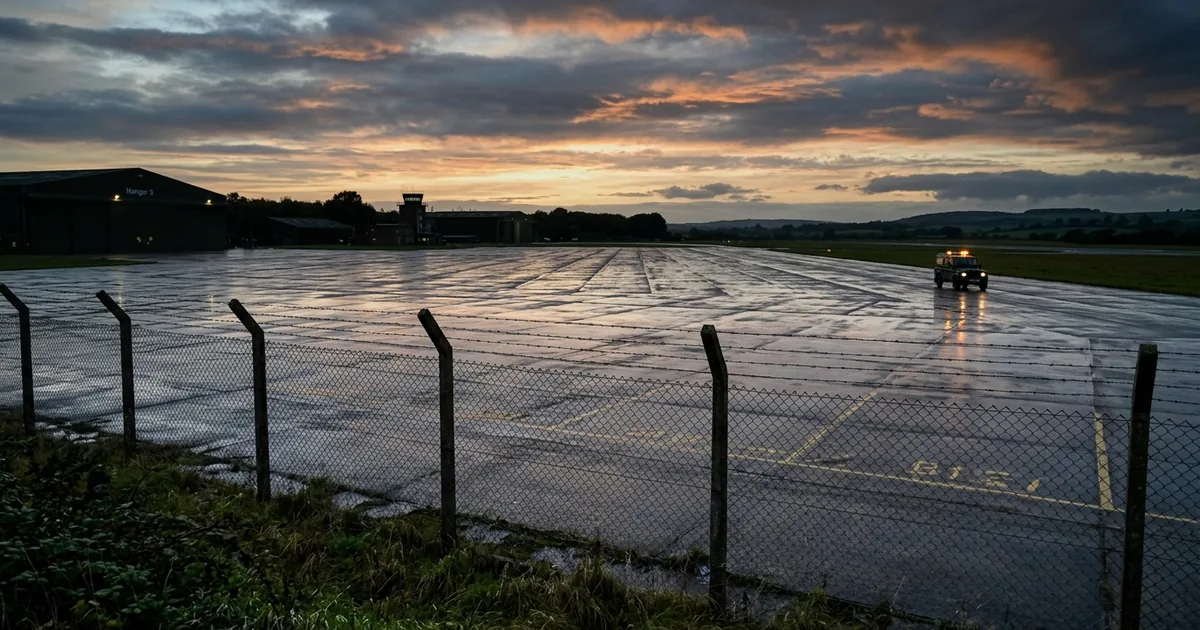
The headline version: the US pulled its bombers out of Britain after an Iran-linked plot against the base.
The record: three vehicles, some petrol, no explosives, six suspects on bail, and a Pentagon that has not said why the planes left.
Every B-1B Lancer the United States kept at RAF Fairford is now back home. The Pentagon confirmed it on Sunday evening, and a week after six men were arrested nearby, most of the coverage has welded the two events into one sentence with “after” in the middle.
That sentence is a guess. We could find no one on the record saying the bombers left because of the arrests, and no one saying the base was the target.
What Actually Left, and When
Air & Space Forces Magazine reports all 12 bombers flew out on Oct. 4, after deploying in early March. The Pentagon’s statement, as Fox News quoted it, said all US bombers there “have re-deployed to their home stations in the United States,” and that the fleet “remains fully prepared to launch long-range strike missions.”
It also said operational security meant it could not confirm the movement in real time. That is an explanation for the silence. It is not an explanation for the departure.
The Arrests, Without the Adjectives
Early on Sept. 27, police stopped three vehicles near the base, as we reported that morning. Here is how the claims stack up a week later.
| Claim | Who says it | Status |
|---|---|---|
| Explosives were found | Nobody | Police say no improvised explosive devices were found |
| Petrol was recovered | UK officials, per Fox News | Confirmed, quantity not given |
| Six people were arrested | Fox News, Jerusalem Post | Five British nationals in their early 20s, one British-Iranian dual national |
| The suspects are still held | Nobody | All released on bail, investigation continuing |
| An IRGC-linked recruiter was behind it | US intelligence officials, via the Wall Street Journal | Not adopted by British authorities |
| A “foreign actor” was involved | Secretary of State Marco Rubio | No country named in his remark |
| The base or the aircraft was the target | Investigators have not established it | Unproven |
The Jerusalem Post is explicit that the IRGC account has not been adopted by the British side. Gulf News reports Iran strongly denies any involvement.
Why the Timing Proves Less Than It Seems
The war context matters. A ceasefire has held since April, and Air & Space Forces reports the bombers have mostly flown training missions since. A seven-month deployment ending is not by itself an alarm.
But an exit announced only after the fact, with the explanation withheld, is exactly the shape a security scare would take as well. The facts fit both stories, which is the point.
What We Think
The Pentagon and British authorities owe the public one plain sentence: was Fairford the target, yes or no. If officials can brief the Iran angle, they can brief this.
Leaving it unsaid lets the loudest framing win. That is how a political account of a threat hardens into settled fact before a single charge has been filed. Six people on bail are entitled to better than being the footnote in somebody’s escalation story.
Until someone with a name attached says the withdrawal was a response to a threat, treat it as a drawdown that happened to land in a frightening week. If that turns out to be wrong, the department has only itself to blame for not saying so.