
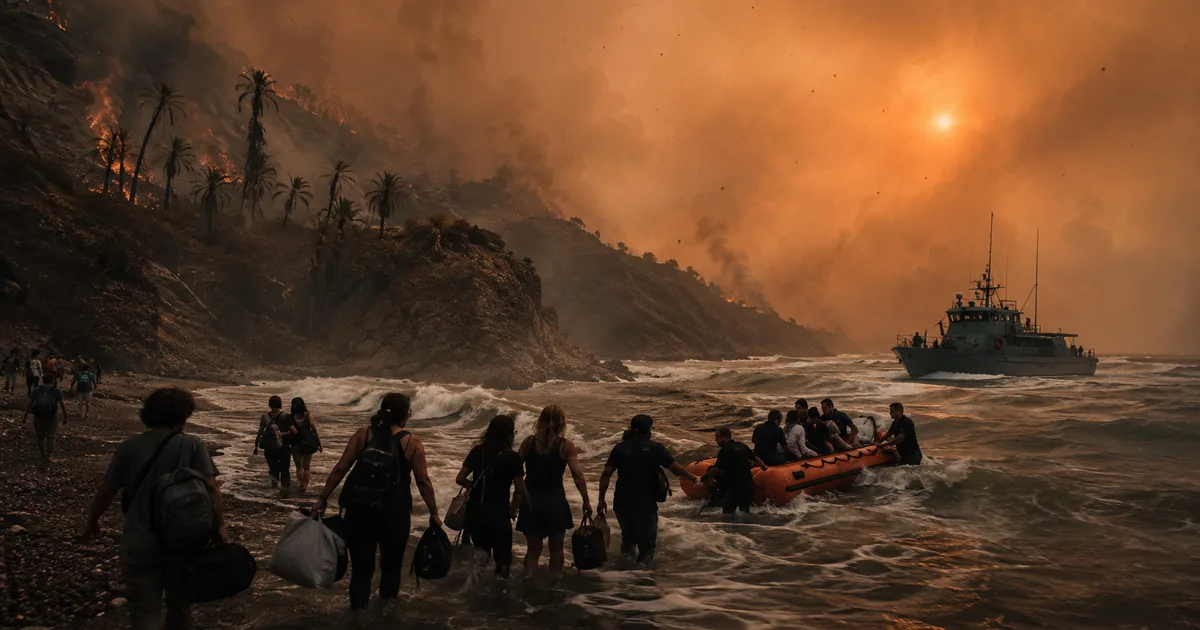
Greek authorities spent Friday morning lifting more than 200 people off beaches on the Gulf of Corinth by boat, with roughly a hundred more still waiting on the sand.
Taking a coastline out by sea is not a dramatic flourish, it is the move a country makes when the road out is already gone and the aircraft that would normally cut a fire off cannot get into the air.
The Boat Is What You Use When the Road Is Gone
The evacuations ran off Agios Vasileios, Agios Nikolaos and Alyki, coastal settlements in Boeotia on the Greek mainland. Protothema reported that a fire near Xironomi was pushing toward Vilia and Porto Germeno with fire whirls forming along a front it described as enormous. Forty-nine firefighters, fifteen engines and two helicopters were assigned to it. Residents of Porto Germeno were told to stand by, and the road in was closed to visitors.
Look at that ratio. A fire large enough to spin up its own weather, and two helicopters.
This is not an oversight by the Greek fire service. It is arithmetic. On the same morning, Achaia had 114 firefighters, 27 engines, four aircraft and three helicopters committed to a single blaze near Floka, where an emergency alert went out at 5am sending residents toward Arla. Argolis had two fronts running at Fichtia and Chinitsa, with homes burning at Fichti and the old Argos to Corinth road shut. Arcadia had a fire that started close to midnight at Falaisia. Crete still had its own. Greece was fighting five significant fires at once, in five different regions, after logging 37 wildfires in a single 24-hour stretch.
Greece Fights Fire From the Air, and the Wind Took the Air Away
Greek wildfire doctrine leans hard on aerial suppression. Water-dropping planes and helicopters hit a front early and hold it down while ground crews cut line. That model has one point of failure, and this week found it. Fire brigade spokesman Vassilis Vathrakogiannis said strong winds and dense smoke were producing near-zero visibility and severe turbulence, making aerial water drops extremely difficult. On Crete, where gusts hit 125 kilometres per hour, the water-dropping aircraft could not operate at all.
Take the planes out of the equation and what remains is people with hoses against a front more than 15 kilometres long. More than 190 firefighters were committed around Rethymno. Fifteen kilometres is roughly the distance from Times Square to JFK. There is no quantity of ground crews that closes a gap like that.
Vathrakogiannis named a second problem that has nothing to do with weather: Greece is hundreds of islands, and moving responders quickly between them is genuinely hard. A country scattered across the Aegean and the Mediterranean cannot surge ground forces the way a contiguous one can, so it compensates with aircraft. Ground the aircraft and the compensation vanishes, leaving the geography exactly as difficult as it always was.
Three Firefighters Died This Week
On July 29, three firefighters were killed. Two were trapped by flames in their fire engine in the mountain foothills near Rethymno, reported to be in their mid-20s and late 50s, and were found near the vehicle. A third was found dead near Gythio in Laconia, on the Peloponnese. The Fire Service said the men fell heroically in the line of duty.
The way that count travelled is worth noting. Several outlets ran the headline as two firefighters dying on Crete, which is accurate for Crete and undercounts the day. The third death happened on the mainland, in a different region, during the same wind event.
No official finding has been released on the circumstances of any of the three deaths, and it would be wrong to assign a cause before one is. What is on the record is the condition every Greek ground crew was working under that day, which is that the aerial layer meant to keep them at a distance from an active front was largely unavailable.
Crete Is Where the Numbers Live
Crete took the worst of it. Greek authorities declared a state of emergency in the municipality of Agios Vasileios, in the Rethymno regional unit, and moved roughly 8,000 residents and tourists out around the resort of Agia Galini on Wednesday. Most have since returned, and peak season resumed around them.
The burn scar says more than the evacuation figure does. Around 4,500 hectares, close to 11,000 acres, were scorched south of Rethymno across Wednesday and Thursday, according to meteo.gr, the weather service of the National Observatory of Athens, working from EU Copernicus satellite imagery.
The coast did the same job there that it did in Boeotia. A Hellenic Coast Guard patrol vessel and two private boats took 51 people out of the Preveli area in Force 8 winds and landed them at Agia Galini. Volunteers running inflatables alongside the Coast Guard completed eight separate runs and moved more than 80 people off Preveli beach, among them tourists, local business owners, and people who had been helping the firefighters. Roughly 700 evacuees spent a night in an indoor sports hall.
A significant stretch of the Preveli palm forest, one of Crete’s most important natural landmarks, burned. The Preveli Monastery, sitting close to the front, came through it intact.
By Friday a fire service spokesperson told AFP that the situation around Rethymno was better, while adding that the blaze was still not contained and that many hotspots remained. Protothema also reported that a Public Power Corporation employee has been arrested in connection with the Rethymno fire, which moves at least part of the ignition question off the weather and onto infrastructure.
Europe Stopped Taking Turns
What makes this week read differently from an ordinary Greek fire season is that Greece is not the only front. Turkey logged 169 fires over the same seven days. Spain has been burning since early July, when a wildfire in Almería killed 12 people around Los Gallardos and Bédar. France carried out what amounted to its largest peacetime evacuation since the Second World War near Bordeaux days ago. England had crews working in Suffolk, near the Sizewell B nuclear plant.
European mutual aid rests on an assumption that fire seasons are staggered. Portugal lends to Greece, Greece lends to Spain, France sends its Canadairs wherever the week is worst. That assumption is holding up badly. When five countries need the same scarce category of asset in the same week, a shared continental pool starts behaving like a national fleet with extra paperwork, and the country with the longest front waits.
August Has Not Started Yet
Greece’s Civil Protection has placed Attica and Evia at category 5, the extreme end of its wildfire risk scale, for August 1. Attica is the Athens region, home to roughly a third of the country.
Prime Minister Kyriakos Mitsotakis called August a traditionally difficult month. That is true, and it is also a strikingly low bar for the week that just happened. The state of emergency, the three deaths, the boats at Preveli and at Agios Vasileios beach, all of it landed in July, with the aircraft grounded and the fronts multiplying faster than crews could be split between them.
So the forecast worth watching is not tomorrow’s wind speed. It is whether a firefighting model built around air power has any answer for a season in which the air keeps being taken away, because the 31 days the Greek fire service has always treated as the hard part start tomorrow.