
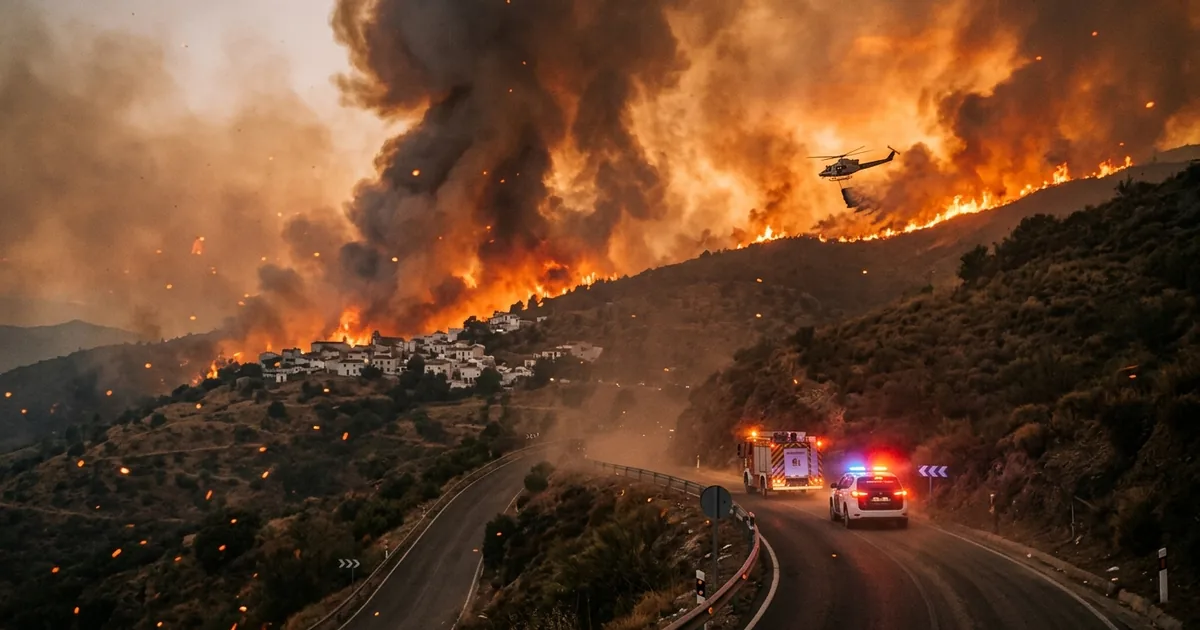
A wildfire that broke out Thursday afternoon near Los Gallardos in Spain’s Almería province has killed at least 12 people, several of whom were found inside vehicles overtaken by flames as they tried to escape.
The death toll, which climbed from six overnight as emergency crews reached the hamlet of Bédar, makes this one of the deadliest wildfires in modern Spanish history, and it happened in a matter of hours, not days.
A Fire That Outran the People Fleeing It
The first calls reached Andalusia’s 112 emergency service around 5:00 p.m. local time Thursday, according to reporting from Xinhua, which cited the regional emergency coordination center. Within hours, flames driven by high temperatures, low humidity, and strong winds had jumped from Los Gallardos into the neighboring municipality of Bédar, a hillside hamlet in the Levante Almeriense.
That speed is the story. The BBC reported that multiple victims were found inside burned vehicles, people who got in their cars and drove, which is exactly what most of us would do, and still could not outrun the fire front. When a blaze moves faster than a car on a winding mountain road, the standard playbook of “evacuate when told” collapses. There was no meaningful warning window. The fire arrived with it.
Regional authorities activated Level 1 of the Andalusian forest fire emergency plan, known as Plan INFOCA, closed stretches of the A-7 motorway and the N-340A road, and evacuated Bédar along with the surrounding communities of Almocaizar, Fuente del Albarico, Los Pinos, La Serena, and Pinar de Bédar. Around 150 firefighters, backed by aircraft and helicopters, worked the fire through the night, with Spain’s Military Emergency Unit called in to reinforce them. Roughly 50 displaced residents were sheltered in a local cultural center. At least six people were injured, including a woman hospitalized with burns and another person treated for smoke inhalation.
Juanma Moreno, the head of Andalusia’s regional government, called the fire “a tragedy” and wrote on X that “our hearts are heavy and we are devastated by grief.” Judicial authorities have opened an investigation into the fire’s cause and the identification of the victims.
The Heatwave Is the Accelerant, and It Was Forecast
None of this happened in a vacuum. Southern Spain has spent days under orange heat warnings, the second-highest alert level, with temperatures in parts of Andalusia pushing past 40C. The same heat dome has been cooking southern Europe for over a week: France24 reported that the Almería blaze erupted amid scorching conditions that had already primed the region’s vegetation to burn.
Europe has been here before, and recently. Just last month, a record-shattering heatwave across France and its neighbors killed people through heatstroke and drownings, a stretch we covered when France logged its hottest day on record. Days ago, a wildfire in the French Pyrénées-Orientales forced mass evacuations. The pattern is not subtle. Iberian summers now produce fires that behave less like the seasonal burns fire services trained for and more like fast-moving natural disasters with minutes-scale timelines.
Here is the uncomfortable structural fact: Spain saw this coming and still could not stop it. Prime Minister Pedro Sánchez announced in May that Spain would field its largest-ever summer wildfire response, more crews, more aircraft, more pre-positioned resources. The response to Los Gallardos was, by the numbers, fast and substantial. And 12 people are dead anyway, because the decisive window in a wind-driven heatwave fire is the first hour, before any national asset can arrive. The state’s capacity has grown; the fires have grown faster.
Why People Die in Cars
The detail that victims were found in vehicles deserves more than a grim mention, because it points to a specific, fixable failure mode. Fire researchers have documented it repeatedly, from the 2018 Camp Fire in Paradise, California, where residents died in gridlocked cars, to Greece’s 2018 Mati fire, where dozens perished on roads and in the sea. Late self-evacuation by car is among the most lethal decisions in a fast fire, and yet it is the default human response when official evacuation orders lag behind the flame front.
That lag is an institutional problem, not a personal one. Rural areas like the Levante Almeriense have aging populations, single-road access to hillside hamlets, and warning systems built for slower emergencies. When the alert arrives after the smoke does, people improvise, and improvising means driving. The question Spanish authorities will now face from investigators and grieving families is whether the evacuation orders for Bédar and its surrounding hamlets went out early enough, and whether anyone modeled what a 40C, wind-driven fire would do to escape routes that funnel onto the N-340A.
The Bill for a Hotter Mediterranean Keeps Arriving
Andalusia will mourn, the judicial inquiry will grind forward, and the fire will eventually be contained. What will not change by next week is the underlying arithmetic: the Mediterranean is warming faster than the global average, Spain’s heatwaves are arriving earlier and lasting longer, and every summer the gap widens between fire behavior and the emergency infrastructure built for a cooler century.
The honest measure of whether Europe learns from Los Gallardos will not be the size of next year’s firefighting budget. It will be whether hillside communities get evacuation modeling, hardened refuge points, and alert systems that fire before the flames crest the ridge. Twelve people got in their cars Thursday evening because that was the only plan available to them. The next fire is already a forecast away.