
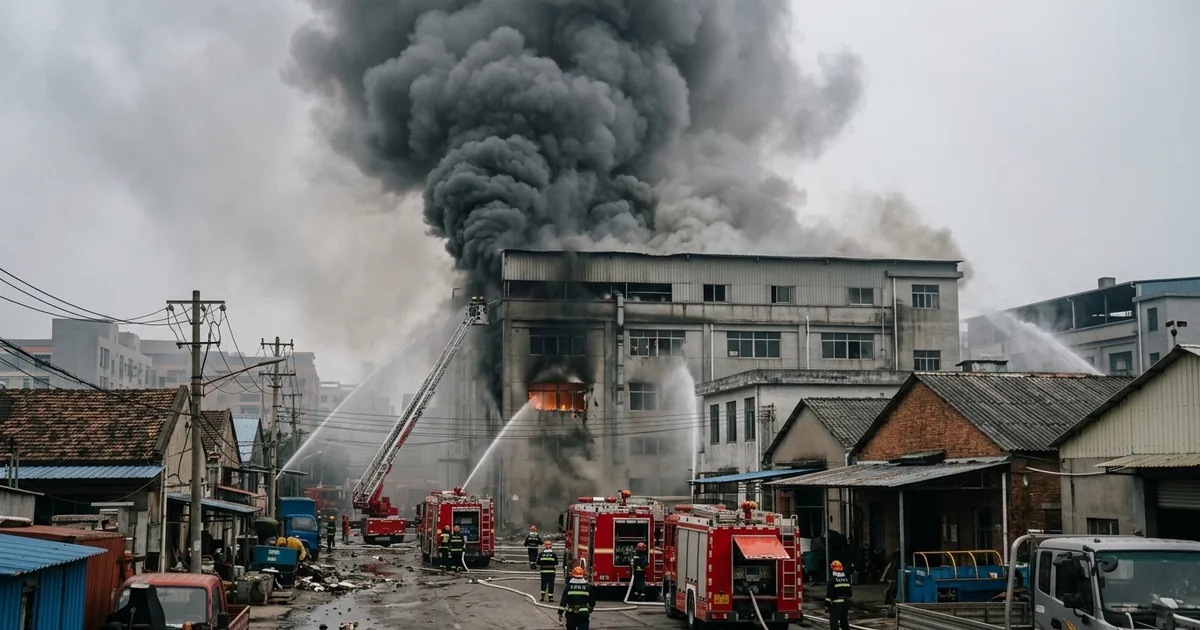
A fire tore through a shoe factory in Jinjiang, the coastal Fujian city known as China’s shoe capital, on Thursday, killing at least 28 people in one of the country’s deadliest industrial blazes in recent years.
The details emerging from state media describe a disaster that was less an accident than an audit of everything Chinese workplace safety enforcement keeps failing to catch: flammable materials stacked inside the workspace, and escape routes clogged with piled goods when workers needed them most.
The blaze broke out at 12:04 p.m. local time at a facility operated by Huiteng Shoes Co. in Jiangtou Village, Chendai Township, according to Xinhua, China’s state news agency. There were 239 people at the site when the fire started, 237 factory workers and two delivery drivers who happened to be inside. Rescuers evacuated 213 people, two of whom later died in the hospital. The remaining 26 who could not get out were confirmed dead, bringing the toll to 28.
Blocked Stairwells and a Building Full of Fuel
The preliminary findings, as reported by Xinhua, read like a checklist of preventable failure. The fire started on the ground floor. Shoe-making materials, which include glues, solvents, synthetic leathers, and foams that burn fast and hot, were stored inside the building and let the flames spread rapidly. Large quantities of goods had been piled up in the stairwells, which hampered both the escape of workers and the firefighting effort that followed.
That last detail deserves to sit with the reader for a moment. Stairwells are the difference between an industrial fire and a mass-casualty event. In a multi-story factory, they are the evacuation plan. When they double as overflow storage, the building has effectively been converted into a trap, and every day it operates that way is a bet that the fire will never come.
NBC News reported that the fire ranks among China’s deadliest in recent years, a grim category with no shortage of entries. A fire at a plant in Anyang in central China killed 38 people in November 2022, and the pattern in these disasters repeats with numbing regularity: flammable stock stored where people work, exits compromised, and safety inspections that either never happened or never had teeth.
The Response Playbook: Detain the Owner, Freeze the Accounts
Beijing’s reaction followed a script it has run many times. President Xi Jinping ordered an all-out rescue and treatment effort and a full investigation. Police detained the company’s owner and several other people suspected of bearing responsibility, and authorities froze Huiteng’s corporate accounts, a move designed to preserve funds for victim compensation before the money can be moved.
The South China Morning Post noted that the blaze struck the heart of China’s shoe manufacturing industry, a region whose factories supply footwear brands sold around the world. Jinjiang and the surrounding Quanzhou area built their economy on exactly this kind of mid-sized private factory, thousands of them, competing on cost in an export market where margins are thin and every square meter of storage space has a price.
That is the structural story underneath Thursday’s fire. Detaining an owner after 28 people die is accountability of a kind, but it is accountability that arrives after the stairwells are already full. The question that a criminal case against one factory boss will not answer is why the piled goods and the flammable storage were not caught before the fire, by the local safety inspections that are supposed to exist precisely for buildings like this one. Local governments in China’s manufacturing belts face a standing conflict of interest: the factories they are charged with inspecting are also the tax base and the employment base they are judged on. Enforcement that slows production is enforcement that costs the county.
A Pattern That Outlives Every Crackdown
Building-safety failures are hardly unique to China. This week alone, New York ordered evacuations over collapse risk at a Manhattan high-rise, but the scale of loss in Chinese industrial fires belongs to a different order. China has responded to previous industrial disasters with waves of safety campaigns, and after each one the inspections tighten for a season. The Anyang fire in 2022 produced a nationwide fire-safety overhaul. Yet the same underlying economics keep regenerating the same conditions, because the incentives that produce a stairwell full of inventory are constant: storage costs money, downtime costs money, and compliance is the easiest line item to quietly cut when no one is checking.
For the global brands whose supply chains run through Fujian, Thursday’s fire is also a reminder of how little visibility most buyers have into the buildings where their products are actually made. Auditing programs tend to focus on labor hours and wages. Fire load and egress, the things that determine whether workers survive a bad day, are harder to see on a spreadsheet and easier for a subcontracted facility to misrepresent between visits.
Xi’s swift statement signals that Beijing understands the political weight of the moment. Industrial deaths at this scale cut against the government’s core legitimacy claim of competent management, which is why the response is always fast, public, and personal, with a named owner in custody within hours. What follows the detention matters more. If the investigation stops at Huiteng’s management, the lesson absorbed by every other factory in Jinjiang will be that the risk of a blocked stairwell is borne by whoever gets unlucky, not by the system that made blocking it rational.
The dead in Jiangtou Village were workers in the middle of an ordinary shift, in a city whose entire identity is built on the industry that employed them. Whether their deaths produce a durable change in how China polices its factory floors, or just another season of inspections that fade as the news cycle moves on, is the test now sitting in front of the investigators Beijing has dispatched, and it is a test the country has failed before.