
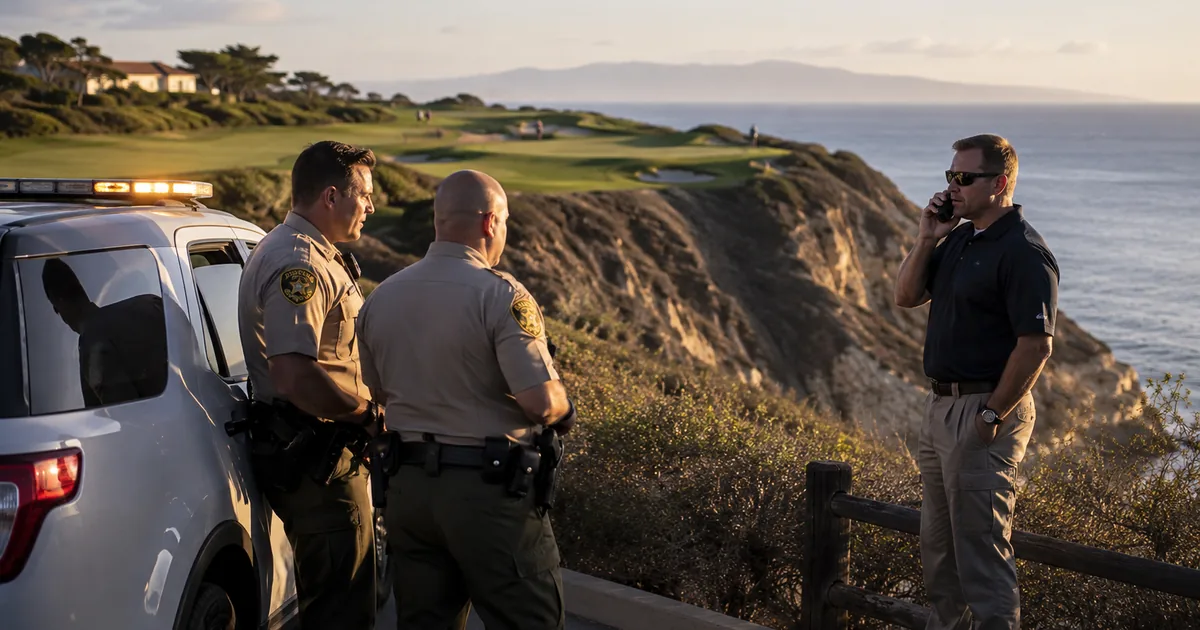
Plainclothes federal agents spotted Jeanine John Taele at Trump National Golf Club in Rancho Palos Verdes on Sunday afternoon, photographing what the Los Angeles County Sheriff’s Department later described as security-planning activity for a presidential visit.
He was arrested that day and his home was searched, but the public did not learn any of it until Tuesday afternoon, hours before Donald Trump was scheduled to arrive at that same address.
The timeline is the story here, and so is the charging sheet. NBC4 Los Angeles reported that agents working the advance for the visit first noticed Taele, 38, of Downey, at about 3:28 p.m. Sunday. Deputies from the Los Angeles County Sheriff’s Department made the arrest. The FBI’s Joint Terrorism Task Force and the United States Secret Service are both attached to the investigation.
That is a serious set of agencies. The charges are not.
What Was in the Car, and What Was in the House
Most of the first wave of coverage collapsed two separate inventories into a single phrase, “weapons cache,” which makes this sound like a plot interdicted at the gate. The sheriff’s department actually described two searches, on two different premises, and the difference between them is the whole case.
In the vehicle and on his person, deputies found a loaded pistol with a round in the chamber, a second loaded magazine of hollow-point ammunition, and a 16-round magazine of hollow-point rounds in his pants pocket.
At his residence, on a warrant served afterward, investigators recovered a very different list. Fox News reported that the home search turned up an illegally modified AR-platform rifle, a 1911 .45-caliber pistol, an AR-platform upper receiver, body armor, high-capacity magazines, bulk pistol and rifle ammunition, two radio signal devices, and multiple notebooks containing what authorities called “concerning statements.”
Everything that makes this sound like a thwarted attack came out of the house, after the arrest, on a warrant. Everything that actually put him in handcuffs came out of the car. Keep those two piles separate and the case looks considerably less resolved than the headlines suggest.
The Gap Between What Alarmed Investigators and What Prosecutors Could Charge
Here is the structural problem sitting underneath this arrest. The conduct that set off the alarm, standing on a golf course photographing how a protective perimeter is being assembled, is not by itself a crime in California. There is no statute against filming an advance team. Surveillance becomes chargeable when the state can prove what it was for, and proving that requires evidence of intent that a camera roll does not supply on its own.
So the case is being held up by two ordinary weapons counts. ABC7 reported that Taele was booked on suspicion of carrying a concealed firearm and possession of armor-piercing or otherwise prohibited ammunition. Both are the sort of counts that come out of a routine traffic stop in Los Angeles County on any given weekend. Neither has anything to do with the president.
That mismatch is not a mistake by prosecutors. It is what the law makes available to them right now. The investigative apparatus attached to this case belongs to a terrorism inquiry. The charging apparatus belongs to a gun case. Those two things are running in parallel, and only one of them is currently keeping him in a cell.
Which is why the notebooks matter more than the rifle. “Concerning statements” is a phrase doing an enormous amount of work in an official statement, and it is the hinge the entire case turns on. If what is written in them establishes intent toward a specific target, the federal exposure changes shape quickly and the state weapons counts become a holding action. If they do not, this is a man from Downey with an illegal magazine and a very bad sense of where to take photographs.
Read the official language closely and you can see investigators drawing that line themselves. The sheriff’s department said it had identified no credible threat to the surrounding communities, a statement carefully bounded to the neighborhood rather than to the protectee. A federal law enforcement source told CNN there was no current indication Taele was plotting an attack on Trump, with the investigation ongoing. “No current indication” and “ongoing” are both load-bearing phrases. They describe what has not been found yet, not what has been ruled out.
Two Days of Silence, Then a Fundraiser
The disclosure timing deserves more scrutiny than it is getting. The arrest happened Sunday afternoon. The story reached the public Tuesday afternoon. Trump was scheduled to headline a Republican National Committee event at the club that same Tuesday evening, with ABC7 reporting a 6:30 p.m. roundtable on a rare Southern California trip for the president.
Roughly 48 hours passed between the handcuffs and the press release, and the release landed on the same afternoon as the event. The visit went ahead as planned. Somebody in the protective chain looked at a man who had been photographing their security preparations, looked at what came out of his house, and concluded the schedule could stand.
That judgment may well be correct. The Secret Service absorbs incidents like this constantly without moving a principal, and cancelling on every arrest near a venue would hand a veto over the president’s calendar to anyone willing to loiter with a camera. But it is a judgment, made by people who are not required to explain it, and the public got told about the underlying facts only once the decision was already locked. When Ryan Routh was found in the shrubbery at Trump’s West Palm Beach course in 2024, the same questions surfaced about how much the public learns, and when, about the near-misses around a sitting president.
What August 26 Actually Decides
Custody is where the ambiguity becomes concrete, and even that is muddled. County jail records initially listed Taele as held without bail, while NBC4 reported bail set at $250,000 as of Tuesday afternoon and a preliminary hearing scheduled for August 26.
That hearing is the date worth marking. By then prosecutors will have had three weeks with the notebooks, the radio devices, and whatever the Joint Terrorism Task Force has reconstructed about why a man drove from Downey to a golf course in Rancho Palos Verdes to record a security detail at work. Either federal charges appear, or this settles into a state weapons prosecution and quietly stops being national news.
The pattern is what should worry people. An armed man at a Trump property in 2024, gunfire outside the White House Correspondents’ Dinner this April, and now someone documenting protective operations two days before the protectee shows up. Each one gets absorbed, charged down to whatever the local penal code can reach, and folded back into the routine. The individual cases keep resolving. The frequency keeps not improving.