
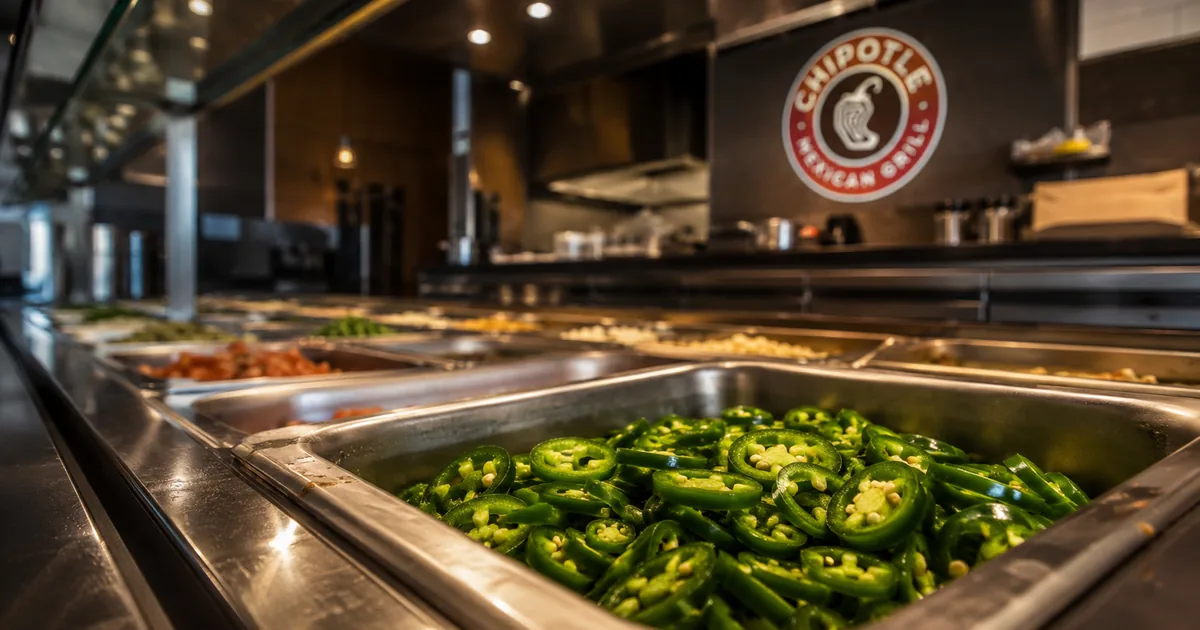
Minnesota has now counted 110 Salmonella Javiana infections tied to Mexican-style quick-service restaurants, and the ingredient investigators suspect was flagged first by a burrito chain reading its own purchase records.
Chipotle pulled the jalapeños on Tuesday and its stock fell about 9 percent, which is the part everyone covered; the part worth your attention is that the fastest food-safety system in this story was a private one.
That is less a compliment to Chipotle than an indictment of everything around it. A company volunteering its own lot data is the thinnest possible foundation for national food safety, and right now it is doing load-bearing work.
What Minnesota’s Interviews Actually Showed
The Minnesota Department of Health did this the old way, by calling sick people and asking what they ate. Of the 84 patients investigators managed to interview, 75, or 89 percent, had eaten at a Chipotle between June 14 and July 14, with most of those meals clustered in a nine-day window from June 24 to July 2. The people who had not eaten at Chipotle had eaten at other Mexican-style restaurants.
Carlota Medus, senior epidemiologist supervisor in the department’s Foodborne Diseases Unit, was careful not to let the finding collapse into a single brand. Medus said in a statement that “based on all the evidence so far, the food that made people sick was served at other restaurants as well,” and added that it is “too soon for us to know if the outbreak is ongoing.”
Read that second quote again, because it is the operative one. Nobody has told the public this is over.
A Company Found the Lot. The Federal File Still Reads “Not Identified.”
Here is the sequence that should bother you. As of its July 30 update, the Food and Drug Administration’s public outbreak table listed a Salmonella Javiana investigation at 212 illnesses, roughly double the 106 it had logged previously, with traceback conducted, sampling initiated, and the food vehicle still recorded as not identified. Days later the answer, or at least a strong candidate for it, arrived from a company’s inventory software.
Chipotle’s account of what it did is worth quoting in full, because it describes a capability the government has spent years trying to mandate. In a statement to Nation’s Restaurant News, the company said: “As part of our established health and safety protocols, upon learning of a potential outbreak, we immediately initiated our ingredient traceability system and were able to identify jalapeños as a potential common ingredient from a common lot, and the restaurants where it was distributed. Out of an abundance of caution, we proactively removed the jalapenos from our restaurants and replaced them with product from different growers.”
Identify the lot. Identify which restaurants received it. Pull it. That is the entire job, and a fast-casual chain did it out of its own records while the federal traceback was still collecting samples.
None of this is an accident of temperament. The federal rule that would have required lot-level tracing across the food supply, the FDA’s food traceability requirement, was pushed to 2028 and left without enforcement funding, which makes the ability to answer “where did this pepper come from” a corporate amenity rather than a legal baseline. Chipotle had it. Whoever else served those peppers may not.
The Recall Was Smaller Than the Headlines, and That Matters
Coverage on Tuesday split badly on a basic question: did Chipotle pull jalapeños nationwide or not? Several outlets said the chain removed them from restaurants across the country. The Associated Press said it pulled them from some restaurants. Both framings miss the shape of what actually happened.
The removal was keyed to the lot, not to a map. Medus said Chipotle took mitigation steps “including removing the suspected jalapeños from all the restaurants that received that product,” and peppers from that supply had reached multiple food service customers in more than one state. The correct answer is neither “every Chipotle in America” nor “a few stores in Minnesota.” It is every location that received the implicated product, wherever those turn out to be, which is a number the public has not been given.
The Restaurants Nobody Has Named
This is the gap the recall does not close. Minnesota’s own epidemiologist has said the contaminated food reached other restaurants. Those restaurants have not been named, and there is no obvious mechanism by which they will be named quickly, because naming them requires exactly the lot-level records Chipotle happened to keep and no rule currently forces anyone else to keep.
A diner who ate a jalapeño at a smaller Mexican restaurant in June has no way to learn whether it came off the same truck. The FDA is still sampling. The state is still interviewing. The one company with good records has cleared its own shelves and switched growers, which protects its customers and does nothing for anybody else’s.
Chipotle has been credited by the investigators themselves. Medus said the chain “has fully collaborated on every aspect of this investigation,” from turning over purchase records to acting immediately, and that the department is not currently concerned about the chain. That cooperation is real and worth saying out loud. It was also entirely voluntary.
What Is Still Unknown
Officials have not released hospitalization figures for this outbreak, and no deaths have been reported. That silence is not reassurance. Severity data typically lags by weeks, and Salmonella Javiana infections that never get cultured never get counted at all. The distance between 110 confirmed cases in one state and 212 on a federal table that names no food is a reminder that outbreak numbers are a floor rather than a measurement.
For anyone who ate at a Mexican-style restaurant in Minnesota in late June, the practical part comes from the Centers for Disease Control and Prevention, which puts the onset of salmonella symptoms at six hours to six days after exposure and the illness itself at four to seven days, with children under five, adults over 65, and immunocompromised people at higher risk of an infection serious enough to need treatment.
The FDA is carrying sixteen outbreak investigations on its table right now, six of them cyclospora, including the Midwest traceback that has already killed two people and still has not closed. This one at least has a suspect ingredient, which puts it ahead of most. It got there because a restaurant chain’s inventory system worked better than the federal one, and the next outbreak will turn on whether the company at its center kept the same kind of records. That is the system as it exists in August 2026, and it is fair to ask how long a country wants to run its food supply on that particular species of luck.