
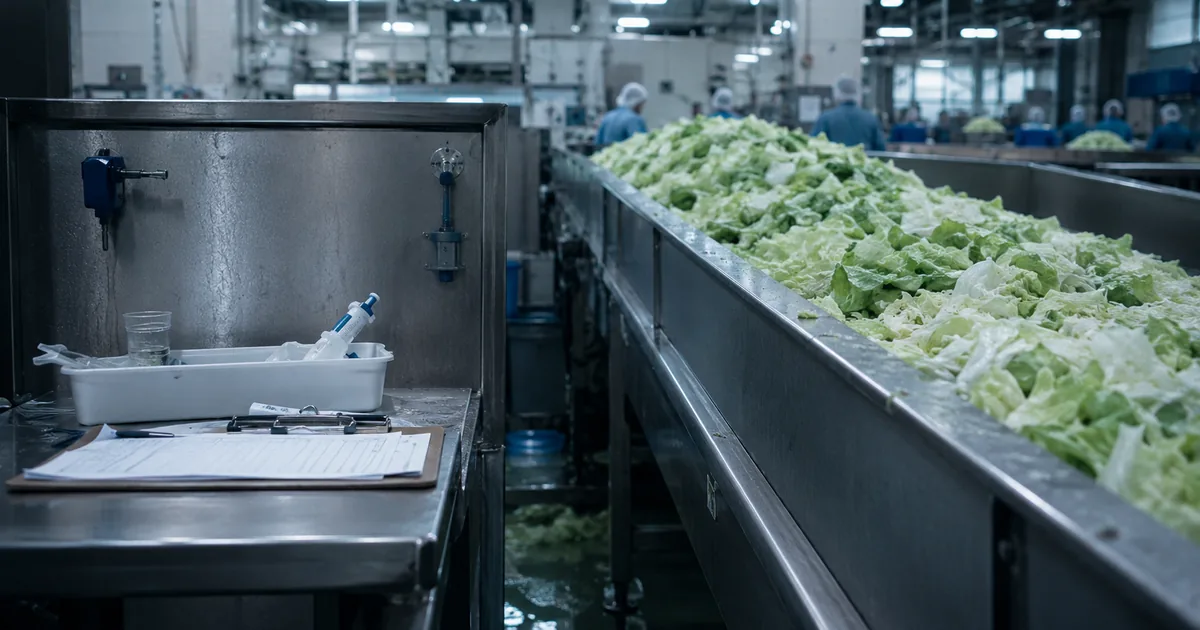
The rule that would have forced a single head of lettuce to be traceable back to a single field was supposed to take effect on January 20, 2026. Congress pushed it to July 20, 2028 and then wrote language into the FDA’s own appropriations bill barring the agency from spending a dollar to enforce it, and four months later Americans started getting sick from a parasite in shredded iceberg lettuce that investigators needed two months to identify.
That is the actual story behind the worst summer of foodborne illness in years, and it is not a story about a bad salad. It is a story about a set of deliberate decisions, made by identifiable people in public, to remove the machinery that finds contaminated food quickly. The cyclospora outbreak now spans dozens of states with thousands of confirmed and suspected cases. A separate salmonella outbreak tied to shell eggs triggered the recall of more than 1.5 million dozen eggs on July 22. Health and Human Services Secretary Robert F. Kennedy Jr. runs both agencies charged with responding, and his food agenda has almost nothing to do with either.
The Rule That Was Supposed to Make This Fast
Section 204 of the Food Safety Modernization Act is unglamorous plumbing. It requires companies handling high-risk foods, leafy greens very much included, to keep lot-level records that let an investigator walk a contaminated product back through every processor, distributor, and grower who touched it. Not in weeks. In hours.
The FDA finalized the rule in 2022 with a January 2026 compliance date, which gave the industry three years to prepare. In March 2025 the agency announced it wanted a 30-month extension, and the Federal Register notice formalizing the delay landed that August. Congress finished the job. A bill passed in November 2025 paused enforcement outright, and the fiscal 2026 agriculture and FDA appropriations act attached a funding prohibition, the legislative equivalent of unplugging a machine and then hiding the cord. The Congressional Research Service overview of the traceability rule lays out the sequence in dry procedural language that hides how one-sided the lobbying was.
The produce industry’s argument was that compliance is expensive and uneven, that a grower ready to comply is still stuck with partners who are not. That is true, and it was true in 2022, and it will be true in 2028. Complexity is a permanent condition of the food supply. It is also the most reliable argument available to anyone who would prefer the deadline never arrive.
Two Months to Name a Lettuce
Here is what the delay bought. The first cyclospora illnesses began in mid-May. The product was not publicly identified until July 17. For roughly two months, contaminated shredded iceberg from a fresh-cut processor moved through retail and restaurant supply chains while epidemiologists worked backward from patient interviews, the slow method, the one traceability records were designed to replace.
Cyclospora is a particularly cruel test case because it does not behave like the pathogens most Americans have heard of. Incubation runs a week or more, symptoms can persist for weeks without treatment, and by the time a cluster becomes visible the implicated produce is usually eaten or thrown out. Speed is not a nice-to-have in that scenario. Speed is the entire intervention.
The parasite also happens to be one of the six pathogens the Centers for Disease Control and Prevention dropped when it narrowed its FoodNet surveillance program from eight pathogens to two in 2025. Food-safety researchers have been careful to say that FoodNet is a trend-monitoring system rather than an outbreak-detection system, and that the cut did not cause this outbreak. They are right, and the distinction matters less than it sounds. We covered how the CDC’s cuts collided with three simultaneous outbreaks earlier this month. Losing baseline data on a parasite is how you lose the ability to notice when that parasite is behaving abnormally, which is the thing that prompts anyone to look in the first place.
Kennedy Is Fighting a Different War
Kennedy came into the job declaring the American food supply the primary culprit poisoning the country. His enforcement energy has gone almost entirely toward chemistry: synthetic dyes, the Generally Recognized as Safe self-certification pathway, ultra-processed foods, refined carbohydrates and the petition to strip corn syrup and similar ingredients of their GRAS status. Some of that agenda has genuine merit. The GRAS loophole really does let companies vouch for their own additives with minimal federal review, and closing it would be a real win.
But dye bans do not find a contaminated field in Guanajuato, and a fight over corn syrup does not staff a laboratory. Pathogens are a different discipline with different infrastructure: inspectors, proficiency testing, sequencing capacity, epidemiologists, and records that link a lot number to a farm. That infrastructure has been cut hard since early 2025, with thousands of FDA staff pushed out and the agency’s inspection and communications functions thinned out along the way, as CNBC reported this week in its account of the outbreak response. Senators including Amy Klobuchar and Jon Ossoff spent mid-July writing letters to Kennedy demanding answers about the surveillance cuts, which is roughly the level of leverage Congress retains after voting to defund the enforcement it now wants explained.
There is a coherent worldview in which all of this fits together. It holds that the federal food-safety apparatus is captured and bloated, that industry cooperation beats federal mandates, and that the real threat is chronic disease from additives rather than acute illness from pathogens. You can hold that view honestly. What you cannot do is hold it while two active multistate outbreaks are running, and while the specific tool that would shorten the next investigation sits unfunded until 2028 at the industry’s request.
The Eggs Are the Tell
The salmonella outbreak is the quieter story and the more damning one. The CDC’s investigation into shell eggs counts 98 confirmed infections across 17 states and 26 hospitalizations, with illness onsets stretching from November 2025 through June 2026. Seven months of infections before a recall. The FDA’s outbreak page links the cases to a single producer whose eggs reached shelves under at least five brand names, including store labels at Kroger.
One outbreak is bad luck. Two concurrent multistate outbreaks, one of them running quietly for seven months, is a detection problem. And the case counts we are debating are the confirmed ones, the fraction of people sick enough to see a doctor who then received the right test. The true totals are multiples higher and always have been.
Nothing about the next twelve months changes this arithmetic. The traceability records stay optional until July 2028, the surveillance stays narrowed, and the staff who ran the labs are not coming back on a supplemental appropriation. The question worth asking every member who voted for that funding prohibition is simple: what is the number of sick Americans that would have made 2026 the right deadline after all?