
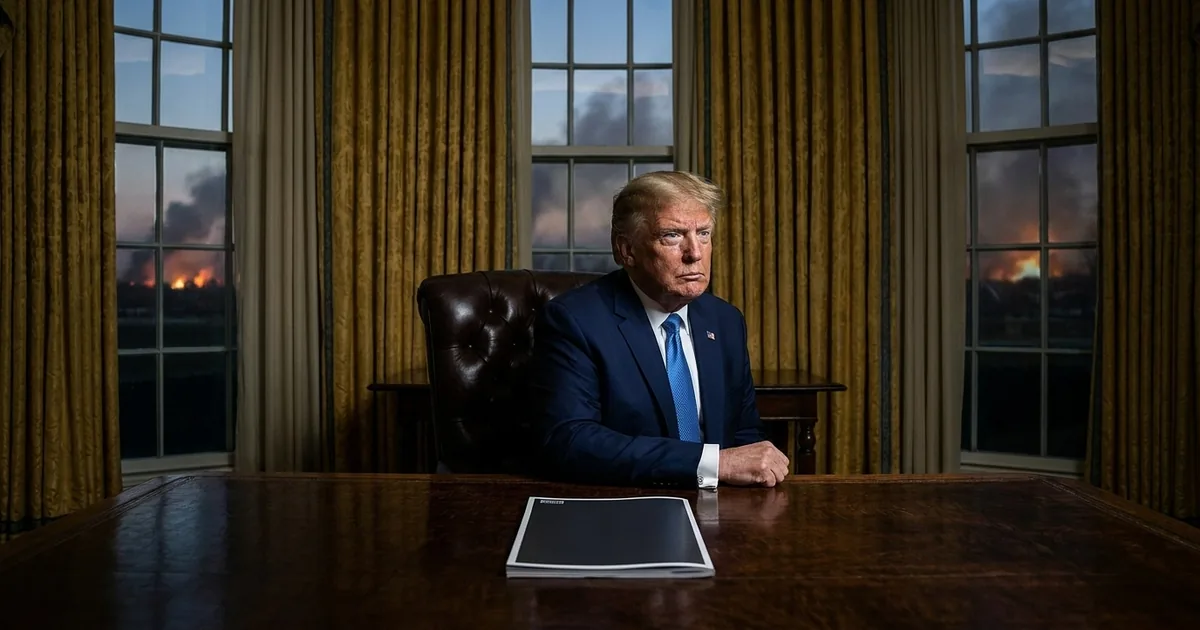
President Donald Trump told TIME in a White House interview published Wednesday that he kept bombing Iran past the point where he needed to: “I could have stopped then, but I wanted to go further,” he said, and he is not ruling out resuming the campaign after the midterms. The admission sits inside a 75-minute transcript that TIME’s own fact-checkers had to go back and correct in six separate places, which tells you almost as much about the interview as the admission does.
Eric Cortellessa and Sam Jacobs sat down with Trump in the Oval Office on September 28 for what became TIME’s cover package, his 56th appearance on that cover, more than any president in the magazine’s history, including Richard Nixon. CNN’s media critic Brian Stelter told readers to go read the raw transcript before doing anything else that day. He was right that it is worth reading, mostly because of what it reveals by accident.
The War He Says He Chose to Extend
Asked why the Iran war had run seven months past the four-to-five-week window he promised publicly, Trump did not dispute the timeline. He owned it. “I could have stopped then, but I wanted to go further,” he told TIME, describing the strikes that followed the B-2 bombing runs as a choice rather than a necessity. Pressed on how a president who calls himself a peacemaker squares that with threatening to “annihilate” Iran, his answer was that the annihilation itself would be the peace: “By annihilating Iran, we’ve created peace in the world.”
He also confirmed, for the first time on the record, that the Strait of Hormuz closure is still in effect on his orders and that Tehran’s own proposal to reopen it was not enough for him to accept a ceasefire. “They made an offer to open the strait. You saw some aspects of it, not all, but it’s just not good enough,” he said, before telling TIME that another round of bombing after the November midterms is “possible.”
That is the real headline buried in the transcript. A sitting president told a national magazine, on the record, that a war he had publicly promised to end in weeks continued because he personally preferred it that way, and that whether it restarts again depends partly on an election. Axios counted it among its five takeaways, and so did CNN, but neither outlet sat with the plainer fact underneath: he was not asked to justify the war’s length. He volunteered that he liked having gone further.
We have covered the collapse of the ceasefire Trump himself ordered once before, when the pause he announced was never put in writing and fell apart within days. This interview is the closest thing to a confession that the pattern was never an accident.
Six Numbers TIME Had to Correct
The same looseness with the war showed up everywhere else Trump talked, and TIME’s own researchers ended up publishing a separate fact-check alongside the transcript to clean up after him. Laid side by side, the gap is not a rounding error.
What Trump Told TIME
- Iran “killed anywhere from 70, 72,000, 75,000” of its own protesters.
- Iran’s inflation is “300% or something like that.”
- He “won 86% of the popular vote” in 2024.
- His convention speech drew “107 million views,” beating the NFL’s 25 million.
- He has the “lowest poverty rate ever,” full stop.
- The US has “more manufacturing jobs coming online than at any time in history.”
What TIME’s Fact-Check Found
- Iranian state media reported 3,117 deaths; outside estimates run as high as 30,000 to 35,000.
- Iran’s central bank reported 83.8% inflation in late September.
- He won 49.8% of the popular vote; 86 was his electoral-vote margin, not a vote share.
- Nielsen measured 2.5 million average viewers on Fox; the NFL game drew 25.1 million.
- The official rate is the lowest on record, but the supplemental measure sits at 13.1%, above its 2021 low.
- Manufacturing peaked in 1979 at 19.6 million jobs; the current total is 12.6 million.
None of these numbers needed to be wrong. Iran’s real inflation rate is still a crisis. The real death toll from its crackdowns is still a mass killing. Trump inflated figures that were already bad for the regime he was criticizing, which is the detail that separates this from ordinary spin: there was no strategic reason to lie, he just did.
The pattern carried straight into the one subject where precision should matter most to him personally. Trump spent part of the interview describing his September 28 dinner with Anthropic CEO Dario Amodei in warm, vague terms, “very smart guy, maybe different than I thought, a little bit,” before pivoting to what he actually wants from the AI industry: no binding rules. “If you’re going to seek regulation, they can put you out of business,” he told TIME, which is less a safety philosophy than a warning to the one lab that has pushed hardest for guardrails.
The day after that dinner, Trump hosted Amodei alongside Mark Zuckerberg, Sundar Pichai, Jensen Huang and Elon Musk to sign a voluntary accord on “Superintelligence” that Trump called “morally binding” and nothing more, an event CNN covered in detail. Footage from the press availability that followed shows the moment that actually went viral: Amodei physically stepping back and raising his hands as Trump pivoted to attacking “fake news” reporters mid-answer.
Watch it next to the TIME transcript and the clip reads differently than the meme treatment it got online. It is not an awkward CEO having a bad camera moment. It is the clearest available picture of what “self-policing” actually looks like in practice: the person who signed the accord physically recoiling from the man he signed it with, in real time, rather than correct him.
Grievance and Gold Leaf as a Governing Style
Ask Trump about the free press and the answer is a formula at this point: “I do respect the free press, but I don’t respect fake news.” What follows it in this interview is less rehearsed. He called CNN’s Kaitlan Collins “the most unhappy young person I’ve ever seen,” floated adding the New York Times to his White House access restrictions, and renamed MSNBC “MSDNC” for the length of the conversation. Mediaite counted two more lines nobody else led with: Trump said he regrets nominating all three of his own Supreme Court picks because they “voted against me too often,” and he raised pardoning his own administration officials before he leaves office, unprompted, while discussing what Democrats might do to him if they win the House.
The same interview circled back, repeatedly, to the physical White House itself. Trump told TIME he wants the gold-trimmed Oval Office declared a protected landmark, called the building “a disgusting mess” when he arrived, and pointed to the roughly $400 million ballroom replacing the demolished East Wing and the Lockheed Martin-funded helipad as the record he wants remembered. On the Kennedy Center, where Congress approved more than $250 million for renovations he has pushed to attach his name to, he would not commit to anything on demolition. Near the end of the interview, by TIME’s account, he complained that reporters had not asked him “one fucking positive question.”
That is the throughline the straight takeaway pieces mostly missed: whether the subject was Iran, the Federal Reserve, the AI industry or the midterms, Trump’s answers kept routing back to the same two places, a grievance against the press covering him and a monument to how he wants to be remembered. On the economy, he would not say whether he regrets nominating Kevin Warsh to the Fed, only that the board still has “Obama and Biden picks” slowing him down, even as the national debt crossed $40 trillion on his watch. On the midterms, he predicted Republicans would “do okay,” then said Democrats will “probably go after me and I’ll go after them” if they don’t, and would not rule out deploying ICE agents to polling places or invoking the Insurrection Act if the result doesn’t go his way. His own cratering approval numbers, he said, are simply “fake.”
We’ll say plainly what the straight recap pieces won’t: a president who cannot accurately state his own country’s inflation rate, let alone an adversary’s, going on the record about resuming a war and not ruling out federal agents at polling places is not a collection of unrelated gaffes. It’s a pattern of someone who treats facts as optional whenever the real numbers are less flattering than the story he wants told, and the people now attaching their names to his AI policy, their Superintelligence accord included, are building that policy on top of it.
TIME’s transcript runs another hour past what’s covered here. The midterms are five weeks out, and by Trump’s own account in this interview, whether the Iran war starts back up again may hinge on how they go.