
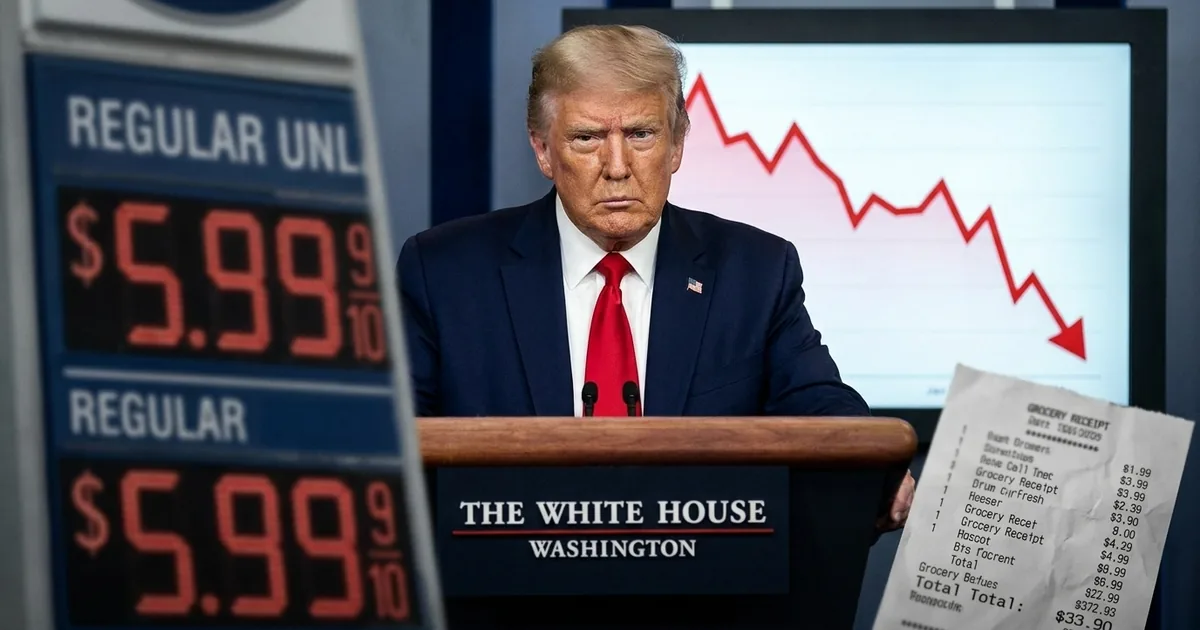
Only 26% of Americans now approve of Donald Trump’s handling of the economy, according to a new AP-NORC poll released Wednesday, the lowest economic rating of his two terms and two points below Joe Biden’s worst showing in the same survey. The topline is bad for the White House. The number that should frighten Republicans five weeks from the midterms is a different one, and most coverage has buried it.
That number is blame. Sixty-five percent of adults now say Trump’s own policies are responsible for high prices. When Biden sat at 28% on the economy in 2022, only 44% blamed him, and a majority pinned inflation on forces outside his control. Biden had an excuse voters accepted. Trump, on these numbers, does not.
The Floor Keeps Moving
Read the decline as a slope rather than a single bad week. The poll of 2,140 adults, taken September 24 to 28 from NORC’s probability-based AmeriSpeak panel with a margin of error of plus or minus 2.9 points, puts his economic approval 14 points below where it stood in March 2025.
On the cost of living specifically, the figure is 17%. Roughly half of adults are now extremely or very concerned about filling the gas tank, up from 39% in July, and about the same share say so about affording groceries. His overall job approval sits near 30%, consistent with the sub-30 reading LNC covered last week from American Research Group.
Why the Blame Split Matters More Than the Approval
Here is the mechanism. A president with a low economic rating can survive if voters think the economy is happening to him. That was Biden’s shield: pandemic supply chains, a war in Ukraine, a global inflation wave. Voters were unhappy, but most did not think he caused it.
Trump has spent eighteen months removing that shield himself. Tariffs are a policy he announced, raised and defended on camera. The war with Iran, which 69% now say was not worth fighting, is a decision he made. When you sign the orders that move prices, you own the prices.
One Voter Who Explains the Whole Poll
Pedro Sanchez, 52, works in law enforcement in Perris, California, and voted for Trump. He told AP that rising costs have eaten his disposable income, and he was precise about who he holds responsible.
“This war in Iran, the tariffs that he’s placing on other countries, obviously are affecting us. Those two things are things he’s been directly involved in that directly affect the economy. I think with Biden, a lot of the stuff was outside of his control.”
Read that again. A Trump voter is extending to Biden the exact defense he refuses to extend to Trump. That is what the 65% looks like at the kitchen table, and it is why this poll differs from the dozen bad approval numbers before it. Sanchez is not a convert to the other side. He is a supporter doing arithmetic.
The Republican Exception Is Shrinking
You will hear the White House point to its base, and the base is still there, up to a point. Two thirds of Republicans still say high prices come from factors outside Trump’s control. But about 60% of Republicans now disapprove of how he is handling the cost of living, up from roughly half in April.
Robert Gault, a 66-year-old retired factory worker and Republican from Bradford, Pennsylvania, told AP he had not seen Trump “Make America Great Again” on the economy. Kristen Slaven, a Republican therapist in Gluckstadt, Mississippi, singled out the administration’s appetite for renaming bodies of water while families struggle to eat. Those are not swing voters. They are the people a midterm turnout operation depends on.
The Rest of the Ledger
The economy is not an isolated weak spot. Approval on trade negotiations has fallen to about 30% from about 40% in March, and 64% say he has gone too far on tariffs, up from 58% in January. Only 28% approve of his handling of the Iran war. Border security, at around 50%, is the one issue where he still breaks even, and it is no longer what voters are asking about. Roughly six in ten say the country is worse off than when his second term began. AP-NORC’s own running tracker on economic approval shows no sustained recovery at any point this year.
Our Read
This site’s view is plain: the administration’s economic problem is not messaging, and it is not a hangover from Biden. It is the predictable result of two choices, broad tariffs and a war in the Persian Gulf, that both push prices up, and voters have correctly connected cause and effect. No press strategy fixes that, because the evidence arrives every time someone pays for gas.
The honest fix would be to unwind the tariffs doing the damage. The White House has shown no sign it will, and five weeks is not enough time for a reversal to reach the pump anyway. So the question for November is not whether economic anger exists. It is whether the two thirds of Republicans still giving Trump a pass hold that line long enough to vote, or start sounding like Pedro Sanchez.