
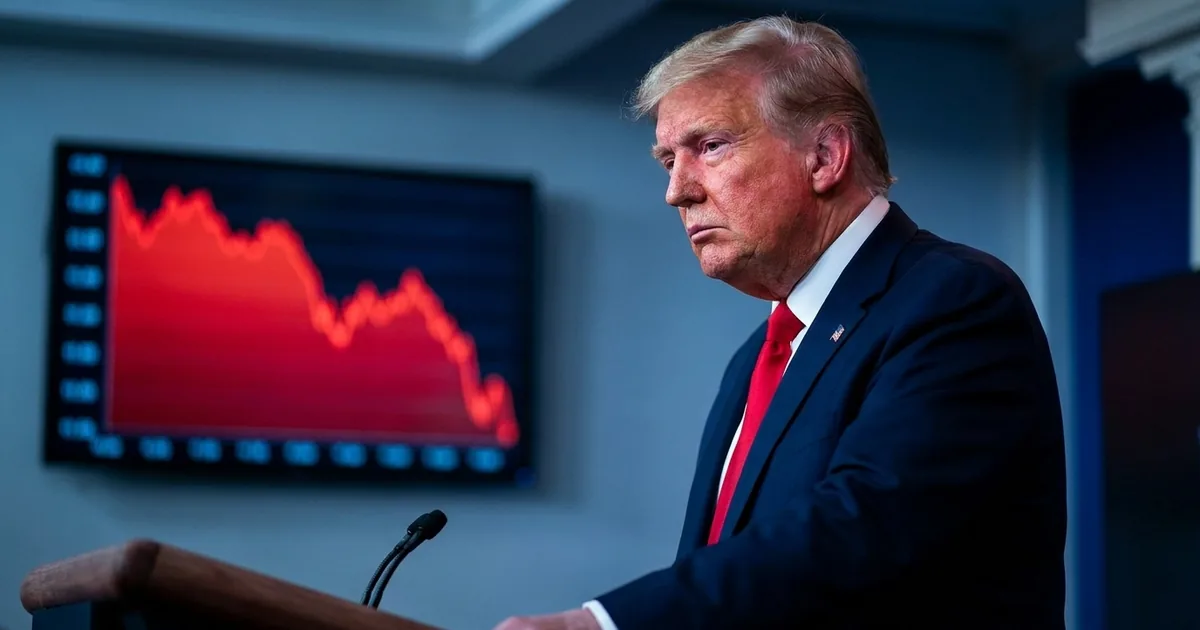
Donald Trump’s approval rating has dropped into the 20s for the first time in either of his presidencies, with American Research Group putting him at 29 percent in a national survey taken September 16 to 20. Most of the coverage stopped at that topline, which undersells it: inside the same poll, only 65 percent of Republicans approve of him, and he is above water in just nine states.
Newsweek reported Monday that ARG surveyed 1,100 adults and found 29 percent approving and 68 percent disapproving, with disapproval up two points from August. ARG, the Manchester, New Hampshire firm that publishes a monthly read on presidential approval, had him at 30 percent in June, July and August. Three months pinned at exactly 30, then a break. Newsweek described it as the first sub-30 reading of either term. The last president to poll that low, Newsweek noted, was George W. Bush at the end of 2008.
The internals are harsher than the headline. Democrats are at 1 percent approval, which surprises nobody. Independents are at 26. Republicans are at 65, meaning roughly one in three people who identify with his own party do not say they approve of the job he is doing. A year ago that would have read as a typo. On the economy, overall approval sits at 26 percent, with 71 percent disapproving. Asked about the year ahead, 70 percent expect the economy to get worse and 6 percent expect it to improve. Three in four describe their household finances as negative.
Then the map. ARG found Trump with positive approval in nine states: Wyoming, North Dakota, West Virginia, Arkansas, Alabama, Idaho, Kansas, Oklahoma and Montana. Every one of them is small, rural and deep red. Not one competitive state is on the list. Not Texas, not Florida, not Ohio, not Georgia. A president who carried 31 states in 2024 is above water in nine of them, by this pollster’s count, six weeks before a midterm his party needs to hold both chambers.
Is ARG an outlier? It runs lower than most firms, and that deserves saying plainly. The major averages had Trump near 38 percent as of September 18. But the direction is not ARG’s alone, and neither is the reason. Ipsos’s release on the Reuters poll taken September 17 to 20 put him at 32 percent, the lowest Reuters/Ipsos has ever recorded for him, with Republican approval down from 86 percent in January to 73. The Strength In Numbers/Verasight survey released Wednesday had him at 33, the worst reading in 16 waves, with his net approval among Republicans down 11 points in a single month. Three firms, three methods, the same week, and the same result: a new low, driven by his own voters.
The issue is the same everywhere too. In the Reuters/Ipsos numbers, Republicans rating Trump’s handling of the cost of living fell from 70 percent to 44 since January. Verasight has him at 21 percent approval on prices overall. ARG’s 26 percent on the economy fits right alongside. Trump ran in 2024 on grocery prices and gas. Twenty months in, the people who believed him are telling pollsters, in three separate surveys, that he has not delivered.
Here is where we land. The 29 matters not because ARG is the final word on his standing, but because it marks the point where a pollster that had held steady at 30 for a quarter finally watched the floor give way, and it gave way among Republicans. Trump’s approval floor was always described as unbreakable because his base approved of him regardless of what happened. A base at 65 percent in one poll and 73 in another is not a floor. It is a leak. That is a verdict on the economy, delivered by the voters Trump most needs to believe his account of it, and no amount of spin about “fake polls” changes the price of a gallon of gas.
The White House’s answer has been to offer money. At the Republican midterm convention in Dallas on September 9, Trump promised a $5,000 “Trump dividend” to every American adult, payable only if Republicans keep both chambers of Congress. Across roughly 270 million adults, that comes to about $1.35 trillion. Rep. Chip Roy asked how it would be paid for, and former Freedom Caucus chair Bob Good called it a “socialist vote-buying scheme.” Our read is simpler. A cash payment conditional on how the country votes is a bribe with a campaign logo on it. ARG’s number came in less than two weeks later, and it went down, not up.
None of this arrived overnight. LNC tracked approval sinking to 34 percent in July, as the Pentagon quietly revised its own war-dead count. By mid-September, with approval at 32 and Democrats leading Senate polls in Texas and Alaska, the damage had reached the midterm map. The explanations have not changed across any of it: a war with Iran still escalating, prices still climbing, and a president who keeps treating both as someone else’s problem. Kyle Kondik of the University of Virginia’s Center for Politics told Newsweek that Trump’s numbers “are worse now than they were eight years ago,” and pointed to inflation.
Bush reached the 20s in the eighth year of his presidency, with a financial crisis underway. Trump got there in the second year of his second term, with a Republican Congress on the ballot in six weeks. The question now is not whether other pollsters follow ARG below 30. It is how many Republican candidates decide, before November 3, that they would rather run as themselves than as his candidates.