
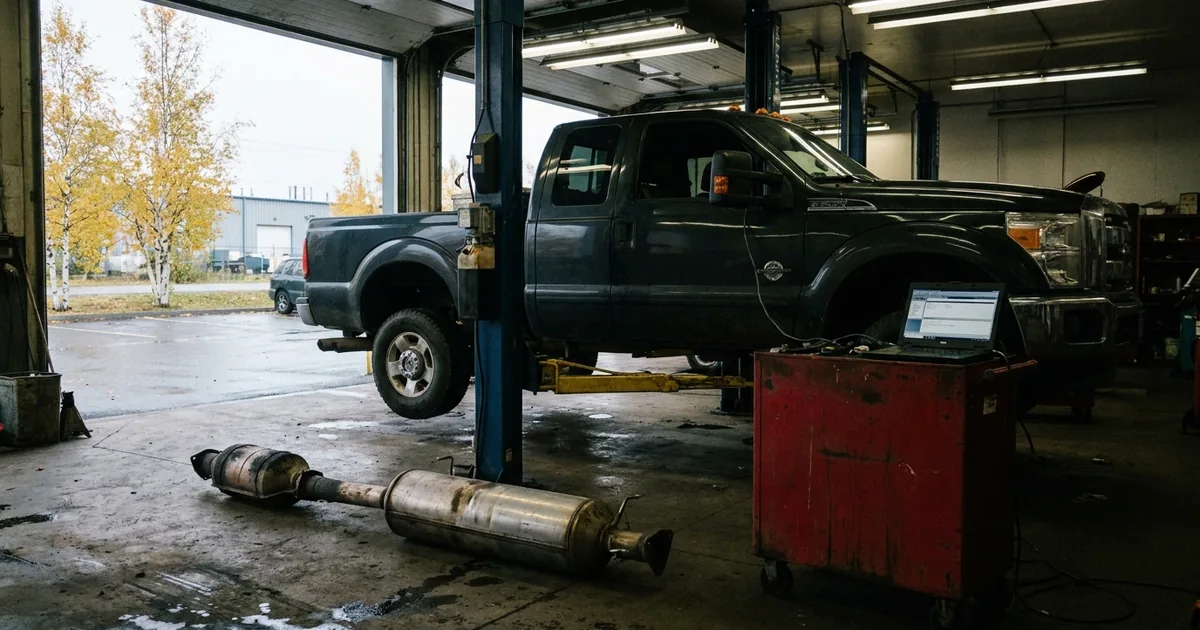
Donald Trump stood at a podium in Wasilla on Tuesday night, signed pardons for two Anchorage diesel mechanics, and told the crowd the government had wanted “to put him in jail for 10 years because they fixed an engine.” The men pleaded guilty in 2022 to a federal conspiracy charge that cannot carry 10 years, none of the three shop owners served a day, and the trucks they “fixed” were deleted in 2019 and 2020 under Trump’s own EPA, which that November published a report counting how many trucks like them were on the road.
“And when you undo that, you therefore send fumes into the air.”
Donald Trump, describing the diesel work he was pardoning, Wasilla, Alaska, October 13, 2026
That line is the most honest thing said on that stage, and it came from the man holding the pen. The morning coverage has the pardons, the cheering and the “newborn baby” joke, and some of it notes the men got probation. None of it checks the speech against the statute the men pleaded to, or against the dates, so here is that check, and here is how to read it.
The two men are Zachary Czubak and Patrick Fleming, co-owners with Michael Hanzuk II of an Anchorage shop called Arm Rippin Toys. Trump called them onto the stage, said “Bring me the pardons,” signed at the podium and held one up to the crowd, as CBS News reported from the rally. Hanzuk, the third owner, had already been pardoned last month. Trump said he was “taking care of” a third person without naming him.
What the Court Record Says
Start with the charge, because the “10 years” depends on you not knowing it. In November 2022 all three owners pleaded guilty to conspiracy to violate the Clean Air Act, according to the U.S. Attorney’s Office in Alaska. Conspiracy against the United States is charged under 18 U.S.C. 371, and the statute sets the ceiling in one sentence: a fine, imprisonment of “not more than five years,” or both. So the number Trump gave the crowd is double the legal maximum for the crime the men admitted.
Then look at what the judge actually did. Czubak was sentenced to five years of probation, a $66,000 fine and 180 hours of community service. Hanzuk got the same, plus one condition the rally did not mention: “a public statement acknowledging wrongdoing.” Fleming was sentenced later on the same terms. Nobody went to prison. Nobody was ever going to serve 10 years, because the law the men pleaded to does not allow it.
Now the conduct. Prosecutors said the owners agreed in July 2019 to start “tuning and deleting” customers’ diesel trucks, and between then and September 2020 they removed emissions control equipment and rewrote the onboard diagnostics on at least 37 vehicles so the trucks would run without the parts and without throwing a warning. They charged between $1,140 and $5,445 a truck and took in about $100,000. Divide it out and that is roughly $2,700 per truck.
You can do one more piece of arithmetic with the record. Three owners, three $66,000 fines, is $198,000, about twice what the shop collected for the deletes. The court that handled this case did not see an engine repair. It saw a business and priced the penalty above the revenue, which is what a fine is for.
Here is what a delete does, in the government’s own numbers from that 2022 release. Pulling a diesel’s emissions controls can raise particulate matter about 40 times, nitrogen oxides about 310 times, carbon monoxide about 120 times and unburned hydrocarbons about 1,100 times. Trump described the same process from the stage in plainer words. If you let people fix the engines, he said, “they’re going to take all of the environmental crap that makes it bad,” and “when you undo that, you therefore send fumes into the air.” He had called the prosecution “sick” a minute earlier. Read those sentences together and he has described the offense accurately and objected only to its being prosecuted.
The dates matter too. Every one of those 37 deletes happened between July 2019 and September 2020, during Trump’s first term, under an EPA he appointed. Two months after the last of them, in November 2020, that EPA’s Air Enforcement Division put out a report on tampered diesel pickups estimating that emissions controls had been stripped from more than 550,000 of them over the prior decade, adding more than 570,000 tons of nitrogen oxides to the air over the trucks’ lifetimes. The “Biden-era” case Trump says “viciously targeted the Alaskan way of life” prosecuted conduct his own administration had just finished measuring as a national problem.
If you were watching the stream, the order of events tells you what the pardons were for.
Trump first told the story of Mac Spurlock, a Wasilla diesel mechanic he pardoned in July. He said Mary Peltola, Sen. Dan Sullivan’s Democratic opponent, “did not say a single word in the trucker’s defense,” that Sullivan and Rep. Nick Begich did, and that “at their urging, I gave him a full unconditional pardon.” Then he brought up Czubak and Fleming, signed, and let Fleming speak (“It really did destroy us. It destroyed friendships. It destroyed families.”). The rally existed to help Sullivan hold a seat in a race where Democrats have led recent polling, and the clemency power was used as the evening’s testimonial.
The Fumes Do Not Get a Pardon
Here is where we land. These pardons do not correct an injustice. They are a campaign prop built on a number that is false on the face of the statute, and on a description of the crime (“they fixed an engine”) that Trump himself contradicted two minutes later.
They are also policy theater with no policy left in them. In January the Justice Department said it would no longer bring criminal cases over tampering with onboard diagnostic devices, and a memo from Deputy Attorney General Todd Blanche ordered prosecutors to drop existing criminal cases over the sale of defeat devices. Nobody is being charged for this anymore. The only thing left to do with the old cases was to turn them into a moment on a stage, and on Tuesday that is what happened.
The cold-weather argument deserves a straight answer, because it is the strongest thing the defenders have. Spurlock and Sullivan say emissions systems fail in deep Alaska cold and can strand a driver, and Sullivan has a bill that would make the EPA rewrite its rule for cold climates. If the failure is real, that bill, or an EPA rule written in public with data, is the answer, because it would cover every Alaskan. A shop charging up to $5,445 a truck to strip the equipment out is not the answer, and neither is clemency handed only to the people who did that and then turned up at a rally. When Spurlock was pardoned in July, his sentence had been five years of probation and a $32,000 fine, and Trump announced it by saying six people had been persecuted “for ‘fixing their car.'” The phrase was wrong then and it is wrong now.
The people who breathe a deleted truck’s exhaust do not get a pardon. They live wherever deleted trucks drive, and by the government’s own figures they take in nitrogen oxides at hundreds of times what the same truck emits with its controls in place. Trump flew eight hours each way, as he reminded the crowd, to tell them the men who sold that pollution were the victims.
What should happen next is simple and probably will not. Sullivan, who applauded the July pardon and whose campaign Tuesday’s rally was held to help, should say whether he thinks deleting a diesel is legal today, and if it is not, why the men who did it 37 times were the night’s guests. And if the administration believes the cold-weather case, it should write the rule instead of the pardons.