
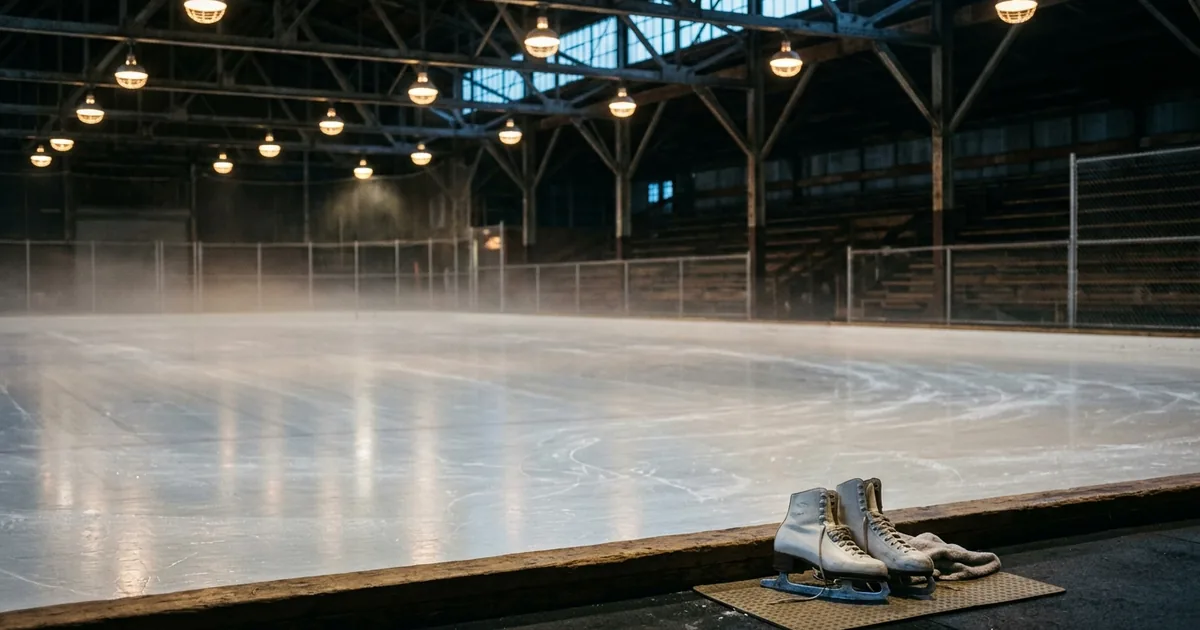
Peggy Fleming is the most-searched name in the United States today, which is an odd thing for a 1968 Olympic champion to be in August 2026.
The reason is a CNN documentary series that went back to something American sports has never fully processed: the morning an entire national team stopped existing.
Everyone on Board, Plus a Farmer in a Field
Sabena Flight 548 left New York carrying the United States figure skating delegation to the World Championships in Prague. On February 15, 1961, the Boeing 707 came apart on approach to Brussels Airport. All 72 people aboard were killed. So was Theo de Laet, a young farmer working a field near the crash site, struck by a piece of aluminum from the aircraft. A second field worker survived and lost part of a leg.
Thirty-four of the dead were the American delegation: 18 skaters, and 16 coaches, judges, officials and family members traveling with them. Not the roster. The program. Every athlete the United States would have entered, and most of the adults who knew how to develop the next ones.
The International Skating Union cancelled the 1961 World Championships by telegram. The cause of the crash was never determined; investigators suspected a failure in the flight control system and could not prove it. That detail has aged strangely. Sixty-five years on, a modern aviation investigation would almost certainly find an answer, and the absence of one here is a reminder of how much of 1961 is simply unrecoverable.
The delegation was not an abstraction. It included Laurence Owen, 16 years old, who had won the US ladies title in January and appeared on the cover of Sports Illustrated on February 13, two days before the crash, billed as America’s most exciting girl skater. Her older sister Maribel was the reigning US pairs champion with her partner Dudley Richards. Their mother, Maribel Vinson-Owen, was a nine-time US champion, a 1932 Olympic bronze medalist and by then the most influential coach in the country. All of them were on the aircraft. Smithsonian’s account of the crash notes that a copy of that Sports Illustrated issue was recovered from the wreckage.
One family, two generations of champions and the coaching lineage attached to them, erased in a single approach to a single airport. That is the kind of concentration risk governing bodies across sport now write travel rules about, and the reason those rules exist traces in part to this flight.
What “Rebuilding” Actually Required
The phrase that gets used is that US figure skating rebuilt itself in seven years. It is true and it undersells the problem. A national team is not primarily a group of athletes. It is a transmission system: coaches who learned from earlier coaches, judges who understand what a program is supposed to look like, clubs and parents and a rough consensus about technique. Kill the athletes and you lose a cycle. Kill the coaches and judges in the same crash and you lose the mechanism that produces cycles.
Peggy Fleming was 12 years old and had been working with her coach, Bill Kipp, for about a year. He died in Brussels. So did most of the people who would otherwise have taught the coach who replaced him.
What happened next is the part that deserves more attention than the tragedy itself, because it is the part with a lesson in it. Eight days after the crash, on February 23, 1961, US Figure Skating created a memorial fund and pointed it at a mundane problem: paying for the training and education of skaters who could not otherwise afford either. NBC Sports traced how that fund became the team’s actual legacy, and it now holds roughly $20 million in assets.
That is not a sentimental gesture. It is an institutional response to an institutional failure, and it widened the funnel at exactly the moment the sport had no depth left to draw on. Fleming came up through the years when that structure was being assembled around her.
Why the Story Keeps Coming Back
CNN’s account of Fleming carrying a nation’s hopes frames her 1968 gold in Grenoble as the moment the rebuild finished, and there is a case for it. She was 19, she took first-place votes from all nine judges, and hers was the only gold the United States won at those Games. She won it on television, in the years when the Winter Olympics were turning into a mass broadcast event rather than a niche one, and the image went into a lot of American living rooms at once.
But the reason this story resurfaces every few years, as it did on the anniversary coverage TODAY ran, is not really about medals. It is that a single mechanical failure erased a discipline’s entire human infrastructure in about four minutes, and the sport’s answer was to spend a decade quietly funding kids. Nobody framed that as heroism at the time. It was closer to bookkeeping.
Fleming has spent the six decades since being described as the person who saved American figure skating, which she has consistently declined to accept. She was one skater. The thing that actually saved it was a decision by a governing body to pay for other people’s children to learn.
That is a harder story to put in a documentary than a gold medal, and it is the one worth searching for.