
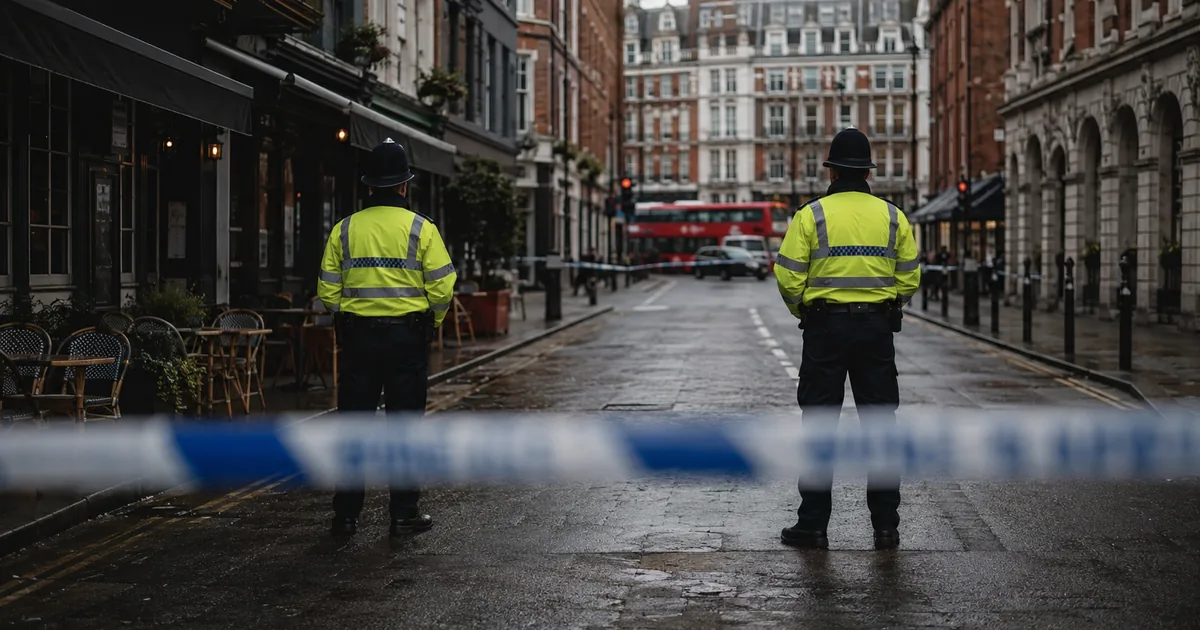
Four men were stabbed on Endell Street in Covent Garden just after 12:27pm on Wednesday, and a 47-year-old woman was in custody within minutes.
The most consequential thing the Metropolitan Police did in the hours that followed was not the arrest, it was a single adjective.
What Happened on Endell Street
The men were 34, 39, 42 and 52. All four were taken to a major trauma centre, and the Associated Press reported that two were discharged the same afternoon while two remained hospitalised with injuries not believed to be life-threatening. Officers recovered a pair of small scissors at the scene. The woman was arrested on suspicion of possession of an offensive weapon and assault, and she remains in custody.
The location matters to how this landed. Endell Street runs north out of Covent Garden toward Bloomsbury, a few doors from the Shaftesbury Theatre, in the stretch of central London that absorbs the highest density of tourists in the country on a Wednesday lunchtime. RTE spoke to witnesses who described a woman who appeared “quite incoherent” and who, in the account of a nearby restaurant manager, Arjan Gjorga, “just started stabbing random people.” That is the raw material of a panic. By mid-afternoon there was a cordon, and several thousand phones pointed at it.
‘Isolated’ Is a Statement About a Network, Not About a Person
Here is what Chief Superintendent Jason Stewart said, and it is worth reading slowly: “Officers responded within minutes of this incident after receiving a number of reports. While still at an early stage of the investigation, we would like to reassure the community that we currently believe this to be an isolated, mental health related incident.”
Two claims are doing very different jobs in that sentence.
“Isolated” is an operational statement about whether anyone else is coming. It tells Londoners there is no second attacker, no cell, no plan, and that the cordon can come down. Police can say that with reasonable confidence early, because it rests on things they can actually check inside an hour: witness accounts, CCTV, whether the suspect acted alone, whether anything at the scene suggests coordination.
“Mental health related” is not that. It is a claim about why, offered before a single interview under caution has concluded, before any assessment, before charges. As CNN’s account of the day makes clear, the force had barely finished counting victims. The motive category was already public, already in every wire story, and already functioning as the answer to the question the city was asking.
Southport Rewrote the Playbook, and This Is the Rewrite Running Live
The reflex is not carelessness. It is policy, and it was purchased at enormous cost.
On 29 July 2024, three girls were killed at a dance class in Southport. In the hours afterward, police said almost nothing about the suspect, and the space they left did not stay empty. A false name and a false claim that the attacker was an asylum seeker spread across social platforms and, as CNN documented at the time, produced the worst public disorder England had seen in more than a decade, with mosques attacked and hotels housing asylum seekers set alight in multiple cities.
The official post-mortem was blunt about the mechanism. His Majesty’s Inspectorate of Constabulary reviewed the disorder and told forces they must fill information voids online, warning, in findings summarised by Press Gazette, that if police fail to communicate the facts repeatedly and continuously then others will take over the narrative. The Law Commission has since argued for earlier release of suspect details on the same reasoning, and the National Police Chiefs’ Council and the College of Policing loosened what forces can disclose about a suspect’s ethnicity and nationality in high-profile cases. When Merseyside Police named the Liverpool parade crash suspect as a white British man within hours, that was the new doctrine’s first real public test, and academics writing in The Conversation read it exactly that way.
So when the Met reached for “isolated, mental health related” on a Wednesday afternoon in the West End, it was not improvising. It was executing. The old failure mode was silence. The new operating assumption is that the first two hours belong to whoever fills them.
The Doctrine Solves One Vacuum by Opening Another
The trouble is that the reforms were written about facts, and what the Met issued was an interpretation.
Name, age, nationality and ethnicity are verifiable at the point of arrest. A motive is not. “Mental health related” is a conclusion, and the force attached hedges to it, “still at an early stage” and “we currently believe,” which the headlines then stripped off. What reaches the public is a diagnosis no clinician has made, about a woman who has not been charged, let alone tried.
The costs run in both directions. It hands the suspect a public characterisation that will follow her through any proceedings. It also flattens a category Britain keeps rediscovering is not simple. This site covered the Ann Widdecombe case in July, where the initial framing shifted once counter-terrorism officers took over, and the Hadi Matar conviction, where the jury’s verdict on the Rushdie stabbing turned specifically on establishing why. Motive is the hardest thing to prove and the first thing modern policing now feels obliged to announce.
There is a version of this that goes badly. A force says “mental health related” at hour two, the investigation finds something else at week six, and the correction reaches perhaps a tenth of the audience the original did. The Southport lesson was that vacuums get filled with lies. The unlearned half is that premature certainty is also a way of being wrong in public, just a more respectable one.
A Woman of 47 With Household Scissors Defeats Everything Britain Has Built
One more thing about Wednesday cuts against the entire policy architecture.
Britain’s knife crime response has been constructed, reasonably enough, around a specific profile: young men carrying large blades bought online. Zombie-style knives were banned from possession in September 2024, a change the Youth Endowment Fund tracked as it took effect. Ninja swords followed under Ronan’s Law, named for a teenager killed with one in 2022. The controls target blade length, serrations, spikes, and age verification at the point of online sale and delivery.
A 47-year-old woman with a pair of small scissors sits outside every one of those controls, and always did. No age check catches her. No blade-length threshold applies. Stop and search is not calibrated for her. Four men went to a major trauma centre because of an object that exists in tens of millions of British homes and offices and cannot be regulated in any meaningful sense.
That is not an argument against the knife laws, which address a real and different problem. It is an argument that the other half of the response, the mental health system meant to reach someone well before a Wednesday lunchtime in Covent Garden, has never been resourced at anything like the same political intensity. Banning a sword is legible, fundable, and produces a photograph. Community mental health capacity produces neither.
What to Watch
The next disclosure is the real test. If the Met charges within days and the mental health framing holds, the doctrine will have worked exactly as designed: no vacuum, no riot, no false name trending by teatime. If the account moves, the force will find out what it costs to be the first voice rather than the accurate one. Either way, a policing culture that once said nothing for 48 hours now says why in 120 minutes, and nobody has yet decided what happens the first time the why turns out to be wrong.