
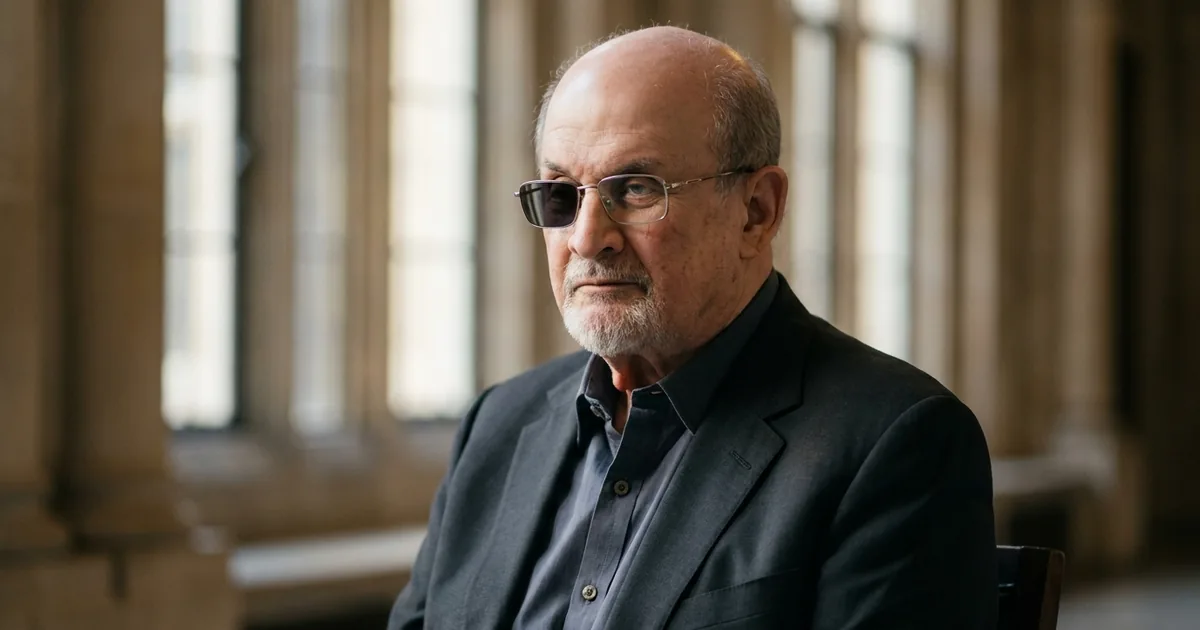
A federal jury in Buffalo convicted Hadi Matar on Wednesday of every count against him, including committing an act of terrorism that crossed national boundaries, for the 2022 knife attack that left Salman Rushdie blind in one eye. Matar had already been convicted once for the same few seconds of violence, and that is the detail that makes this verdict something other than a formality.
The state case, tried in Chautauqua County Court in February 2025, was about what he did. Prosecutors needed to show that a man climbed onto a stage and stabbed a novelist in front of an audience, and the jury took less than two hours to agree. Why he did it was not something they had to establish. He was sentenced to 25 years in state prison in the spring of 2025 and has been serving that time ever since.
The federal case was built on the opposite premise. To convict him of terrorism, the government had to prove the thing the first trial could leave alone.
What the First Trial Never Had to Establish
The three-count indictment filed in U.S. District Court accused Matar of committing terrorism transcending national boundaries, providing material support to terrorists, and attempting to provide material support to Hezbollah, the Lebanese militia the United States designates a foreign terrorist organization. As PBS NewsHour reported when the charges were filed, prosecutors tied the attack to Ayatollah Ruhollah Khomeini’s 1989 edict calling for Rushdie’s death over the novel “The Satanic Verses.”
Those statutes are not interchangeable with attempted murder, and the difference is the whole story. Material support law was written for the person who wires money, ships weapons, or supplies a safe house. The government’s theory here was that the attack itself was the service rendered, offered up to an organization that never asked Matar for it. Prosecutors argued he wanted everyone to know he had done this for Hezbollah.
Nobody suggested he took orders. There was no handler, no cell, no travel to a training camp, no wire transfer. What the jury accepted was that a man in New Jersey could align himself with a foreign militia by his own decision, and that the alignment was legally real enough to carry a terrorism conviction. That is a meaningful reach for a body of law built around organizational plumbing, and it is now a reach that has worked in front of a jury.
The Evidence Was Mostly His Own Phone
The case the government built ran through Matar’s own devices. Messaging app communications from 2021 and 2022 showed him discussing the fatwa, at first talking about wanting to expose Rushdie and later about taking his life. In a private note to himself he wrote, “We need to kill him ASAP.” Photographs found in his New Jersey bedroom and on his computer indicated support for Hezbollah. By the spring of 2022, the Associated Press reported, the chats showed him working out where Rushdie lived and tracking his public appearances, eventually landing on a scheduled August talk at the Chautauqua Institution, the arts and education retreat in western New York.
On August 12, 2022, Rushdie was being introduced there for a conversation about keeping writers safe. Matar ran onto the stage and stabbed him roughly 15 times before spectators and Henry Reese, the man Rushdie was to appear alongside, pulled him off.
Matar declined to testify. His lawyer, Nathaniel Barone, argued that the prosecution had no proof of what actually drove his client, a defense aimed squarely at the weakest joint in a motive case.
Rushdie took the stand on the trial’s second day at the Robert H. Jackson Federal Courthouse and described an attack he never saw coming. “I didn’t actually see him coming up the steps,” he told the court, recalling a figure in a black COVID mask and dark clothing. His first thought was not that he had been stabbed. “I thought I had been punched very heavily and I thought he had broken my jaw.” The wounds ran across his torso, his upper thigh, and his right eye. “I could feel the pain in my eye,” he said. “I kept asking people, what happened to my eye?” Of the recovery that followed, he offered a line that does more work than any statistic: “I had to learn how to redo things that we all take for granted.”
He would not speculate about his attacker. “I can’t say what his ambitions or his aim was, but the wounds were dispersed across my body,” Rushdie testified. The victim declined to assign a motive. The jury had to supply one anyway, and it did.
An Order That Iran Has Never Withdrawn
Khomeini issued the fatwa in February 1989 and died four months later. Iran’s government told Britain in 1998 that it would not pursue the matter, a piece of diplomatic language carefully built to end an argument without ending the edict. It was never formally revoked. A religious ruling calling for a writer’s killing simply kept existing, unenforced by any state and available to anyone who decided to treat it as a live instruction.
Matar is 28 and was born in the United States, which means he arrived after the book, after the fatwa, and after the diplomatic settlement that was supposed to defuse it. He had no personal history with any of it. Prosecutors said he was angry that Rushdie had survived so long, believing the survival emboldened Islam’s critics. He acted on a document older than he is, and the trial that just ended was in large part an attempt to write down, with legal force, how a 1989 decree in Tehran produced a knife in western New York in 2022.
The verdict also lands in an ugly moment. It arrives with Washington and Tehran locked in the confrontation that has consumed much of this summer, including the pause in the U.S. strike campaign and the competing peace tracks now being pushed through third parties. A federal jury spent this week formally attributing an act of violence on American soil to an Iranian religious authority, and it did so while the two governments negotiate. Those two facts will be read together whether the Justice Department intended it or not.
What the Second Conviction Actually Buys
Sentencing has not been scheduled. Matar faces up to life, on top of a 25-year state term he was already unlikely to finish before late middle age. Measured in years he will physically serve, the practical difference may be small.
What the second trial produced is a finding of cause, entered in a federal record, that the first one had no reason to reach. That is not a symbolic prize. It is the kind of thing that shapes how the next case gets charged, how threats against writers are classified by the agencies deciding whether to take them seriously, and how a standing incitement with no living author is treated once someone finally acts on it. Translators, publishers, illustrators, and novelists have spent decades absorbing the risk of edicts like this one, including artists such as Marjane Satrapi, who worked for years under threat for what she drew.
The conviction says the state now recognizes that risk as terrorism rather than as a lone man with a knife. The harder question is what a designation does about an order that outlived the man who gave it, and that anyone can still choose to obey.