
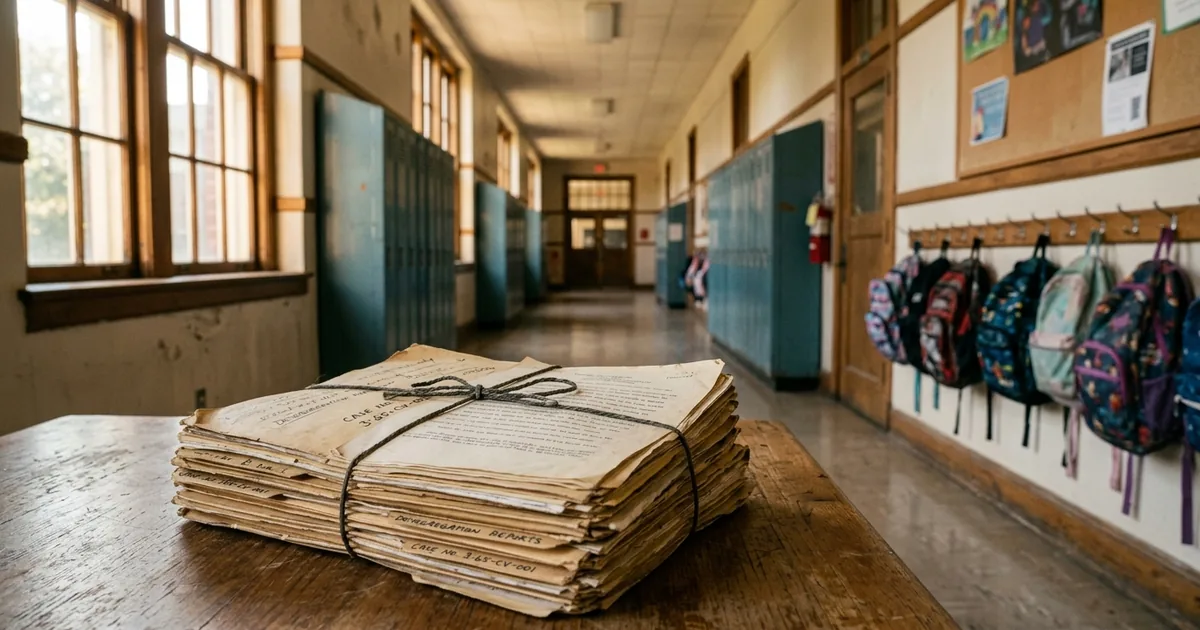
The legal test for ending a desegregation order has six parts. The press release announcing the end of more than fifty of them mentions none.
Somewhere in a federal courthouse in the Deep South sits a school desegregation case file older than the moon landing, and on Thursday the Justice Department announced it was done with it, along with more than fifty others. The Civil Rights Division says the districts involved, from Waterbury, Connecticut, to Flagler County, Florida, have reached “unitary status,” the legal finding that a school system has wiped out the traces of Jim Crow segregation. What nobody covering the story has done is ask the obvious follow-up: unitary according to whom? A consent decree ends when a federal judge says so, not when an assistant attorney general announces it, and in some of these cases, CBS News reported, the department has asked for a dismissal and no judge has ruled yet.
That gap between announcement and adjudication is the whole story. The department is selling a verdict it has not been handed yet, and the research on what happens after districts are released suggests the verdict it wants is the wrong one.
What the Justice Department Actually Announced
The numbers, as the department and CBS laid them out:
- More than 50 cases closed in Thursday’s announcement, many of them open for over half a century.
- Nearly 80% in five Southern states: Georgia with 15, Mississippi with 13, Louisiana with 11, Alabama with 5 and South Carolina with 1.
- Some cases in Tennessee, Florida and Mississippi where judges have already agreed to dismiss.
- Some cases where the department filed and is still waiting, meaning the “ended” in the headline is, for now, a request.
- Roughly 140 desegregation cases were still on the department’s books as of May 2022, so this batch alone covers well over a third of that docket.
Assistant Attorney General Harmeet Dhillon framed it as fiscal housekeeping. “Now these local school districts can redirect taxpayer dollars back to benefitting students, instead of funding onerous and outdated consent decrees,” she said in the department’s own release. The release does not name most of the districts, does not say which ones a judge has actually found unitary, and does not describe what evidence the department reviewed. It states a conclusion and asks you to take the paperwork on faith.
Alabama Attorney General Steve Marshall, as The New Republic noted, called it “just the beginning,” which is a strange thing to say about a process that is supposedly a careful, district-by-district legal review.
The Six-Part Test Nobody Mentioned
Here is the part a reader deserves and no outlet has spelled out. “Unitary status” is not a vibe. Since the Supreme Court’s 1968 decision in Green v. County School Board, courts have measured it against six specific areas of school life, usually called the Green factors:
- Student assignment: whether Black and white children still attend racially identifiable schools.
- Faculty: whether teachers are assigned so that some schools are staffed as “Black schools.”
- Staff: the same question for principals, counselors and support staff.
- Transportation: whether bus routes still carry the old segregated map.
- Extracurricular activities: whether teams, clubs and programs are integrated.
- Facilities: whether buildings, equipment and resources are distributed equally.
Later cases, Board of Education of Oklahoma City v. Dowell in 1991 and Freeman v. Pitts in 1992, made it easier for districts to get out, including piece by piece. But they did not throw out the test. A district still has to show a court, factor by factor, that it has complied in good faith and that the vestiges of the old system are gone “to the extent practicable.”
So when a department announces fifty-plus districts have cleared that bar in a single press release, the reasonable response is to ask for the six-factor findings, district by district. They are not in the release. If the evidence exists, publish it. If it does not, the announcement is a policy preference dressed up as a legal conclusion.
What Happened the Last Time Districts Got Out
We do not have to guess how this goes, because the country ran the experiment once already. Between 1991 and 2008, after Dowell opened the exit, more than 200 medium and large districts were released from court orders. Stanford researchers Sean Reardon, Elena Grewal, Demetra Kalogrides and Erica Greenberg tracked what happened next in a study titled, with admirable bluntness, “Brown Fades.”
What they found:
- Segregation in released districts rose gradually after release compared with districts still under court order.
- The increase was larger in the South, which is where roughly 80% of this week’s cases sit.
- It was larger in elementary schools, where neighborhood assignment does most of the sorting.
- It was also larger where segregation had been low before release, meaning the districts that looked most “finished” had the most to lose.
The authors’ conclusion was that court-ordered plans work, and that their effects fade over time once nobody is watching. That is almost a word-for-word rebuttal of Dhillon’s premise. The oversight does not look outdated in that data. It looks like the reason the numbers held.
Where LiveNewsChat Stands
Some of these decrees probably should end. A district that has been fully integrated for thirty years and is still filing compliance reports on a 1969 bus map is a real inefficiency, and nobody sensible wants federal judges running school boards forever.
But that is an argument for doing the work in the open, one district at a time, with the six-factor record on the table. It is not an argument for closing more than fifty cases in a batch, from a Civil Rights Division that CBS reports has lost more than three-quarters of its staff to resignations and early retirements, and then describing the result as if every judge had already signed off. A department that no longer has the lawyers to monitor these cases has an obvious incentive to declare them finished. That is the structural reason this happened, and it has nothing to do with what is going on in the classrooms.
The fix is simple and cheap. Publish the list of districts. For each one, publish whether a judge has ruled and what the court found on each Green factor. Then let parents in Georgia and Mississippi judge for themselves whether their schools are “unitary” or just unwatched.
What to Watch
- Which judges push back. Pending motions are the test. A judge who asks for the factor-by-factor record is doing exactly what the law requires.
- The Alabama follow-through. Marshall has promised more. Watch whether the next batch comes with findings or with another press release.
- Enrollment data in two or three years. If the Stanford pattern repeats, it will show up first in elementary school attendance zones, long after the headlines have moved on.
The department wants this remembered as the day Jim Crow’s last paperwork got filed away. The better question is whether anyone will still be checking the classrooms when the filing is done.