
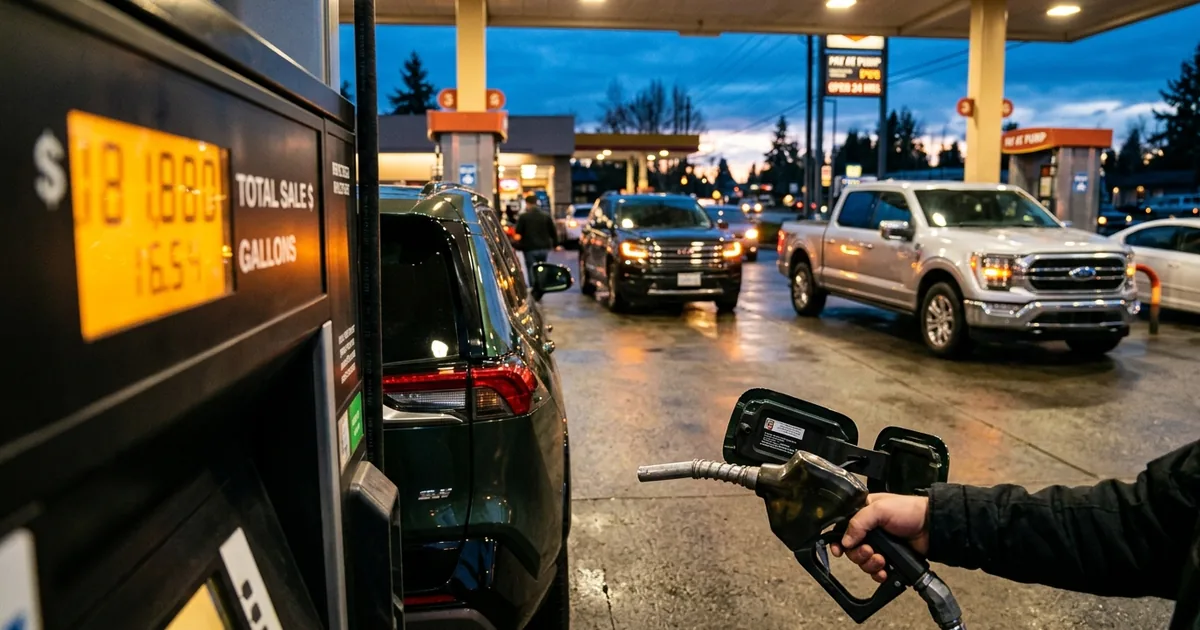
President Trump said Saturday he has approved new federal fuel economy standards, and his Transportation Department will finalize them Monday. The target for 2031 drops from about 50.4 miles per gallon to roughly 34.5. That second number is the one to remember, because according to the Union of Concerned Scientists it is lower than the 35.4 mpg the U.S. new-car fleet already averaged in 2024. In other words, the “new standard” asks automakers to get slightly worse over seven years and calls that a rule.
Coverage so far has run Trump’s promise of cheaper cars next to a vague line about gas costs. Almost nobody has pointed out that the administration’s own numbers answer the question, or that Congress already made the rule unenforceable last year.
Trump announced it in a social media post. He said the change would “TERMINATE” what he called Biden’s EV mandate and deliver “LOWER PRICES, saving families thousands.” Transportation Secretary Sean Duffy followed with “A major victory for America’s auto workers is coming Monday,” Reuters reported. Bloomberg had the Monday timing first.
There is no federal EV mandate to terminate. Al Jazeera noted that Corporate Average Fuel Economy rules set a fleet-wide average and leave the mix of vehicles to the automakers. Nobody was ever required to sell you an electric car.
The White House Account
Cars get cheaper. The Transportation Department estimated its proposal would cut the average new vehicle’s cost by about $930 and save automakers roughly $35 billion through 2031. Trump says families save “thousands.”
The Department’s Own Math
Drivers pay it back at the pump. The same analysis projects about 100 billion more gallons of gasoline burned and up to $185 billion in extra fuel spending through 2050. By the Union of Concerned Scientists’ reading, a buyer loses about $600 over a car’s life.
Both columns come from the government. The left one is the headline. The right one is the footnote.
Reuters laid the tradeoff out in December, when the proposal was published: the $930 upfront saving appears only if automakers pass it on, while the fuel costs land on every owner for as long as they drive the car. Jason Schwartz of New York University’s Institute for Policy Integrity told Reuters the savings would evaporate “very quickly indeed.” His institute’s formal comments to the agency make the case in detail.
The Union of Concerned Scientists ran the numbers on a single car: roughly $500 saved at the dealer, roughly $1,100 more spent on gas. The group’s Dave Cooke says buyers start losing money on the deal as early as model year 2027.
The Rule Barely Matters, and That Is the Point
Here is the part that changes how to read Monday’s announcement. Since last summer, missing a CAFE target has cost an automaker nothing.
The One Big Beautiful Bill Act, signed July 4, 2025, reset the maximum civil penalty for violating fuel economy standards to zero. The statute still exists. The targets still exist. The consequence does not. Federal regulators then waived penalties reaching back to the 2022 model year.
So Monday’s rule is not really about what Detroit is allowed to build. With fines at zero, automakers could already build whatever they wanted. What a lower target actually does happens one step removed, in three places.
First, it destroys the credit market. Automakers that beat the standard used to sell compliance credits to automakers that missed it. That money went mostly to EV makers and helped pay for the next generation of efficient cars. With no fine to avoid, and now a target anyone can hit, those credits are worth close to nothing. That is a transfer out of the companies building efficient vehicles, and it will not show up in any sticker price.
Second, it locks in the fleet for a long time. A car sold in 2030 is still on the road in 2045, often with its third owner. The people who buy used cars are disproportionately the people for whom a gas bill is a real budget line, and they never see the $930 at a dealership. They just inherit the mileage. The “affordability” math only works if you count the first buyer and forget the next two.
Third, it makes the next reversal expensive. Product plans run five to seven years out. Automakers that retool around a 34.5 mpg ceiling will not snap back if a future administration restores tougher targets. They will lobby against it, and they will be able to point to the factories they built on the promise that this was permanent.
That is the pattern worth naming. The official argument is about car prices this year. The actual effect is felt by used-car buyers in the 2030s and 2040s, by the EV companies that lose credit revenue, and by whoever writes the next rule. None of them get a line in the press release.
Our position is simple. A standard set below what the industry already achieves is not a standard. It is a line in the Federal Register built to be passed over. If the administration believes lower mpg targets save families money, it can publish the net lifetime cost per vehicle from its own analysis next to the $930 on Monday and let buyers do the arithmetic. Its December numbers already say how that comes out.
Watch Monday’s final rule for three things: whether the 34.5 mpg figure survived from the proposal, whether the department updated its fuel-cost estimate, and whether it says anything at all about the credit market it just emptied. Newsweek reported Trump framing it purely as a car-price story. The gas station is where the rest of it gets paid.